

Picosecond Laser vs Traditional Tattoo Removal: What’s the Difference?
Anyone comparing tattoo removal systems hits the same wall quickly. Brochures say picosecond is the future, while experienced operators point out that the Q-switched machine in the treatment room still clears plenty of ink. Both views hold some truth. The real gap comes down to pulse duration, and buyers often treat that single number as a verdict. This guide explains what it changes, what it leaves alone, and why picosecond laser vs traditional tattoo removal is a question of fit rather than a simple winner. A large systematic review gives us a reliable place to start.

What Shorter Pulses Change Inside the Skin
Both technologies work on the same principle. A brief, intense light pulse is absorbed by ink particles; the particles break apart, and the body clears the fragments over the following weeks. What differs is how long the pulse lasts. Traditional Q-switched systems fire nanosecond pulses, which are billionths of a second. Picosecond systems fire pulses measured in trillionths of a second, roughly a thousand times shorter.
Shorter pulses lean more on a mechanical, shockwave-like effect and less on heat. The common picture is rocks versus sand. A nanosecond pulse is thought to crack ink into pebbles, while a picosecond pulse is thought to shatter it into finer dust that is easier to clear. It is a useful image, but it simplifies what happens in real tissue and should not be read as a measured result for any one machine. Manufacturers use it often, and buyers are right to ask what data backs it up.
Three things often get blurred together. Pulse duration is how long the light lasts. Wavelength decides which pigments absorb it. Energy and spot size set how much reaches the target. A picosecond system with the wrong wavelength for a stubborn colour will not beat a well-matched traditional one. Shorter pulses also reduce heat and risk to nearby skin. They shift the balance, which is why picosecond laser vs traditional tattoo removal cannot be settled by pulse length alone.
Ink Colours Respond Differently
A 2020 systematic review in the Journal of the American Academy of Dermatology found that both laser types work well on black ink. For blue, green, and yellow ink, picosecond systems generally performed better. That matters for clinics that see a lot of coloured work, but the review also noted that most underlying studies were case series, with only a handful of randomised trials. It supports a trend, not a universal ranking.
Wavelength matters just as much as pulse length. Dark inks absorb 1064 nm light well, while 532 nm is commonly used for reds and oranges. Lighter or less common colours may need other wavelengths, and some inks never clear fully on any system. Pastel and white inks are a common example, since they absorb very little of the available light. For a wider look at how paired wavelengths behave, see our guide to dual-wavelength laser treatments.
The tattoo itself counts too. Dense, layered professional work usually takes longer than a light amateur piece. Age, body location, and skin tone all shape the plan. In the picosecond laser vs traditional tattoo removal comparison, colour is where the gap shows most. Yet, a platform with several wavelength options often helps a clinic more than any technology label.
Sessions, Recovery, and Safety
Almost every tattoo needs several sessions, whichever laser is used. Each treatment breaks up some of the ink, and the body needs weeks to clear it before the skin is ready for another pass. Rushing that interval raises the chance of skin damage without speeding anything up.
Does picosecond mean fewer sessions? Possibly, but the evidence is softer than the marketing. A 2026 retrospective hospital review found that patients treated with a picosecond 1064 nm laser reached top-tier clearance more often and needed somewhat fewer sessions than the Q-switched group. The authors were careful, though. The study was not randomised, and they called for controlled trials. One study should never become a promised treatment schedule.
Recovery looks similar across both. Redness, swelling, and tenderness are common, and in that same review, both lasers settled within a few days, with no meaningful safety difference. Blistering, crusting, pigment changes, and scarring remain possible with any laser. Good practice matters more than the label. That means assessing the patient before treatment, obtaining informed consent, using test spots where appropriate, choosing careful settings, and providing clear aftercare instructions. Operator skill stays one of the biggest variables in both results and risk. Skin type adds another layer. Darker skin has a higher chance of pigment changes with any laser, so conservative settings and test spots matter even more. Clients should also be told that a tattoo may fade rather than disappear, whichever system is used.
How to Compare Laser Platforms Before Buying
For clinics and distributors, the key question isn’t which technology wins, but which system fits the expected workload. Pulse duration is one line on a spec sheet. These details often decide day-to-day value as much as, or more than:
- Wavelengths available, and whether extra ones can be added later
- Adjustable energy, repetition rate, and spot size
- Cooling design and any built-in monitoring
- Handpiece options and how easily they swap
- Operator training and clear safety controls
- Spare parts, warranty, and technical support
- Certification documents and the intended-use statement for your market
Ask for each of these in writing. Treat advertised figures as manufacturer claims until documents back them up, and confirm that pulse width is stated as a measured specification. Local rules on who may operate a device, and for which indications, also vary, so check them before ordering professional tattoo removal equipment. Compare total cost of ownership, including servicing and replacement parts, not just the purchase price. For buyers, picosecond laser vs traditional tattoo removal ultimately comes down to caseload and pigment mix.
The Bottom Line for Tattoo Removal Businesses
A picosecond platform deserves serious consideration from clinics that treat many coloured or stubborn tattoos, since the evidence leans in its favour. Traditional Q-switched laser tattoo removal stays relevant for black ink work and for businesses weighing cost against volume. Deciding between picosecond and traditional tattoo removal should depend on target pigments, safety protocols, evidence, and total cost of ownership. No single machine is the right answer for every clinic.
Where OJAN Beauty’s Portable Picosure Laser Fits
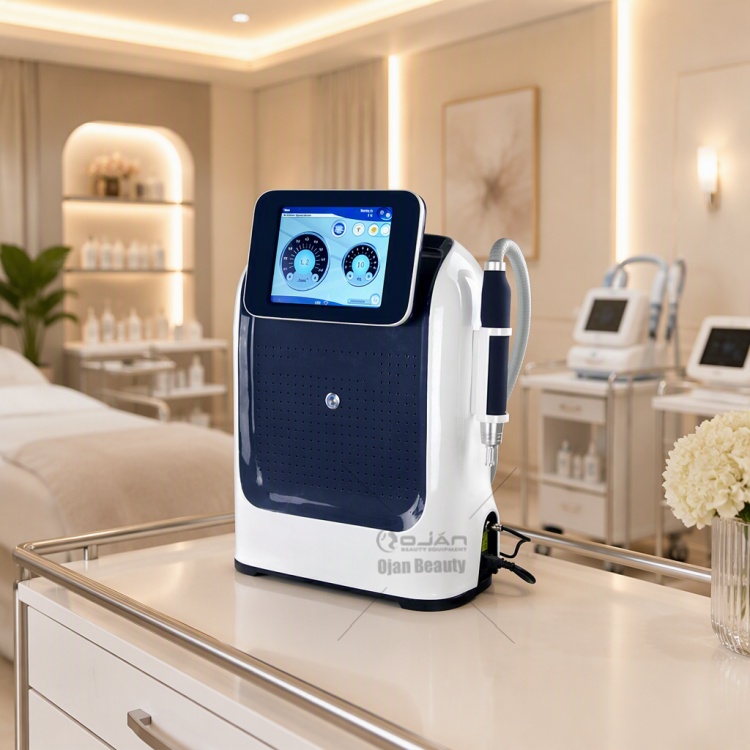
OJAN Beauty’s Portable Picosure Laser Tattoo Removal Machine, model MX-Q1, is a portable Nd: YAG system with 1064 nm, 532 nm, and 755 nm wavelengths and an adjustable working frequency of 1 to 10 Hz. Buyers researching picosecond laser tattoo removal should first check pulse width. The MX-Q1 has a stated pulse duration of 6 ns, placing it in the nanosecond range rather than the picosecond range, so it should not be treated as a picosecond-class laser without documentation that says otherwise.
Day to day, the operator works from a 10.4-inch colour touchscreen. A built-in water circulation system with temperature control prevents overheating during continuous use, and the portable body suits clinics with limited space. Honeycomb spot technology is designed to make treatment more comfortable and recovery smoother, though that remains a design aim rather than a proven clinical outcome. The housing is ABS plastic and metal, the input rating is 1200W, and the supply voltage is 220V or 110V, which matters for distributors shipping to different markets.
Intended applications are tattoo removal, pigment removal, skin whitening, and skin rejuvenation. Buyers should confirm which of these are permitted for professional use in their market before promoting them. For private label buyers, OEM options cover logo, housing colour, packaging, and software language or splash screens, with OEM orders starting at 5 units. Support covers user manuals, video training, and remote assistance.

For anyone weighing picosecond laser vs traditional tattoo removal, classification remains unresolved. Before purchase, ask OJAN for written confirmation of the measured pulse width and the device classification, and treat the MX-Q1 as a nanosecond system unless reliable documentation shows a picosecond pulse duration.
Frequently Asked Questions
Is a picosecond laser better than a Q-switched laser for every tattoo?
No. In the picosecond laser vs traditional tattoo removal comparison, evidence favours picosecond systems for blue, green, and yellow ink, while both perform well on black. Wavelength, ink depth, and operator skill also shape results, so no universal ranking holds.
How many sessions does picosecond tattoo removal usually require?
It varies with ink density, depth, colour, and how the individual responds. Some studies comparing picosecond lasers with traditional tattoo removal suggest fewer sessions with picosecond lasers, but no number can be guaranteed.
Can picosecond lasers remove colored tattoos?
They can improve many colours, but results depend on wavelength and pigment. A system with several wavelengths covers more cases, and some inks may still fade only partly.
Is picosecond tattoo removal safer than traditional laser treatment?
Current evidence shows similar short-term safety, mainly redness and swelling. Pigment changes and scarring remain possible with either, so assessment, settings, and aftercare matter more than the label.
What should a clinic check before buying a picosecond tattoo removal machine?
Check wavelengths, adjustable parameters, cooling, training, warranty, spare parts, and certification documents. Ask for the measured pulse width in writing and confirm local regulations.