

Dual-Wavelength Laser Treatments: What Can They Actually Do for the Skin?
A client comes in for texture and fine lines. The next one wants sunspots and an uneven tone treated. A single fractional laser can usually handle one well and the other only partially, because different skin concerns sit at different depths. This is the real case for dual wavelength laser skin resurfacing: not a stronger laser, but two lasers built for two different jobs on one console.
The practical question for a clinic isn’t which wavelength is better. It’s what each one is actually built to treat, and whether having both changes what the business can offer in a single appointment.

Two Wavelengths Working at Different Depths
A 1550nm Erbium laser and a 1927nm Thulium laser don’t compete for the same job. The 1550nm wavelength is non-ablative and reaches deeper into the dermis, creating controlled microthermal zones that prompt tissue repair without breaking the surface. The 1927nm wavelength works more superficially, targeting water in the skin, and produces a non-ablative to micro-ablative effect closer to the surface.
A single fractional laser often leaves a gap because of this depth difference. A device built around one wavelength treats its target depth well and does relatively little for concerns that sit elsewhere. Dual-wavelength laser skin resurfacing takes a different approach. Both depths sit on one system, so an operator chooses the wavelength that matches the concern instead of referring the client elsewhere.
This matters most during consultation. A single-wavelength device forces a clinic to either turn away part of a client’s concern or treat it with a tool that wasn’t built for that depth. A system built around two wavelengths removes that trade-off.


What the 1550nm Wavelength Treat
The 1550nm wavelength is generally the choice for concerns that sit deeper in the skin. Because it reaches the dermis without damaging the epidermis, 1550nm laser skin resurfacing is commonly used for deep wrinkles such as nasolabial folds, crow’s feet, and lines around the mouth.
It’s also a common choice for acne scar laser treatment and older surgical scars, since the microthermal zones it creates support tissue remodelling over time. It treats enlarged pores and mild to moderate skin laxity through the same mechanism, working from underneath rather than directly resurfacing the visible layer.
Energy control directly affects how this works in practice. On a professional system, frequency and pulse output at 1550nm are usually adjustable rather than fixed. An operator can then match 1550nm laser skin resurfacing settings to different skin types and different treatment goals, instead of running the same protocol on every client. A lower setting suits a first-time client or a more sensitive area, while a higher setting can be reserved for deeper scarring or more resistant wrinkles.
What the 1927nm Wavelength Treats
The 1927nm wavelength works closer to the surface, making it a better fit for concerns in the outer layers of skin. It targets water content in the skin, and the dermis holds more water than the epidermis does. As a result, heat builds mainly in the dermis, while the surface itself is only lightly affected.
Pigmentation, uneven tone, sunspots, and general texture and dullness all respond to this same surface-level mechanism, which is why laser skin resurfacing for pigmentation often relies on the shorter wavelength rather than a deeper one. It’s the wavelength a clinic reaches for when the concern is how the skin’s surface looks, rather than a deeper structural issue like a fold or a scar.
Recovery is usually part of the appeal here too. Because the effect stays closer to the surface, a 1927nm treatment session generally comes with shorter visible downtime than deeper resurfacing work. Many clinics position the 1927nm treatment as a lunch-break option for surface concerns because of that shorter downtime, rather than one that needs a few days of visible recovery built into a client’s schedule.

1550nm vs 1927nm at a Glance
| 1550nm Erbium | 1927nm Thulium | |
| Treatment depth | Deep dermal, non-ablative | Superficial, non-ablative to micro-ablative |
| Common focus | Wrinkles, scars, tissue remodelling | Pigmentation, tone, texture |
| Resurfacing objective | Stimulate repair without surface damage | Address surface concerns with faster recovery |
| Typical use cases | Nasolabial folds, crow’s feet, acne and surgical scars, pore tightening, mild sagging | Sunspots, melasma, uneven tone, dull complexion, daily texture maintenance |
What a Dual-Wavelength System Adds to a Treatment Menu
For a clinic, the practical value of dual-wavelength laser skin resurfacing is fewer trade-offs per appointment. A client who wants both acne scar laser treatment and an even tone doesn’t need two separate machines or two separate visits. The operator selects the wavelength that matches the concern, sometimes using both in the same session on different areas.
Booking flexibility improves too. Instead of a laser service built around one narrow use case, a dual-wavelength fractional laser supports a broader menu. It covers deep wrinkle and scar work on one side and pigmentation and general resurfacing on the other, without adding a second piece of equipment to the treatment room.
A broader menu like this tends to suit a specific range of businesses. Medspas already running a mixed menu of skin treatments can add dual-wavelength laser skin resurfacing without introducing a whole new equipment category. Dermatology and laser-focused clinics get a single system that covers scar and pigmentation work instead of two separate purchases.
What to Check Before Choosing a Dual-Wavelength Laser
These points matter most when evaluating a dual-wavelength laser skin resurfacing system for a clinic’s own use or for a distributor catalogue.
- Energy control. Independently adjustable power, frequency, and pulse settings for each wavelength, not a single shared setting.
- Scan modes and graphics. Sequential, random, or continuous scanning, and shape options that match the treatment area rather than forcing one pattern everywhere.
- Dot pitch and spot size. A wider adjustable range supports more precise control over energy density and client downtime.
- Handpieces and tips. Interchangeable tips for each wavelength affect how flexible the system is between spot treatment and broader passes.
- Cooling system. Air-cooled systems generally mean lower maintenance than liquid-cooled alternatives.
- Training and documentation. Operators need to understand two wavelengths, not one, so manufacturer training and written protocols matter more here than on a single-wavelength device.
- Local regulatory requirements. Laser equipment rules vary by market, so buyers should confirm what applies before importing or operating a system.
Inside the Ojan Beauty MX-TH68
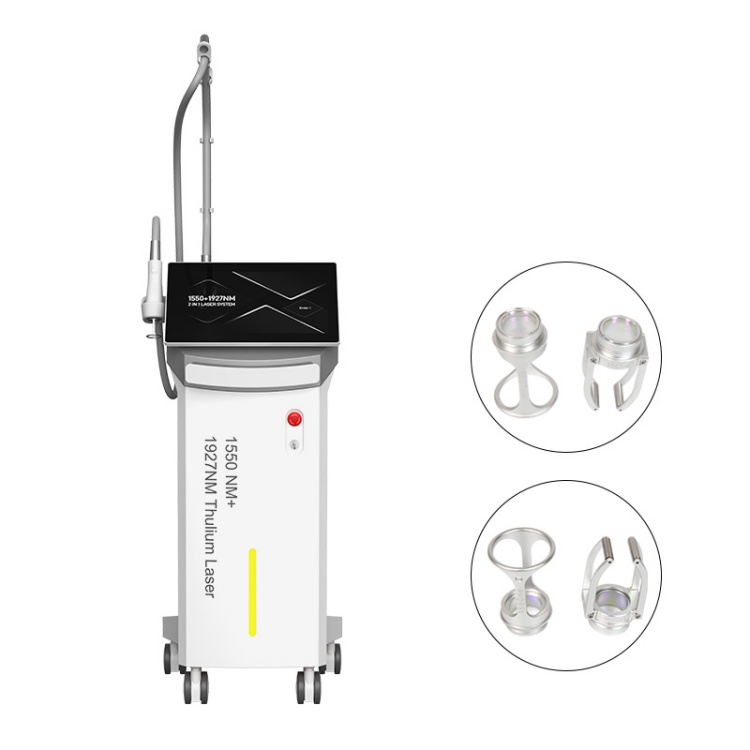
MX-TH68 pairs a 1550nm Erbium laser with a 1927nm Thulium laser on one 15.6-inch touchscreen console. The 1550nm side runs in continuous-wave mode with a 1 to 1000Hz tunable frequency and 30W output. The 1927nm side runs in fractional pulse or super pulse mode, with a 0.1 to 20ms pulse width and 1 to 300mJ of adjustable pulse energy.
Both wavelengths share a dot pitch adjustable from 0.1mm to 2.0mm and four scan graphics (square, circle, triangle, and custom) across sequential, random, and continuous modes. Graphic sizes range from 1.0×1.0mm up to 20×20mm. Each wavelength offers interchangeable fractional and sliding tips, and the system is air-cooled rather than liquid-cooled.

For distributors evaluating shipping and installation, the console runs on AC110-130V or AC220-240V at 50/60Hz, ±10%, so it accommodates both major power standards without a separate transformer. The unit measures roughly 112 × 44.5 × 53cm and weighs about 26kg unpackaged or 43kg packaged, figures worth checking against a clinic’s available floor space and a distributor’s shipping costs before ordering.
For distributors and resellers, OJAN Beauty offers the MX-TH68 factory-direct with OEM branding, custom packaging, and flexible minimum order quantities, making it a straightforward addition to a private-label dual-wavelength laser skin resurfacing lineup. For more on choosing laser equipment generally, see OJAN Beauty’s laser facial machine buying guide.
FAQs
What is a dual-wavelength laser?
It’s a laser system that combines two different wavelengths in one device, each built to treat a different depth or type of skin concern. This combination is the basis of dual-wavelength laser skin resurfacing: a clinic can address deeper structural issues and surface-level concerns without switching equipment.
What is the difference between 1550nm and 1927nm laser treatments?
1550nm is a deeper, non-ablative wavelength generally used for wrinkles, scars, and tissue remodelling. 1927nm works more superficially and is generally used for pigmentation, tone, and texture. They target different depths and different concerns.
What is a 1927nm Thulium laser used for?
It’s generally used for surface-level concerns such as sunspots, melasma, uneven tone, and dull complexion, since it targets water in the skin and produces effects closer to the surface than a deeper wavelength like 1550nm.
Can a dual-wavelength laser treat pigmentation and skin texture?
Yes. Laser skin resurfacing for pigmentation and general texture is generally handled by the more superficial wavelength on a dual-wavelength system. In contrast, the deeper wavelength addresses wrinkles and scarring in the same device.
Is a 1550nm/1927nm laser suitable for professional skin resurfacing?
Yes, when trained staff operate it and follow the manufacturer’s protocols. Professional systems offer independent control over each wavelength’s energy, pulse settings, and scan pattern, which single-wavelength or consumer-grade devices typically don’t provide.


