

How Does Vacuum RF Roller Therapy Work for Body Contouring?
Switch on a roller-based machine, and it behaves differently from a typical RF or cavitation device. The handpiece doesn’t just rest against the skin and deliver energy. It pulls tissue upward through suction and rolls across the surface while RF heats it underneath. That physical movement is what sets vacuum RF body contouring apart from most of the rest of a body-contouring menu.
For a business, the real question isn’t whether vacuum, RF, and roller each work on their own. It’s what a machine gains by running all three from one console, and whether that’s worth paying for over buying separate single-function equipment.

How Vacuum, RF, and Roller Divide the Work
Each function does a different job. Vacuum pulls and manipulates tissue through suction. RF heats the skin and connective tissue underneath. The roller adds movement, working across the area the way a hand would during a massage. None of the three replaces the others, so a machine built around all three isn’t repeating itself. It’s layering three separate effects into one pass.
On some machines, that layering happens inside a single handle instead of through separate heads. Vacuum lifts the tissue, RF heats it while it’s held in place, and the roller moves across it at the same time. That’s a different experience than switching between three separate tools.

The Suction Side of the Treatment
Vacuum suction pulls and moves tissue, something an energy-only treatment simply doesn’t do. Adjustable suction lets an operator increase or decrease how much tissue gets drawn into the handle, which matters because different areas and different clients tolerate pressure differently.
A machine stuck at one suction level only works well for a narrow set of areas and clients. A wide adjustable range, ideally with some form of consistent pressure control rather than a basic on-off setting, gives an operator far more room to tailor a session to the person on the table. This is one reason vacuum RF treatment is generally described as more adjustable than a fixed-energy service.
The Heat Side of the Treatment
RF’s job is controlled heat, and that heat supports skin firmness in a way vacuum and roller action alone can’t. Heat also changes how tissue responds to the mechanical work happening alongside it, which is likely why RF ends up built into so many roller-based systems instead of sold as a separate add-on.
Frequency and output matter here too. A machine locked to one RF setting is more limited than one where frequency or intensity can shift for different tissue depths and different areas. A clinic planning to run RF vacuum therapy across several services should check this before buying, not after.
What the Roller Adds
The roller is what makes this category feel different to a client. Vacuum lifts tissue and RF heats it, but the roller moves across the skin, creating a rolling, kneading feel closer to hands-on massage than any energy-based treatment.
That’s also why roller-equipped machines show up so often in services built around roller body contouring for specific areas. Repeated mechanical passes over an area create a different kind of stimulation than a static treatment head, and adjustable roller speed lets an operator match that action to what the client can comfortably tolerate.
What Cellulite Body Contouring Treatment Can Realistically Deliver
Cellulite is probably the single biggest reason clients ask about this kind of machine, so it’s worth being exact about what a business can honestly say. Vacuum, RF, and roller technology are generally linked to a temporary improvement in how an area looks. It doesn’t change the tissue structure that causes cellulite in the first place. A smoother appearance after a session or a course of sessions is realistic. A permanent fix is not.
Businesses do better describing this plainly than dressing it up. A course of consistent sessions may improve appearance; results vary from person to person, and that improvement generally needs maintenance to hold. Clients told this upfront tend to stay more satisfied than clients who were promised more than any machine can deliver.
Inside a Typical Vacuum RF Body Contouring Session
In practice, a session is more routine than a clinical protocol. The operator selects the area and the right handpiece for it, since body areas and facial areas call for different heads. The operator sets the vacuum for the area and the client’s comfort, adjusts the RF for depth and intensity, and the roller works across the surface. Throughout, the operator watches how the skin responds and makes small adjustments rather than running one fixed program regardless of the result.
Exact settings and sequencing should always come from the manufacturer’s own instructions for that specific machine, since vacuum RF body contouring systems vary in how their functions are controlled.
One Machine, Several Service Lines
Beyond the treatment itself, there’s a practical operational reason to choose equipment that covers vacuum, RF, and roller in one unit. A clinic offering roller-based massage, RF firming, and cellulite-focused work from separate machines needs separate budgets, training, and space for each. A single vacuum RF body contouring machine lets a business offer all three without three purchases.
Treatment-room space is often the real limit on how many services a clinic can add. Every extra machine takes up space, and most clinics work with a fixed number of rooms. Equipment that combines several functions in one unit lets a business expand its service menu without adding another room. The machine also gets used more throughout the day, instead of sitting idle between narrow, single-purpose bookings.
Features That Matter When Buying a Vacuum RF Body Contouring Machine
- Vacuum control. A wide adjustable range, ideally with consistent pressure regulation rather than a basic fixed suction level.
- RF controls. Adjustable frequency and output to treat different depths and areas on the same machine.
- Roller design and speed. Adjustable speed and a roller design suited to the areas the business plans to treat.
- Handpieces. More handpieces generally mean more versatility, including the option to extend into facial or eye-area work.
- Interface. A clear, simple control system, ideally with adjustments available at the handpiece itself rather than only at a central console.
- Maintenance and support. How quickly a clinic puts new equipment into regular use often comes down to the support and documentation behind it.
- OEM options. For distributors and resellers, private-label availability can matter as much as the underlying technology.
What the MX-V687 Offers?
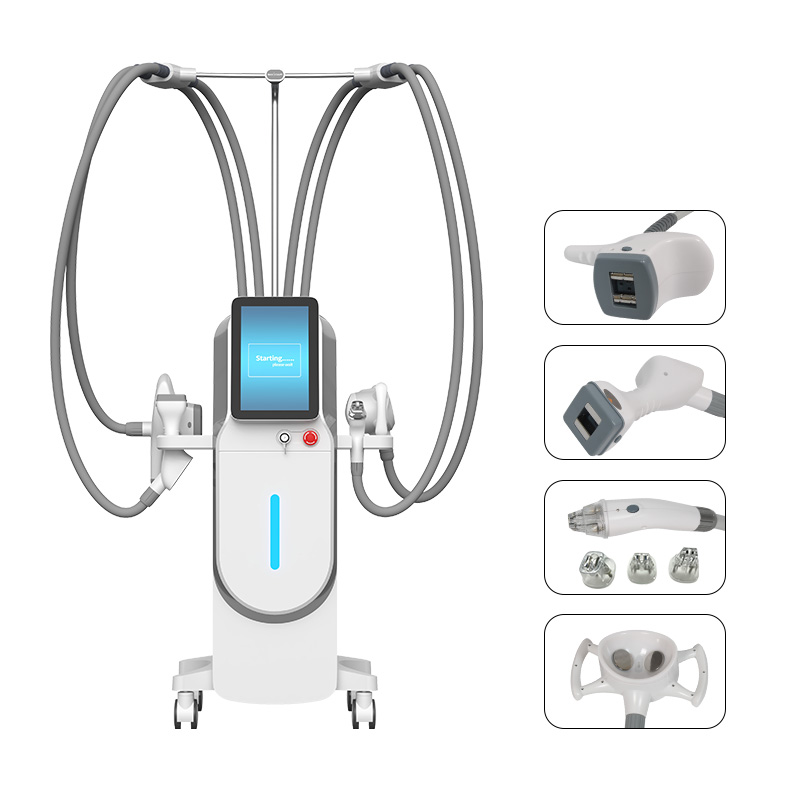
MX-V687 takes a four-handle approach rather than one fixed head, spreading vacuum, RF, roller, cavitation, and laser functions across them. Two handles pair vacuum, roller, and RF in a single applicator, in two sizes: a larger one for the abdomen, back, and thighs, and a smaller one for arms and calves. A third handle swaps the roller for 40KHz cavitation on fat-focused body work, and a fourth is built specifically for facial and eye-area treatment with its own set of smaller tips.

That handle setup answers the buying considerations above directly. Vacuum pressure is adjustable across a wide range, and RF frequency can be selected for different tissue depths and treatment areas. Each handle also carries its own touchscreen, so an operator can change settings mid-treatment without stepping away from the client to reach the main console.
For distributors and resellers, OJAN Beauty offers the MX-V687 factory-direct with OEM and private-label options, documentation, and after-sales support. It also sits on a mobile trolley, a practical detail for clinics that move equipment between treatment rooms rather than keeping it in one fixed spot.
For more on how the suction side of this works, see OJAN Beauty’s vacuum therapy machine guide.
FAQs
What is vacuum RF roller therapy?
It’s a body-contouring treatment that combines three functions in one handpiece or system: vacuum suction to lift and move tissue, RF to heat the skin and support firmness, and a roller to add mechanical, massage-like movement across the area.
How does vacuum RF work for body contouring?
Vacuum suction draws tissue into the handle while RF energy heats the skin and underlying tissue at the same time or in the same session. The combination is generally described as vacuum RF body contouring because neither function alone produces the same effect.
What is the role of rollers in vacuum RF treatment?
The roller adds physical movement across the treated area, creating a kneading sensation similar to massage. It works alongside vacuum and RF rather than replacing either, and it’s a big part of why this category feels different from purely energy-based treatments.
Can vacuum RF rollers help improve the appearance of cellulite?
They can support a temporary improvement in how an area looks, generally through better circulation and reduced surface irregularity. They don’t change the underlying tissue structure that causes cellulite, and results depend on consistent sessions and vary by person.
What should I look for in a vacuum RF body contouring machine?
Adjustable vacuum pressure, adjustable RF frequency and output, roller speed control, the number and type of handpieces available, ease of use, and the support, training, and OEM or private-label options the manufacturer offers.