

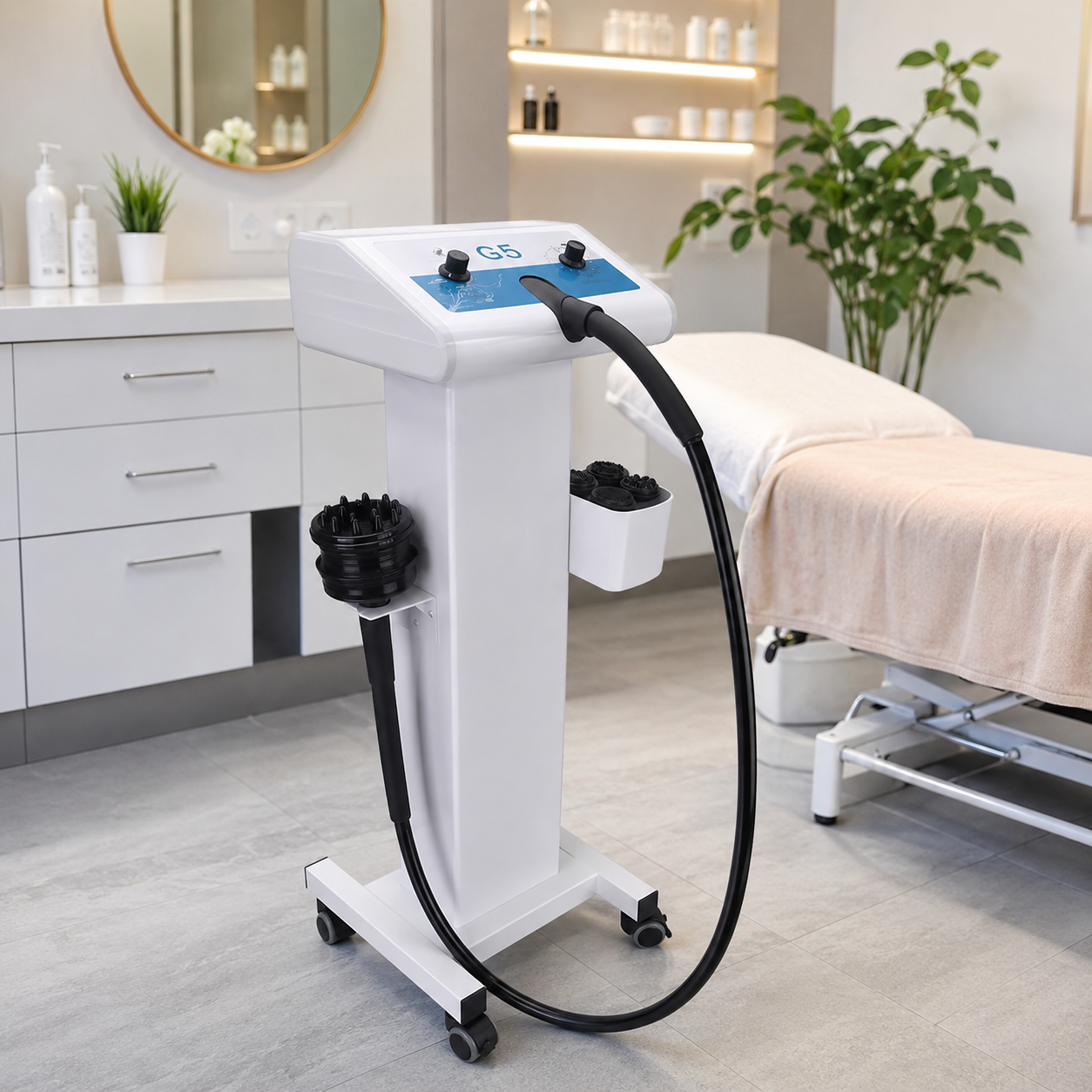
G5 Machine (Massage Machine): What It Is & How It Works
A G5 machine is a motorized massage device that uses a mechanical arm to drive percussion or vibration heads deep into muscle tissue. It was originally built for physiotherapy clinics, and it’s now common in spas, slimming centers, and sports recovery facilities too. A typical session runs 10 to 30 minutes, and the machine’s real value comes from its motor strength and interchangeable heads, not from any single “miracle” claim.
Quick Facts
- Mechanism: Motor-driven percussion or oscillating vibration through swappable massage heads
- Typical frequency range: Roughly 20 to 50 Hz depending on the model and setting
- Session length: 10 to 30 minutes per body area
- Best for: Physiotherapy clinics, slimming and body-contouring salons, sports recovery centers, wellness spas
- Pricing model: Wholesale units are usually quoted per order based on motor power, head count, and certification. Ask your supplier for a written quote rather than relying on published estimates, since specs vary widely between manufacturers
If you’re buying one for a clinic, salon, or as a distributor stocking equipment for resale, the real questions aren’t “does it feel nice.” They’re what the motor and heads actually do to tissue, which specs matter, and which certifications protect you. We manufacture this category of equipment ourselves, including the OJAN G5 Massage Machine for Body Slimming & Cellulite Reduction, so this guide covers what buyers usually get wrong.
What Is a G5 Machine?

A G5 machine, also called a G5 massager or G5 full body massager, is a floor-standing or benchtop device with a motorized arm connected to interchangeable massage heads. Unlike a handheld massage gun, it isn’t held by hand the whole session. A therapist or technician guides the head across the body while the machine supplies the driving force. That’s the core mechanical difference, and it’s why G5 units can sustain longer, more consistent pressure over larger areas without operator fatigue.
The name traces back to early physiotherapy equipment lines from the mid-20th century, and “G5” has since become a generic category term the way “Jacuzzi” became shorthand for a hot tub. Today it covers a wide range of build quality, from lightweight home units to heavy-duty clinic machines with pillar stands and multiple speed settings, similar in structure to models built for commercial daily use.
G5 Machine vs. Massage Gun vs. LPG/Endermologie
These three get confused constantly, and the differences actually matter for buyers.
| Feature | G5 Machine | Massage Gun | LPG / Endermologie |
|---|---|---|---|
| Mechanism | Motor-driven percussion/vibration via swappable heads | Handheld percussion, self-operated | Motorized roller plus vacuum suction |
| Depth of action | Deep tissue, larger surface coverage | Deep but localized, spot treatment | Superficial to mid-layer, skin and fascia |
| Typical setting | Clinics, salons, spas | Home, gym bag, personal use | Aesthetic/slimming clinics |
| Operator | Therapist or technician | Self-applied | Trained technician (proprietary device) |
| Session length | 10 to 30 minutes | 1 to 2 minutes per muscle group | 20 to 35 minutes |
If your business needs to treat multiple clients daily across full-body sessions, a G5 machine generally outperforms a massage gun on durability and coverage. If your service menu is specifically vacuum-roller lymphatic work, LPG is a different technology entirely, not a G5 substitute.
How Does a G5 Machine Actually Work?

Strip away the marketing language and the mechanism is straightforward. An electric motor inside the housing drives a connecting arm, which moves the attached massage head in a repetitive percussive or oscillating pattern. When the technician presses that head against skin and muscle, the mechanical force transfers into the underlying tissue, creating rhythmic compression and release.
That repetitive compression does three things physiologically. It stimulates local nerve receptors, which is part of why it feels relaxing. It mechanically works through areas of muscle tightness. And it temporarily increases local blood flow to the treated area. None of that is exotic. It’s the same basic principle behind manual deep-tissue massage, just delivered with more consistent mechanical force than human hands can sustain for a full shift.
Frequency, Amplitude, and Stroke: What the Numbers Actually Mean
This is the part almost no consumer-facing article explains, and it’s exactly what a buyer or distributor should be asking suppliers about.
- Frequency is how many times per second the head moves back and forth, measured in Hertz (Hz). Higher frequency generally feels more intense and penetrates faster; lower frequency feels broader and gentler.
- Amplitude (stroke length) is how far the head physically travels with each cycle. A longer stroke moves more tissue volume per pass but can feel more aggressive.
- Motor power (wattage) determines how well the machine holds its frequency and stroke under real pressure. A weak motor bogs down when a technician leans into a client’s back; a stronger motor doesn’t.
A machine that looks identical to a competitor’s on a spec sheet can perform very differently in daily clinical use if the motor is undersized. This is one of the most common ways buyers get misled by product photos and marketing copy that all sound the same.
What the Physiology Research Actually Shows
It’s worth being honest about the evidence base instead of overselling it, which most articles in this space do not do.
Most of the peer-reviewed research on mechanical vibration and blood flow comes from whole-body vibration platforms rather than handheld G5-style devices specifically, so the findings are directionally relevant rather than a one-to-one match. A controlled study from Loma Linda University’s Department of Physical Therapy, published via PubMed, found that short bouts of vibration significantly increased skin blood flow, roughly doubling it for at least 10 minutes after the session ended, in subjects with healthy circulation. Separately, a systematic review of whole-body vibration for non-specific low back pain, published through the National Center for Biotechnology Information, found consistent improvements in pain and function across multiple randomized trials, though researchers noted that optimal frequency and session length are still not standardized across the field.
Translated for a G5 buyer, the mechanism of increased local circulation and reduced perceived muscle tightness is genuinely supported by research. Claims about permanent fat loss or guaranteed inch loss from vibration alone are not. Those outcomes depend far more on diet, hydration, and overall lifestyle than on any single massage device, and any supplier who tells you otherwise is overselling.
G5 Machine Heads And Attachments Explained

The heads are where most of the practical differences between machines actually live, and it’s the section competitors skip entirely.
- Sponge or foam heads: broad, low-intensity coverage for large muscle groups like the back and thighs, good for relaxation-focused sessions
- Rubber curved heads: contour to rounder body areas (hips, calves, shoulders) for more even pressure distribution
- Spiky or nodular heads: concentrated point pressure aimed at localized tightness or targeted cellulite work
- Flat firm heads: deeper, more direct percussion for larger flat areas like the upper back
A machine that ships with only two or three heads limits what a clinic or salon can actually offer on a service menu. Five or more interchangeable heads, like the head set included with the OJAN G5 Massage Machine, is a reasonable baseline for a commercial-grade unit.
What Is a G5 Machine Used For?

Physiotherapy and Rehabilitation Clinics
Physical therapists use G5 machines as a supplement to manual therapy, helping loosen tight muscle groups before stretching or exercise-based rehab, and as part of general soft-tissue mobilization protocols.
Slimming and Body-Contouring Salons
Aesthetic and slimming clinics often position G5 sessions as part of a broader body-contouring service menu alongside treatments like cavitation or lymphatic drainage, marketed around circulation support and the temporary reduction in the visible appearance of cellulite that comes with improved local blood flow.
Sports Recovery and Fitness Facilities
Gyms and sports recovery centers use G5 machines post-workout to help ease muscle soreness and support recovery between training sessions, functioning similarly to how foam rolling or manual sports massage is used.
Spa and Wellness Centers
Day spas add G5 sessions as a premium relaxation service, often paired with hot stone or aromatherapy add-ons for a full-body wellness experience.
Is a G5 Machine Safe? What to Know Before a Session
G5 massage is broadly low-risk when performed by a trained operator, but it isn’t appropriate for everyone, and any credible source on this topic should say so plainly rather than glossing over it.
Who Should Avoid or Get Medical Clearance First
- People who are pregnant
- Anyone on blood-thinning medication
- People with active skin infections, open wounds, or conditions like eczema or psoriasis at the treatment site
- Anyone with a history of deep vein thrombosis (DVT) or a pacemaker
- People with recent fractures or unhealed injuries in the treatment area
None of this is a substitute for professional medical advice. Anyone with an underlying health condition should talk to a doctor before starting G5 sessions, and clinics should include a basic health screening as part of intake.
Expected Side Effects vs. Warning Signs
Mild, temporary redness or light soreness in the first day after a session is common and expected, similar to how muscles can feel after a deep manual massage. Persistent bruising, sharp pain during treatment, or numbness afterward are not normal and warrant stopping the session and consulting a doctor.
G5 Machine Specifications Buyers Should Compare
This is where most consumer content stops, and where a distributor or clinic owner actually needs to start.
| Spec | Entry-Level Unit | Professional/Clinic-Grade Unit |
|---|---|---|
| Motor power | Under 60W | 90 to 150W |
| Number of heads | 2 to 3 | 5 or more |
| Duty cycle | Intermittent, home use | Continuous, multi-client daily use |
| Stand/mobility | Handheld or tabletop | Pillar stand with wheels |
| Noise level | Higher, less insulated | Lower, insulated housing |
| Speed/intensity control | Fixed or 2-speed | Variable dial with multiple settings |
If a supplier can’t tell you the motor wattage or duty cycle rating, that’s a red flag worth pushing on before you order.
Certifications and Compliance to Verify Before You Buy
This is the section most buyers skip, and it’s the one that causes the most expensive mistakes down the line.
- CE marking confirms the device meets EU safety requirements. Ask for the actual Declaration of Conformity document, not just a logo printed on the housing.
- ISO 13485 is the quality management standard specific to medical device manufacturing, showing the factory follows documented, auditable production processes.
- RoHS covers restriction of hazardous substances, commonly required for import into the US, EU, and several Middle Eastern markets.
- A Free Sale Certificate is frequently requested by customs authorities and importing distributors as proof the device is legally sold in its country of origin.
Requirements differ by destination market. If you’re importing or reselling internationally, always confirm what your specific country requires before placing a bulk order, and ask your supplier directly which certificates apply to the exact model you’re buying, since not every certification automatically covers every product line from a manufacturer.
Buying a G5 Machine as a Distributor or Reseller

If you’re sourcing this equipment to resell rather than to use in your own clinic, this is the part almost no competitor content addresses.
How to Vet a Real Manufacturer
Confirm you’re dealing with an actual factory, not a trading company adding markup with no quality control behind it. Ask for a live video walkthrough of the production floor, including the assembly line, testing stations, and finished inventory. A supplier who can’t show you this in real time usually isn’t manufacturing anything themselves.
Private Label and OEM Options
Manufacturers offering OEM/ODM services can build machines to your own artwork, add your logo to the unit and packaging, and customize box design to match your brand. For distributors trying to build recurring wholesale relationships instead of one-off sales, this turns a generic import into a product with your own brand equity behind it.
Warranty and After-Sales Questions to Ask
Get warranty terms in writing. How long is coverage? Does it include the heads and consumable parts or just the motor housing? Who pays for replacement part shipping if something fails after year one?
FAQs About G5 Machine (Massage Machine)
No. A G5 machine is a motorized, stand-mounted or benchtop device operated by a technician over larger areas, while a massage gun is a smaller handheld tool typically self-applied to one muscle group at a time.
G5 sessions can temporarily improve the visible appearance of skin texture by increasing local circulation, but there’s no clinical evidence that vibration or percussion alone permanently eliminates cellulite. Results are typically most noticeable when paired with a full body-contouring service plan.
It’s generally not recommended without direct clearance from a doctor. Most clinics list pregnancy as a standard contraindication for deep-tissue vibration massage.
A G5 machine uses percussion or vibration heads pressed against the skin. LPG (endermologie) uses a motorized roller combined with vacuum suction, a different mechanism aimed more at fascia and skin surface than deep muscle tissue.
Yes. Manufacturers offering OEM/ODM services can build to your artwork, apply your logo to the unit and packaging, and customize the box design, which is common for distributors building their own brand rather than reselling a generic import.
Final Thoughts
A G5 machine is a well-established, mechanically simple piece of equipment once you look past the marketing language layered on top of it. The mistakes that cost buyers money almost never come from the technology itself. They come from skipping certification checks, buying from a trading company instead of a real factory, or picking a machine with an undersized motor that can’t hold up under daily clinic use. Treat this as a manufacturer relationship rather than a one-time purchase, and you’ll end up with equipment that performs consistently for years.
Ojan Beauty has manufactured beauty and aesthetic equipment since 2008, with CE, RoHS, ISO 13485, and Free Sale certifications behind our product lines, along with full OEM/ODM support for distributors building their own brand. If you’re evaluating suppliers, check out the OJAN G5 Massage Machine for Body Slimming & Cellulite Reduction or get in touch for a direct factory quote.