

What Can RF and Cavitation Do Together for Body Contouring?
A client books cavitation sessions to reduce fat around the abdomen. After three sessions, the area is smaller, but the skin over it isn’t quite as firm as before. Experienced operators plan around this instead of being surprised by it. Fat and skin are two different problems, and a machine built for only one leaves the other unaddressed.
That’s why RF and cavitation show up together on so many body-contouring platforms. Both technologies are familiar on their own. What matters more for a business is what changes when both are available from one system, and where that combination is actually worth it in an RF and cavitation body contouring setup.

Different Jobs, One Treatment Room
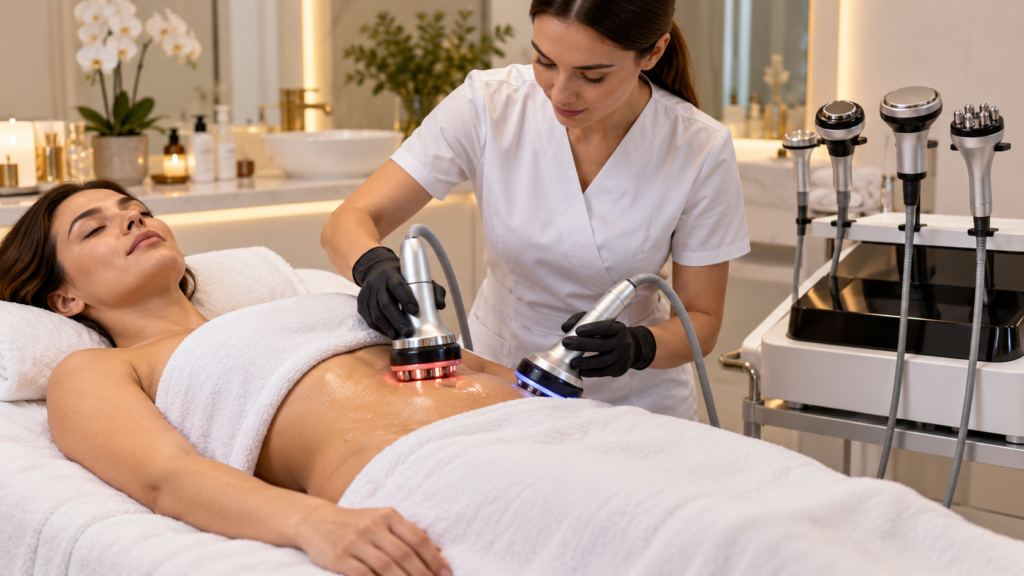
Cavitation works on fat in a specific area. RF works on the skin covering that area. A platform offering both can take a client who wants fat reduction, a client who wants firmer skin, or a client who wants both, without turning anyone away or sending them somewhere else.
That flexibility also changes how a treatment plan gets built. An operator might open with cavitation to reduce fat volume, then bring in RF later once the skin also needs attention. Or the two might simply serve different clients on different days, depending on what each person is asking for.
There’s also a practical equipment reason. One RF and cavitation body contouring machine takes up one spot in the treatment room. A spa buying separate RF and cavitation units needs two spots, two setups, and two budgets for what a single combined system already covers.
What RF Brings to a Cavitation-Based Treatment
Cavitation reduces fat, but on its own it does relatively little for the skin sitting on top of that fat. If a client’s skin already has good elasticity, the lack of skin-focused treatment rarely matters. If it doesn’t, the treated area can look a little softer than fat loss alone would suggest.
RF is the tool built to address that. It heats the skin and the surrounding connective tissue rather than the fat cells. That’s why radiofrequency body contouring is usually discussed as a skin-firmness treatment, not a fat-reduction one. RF also works fine as a standalone service. A client doesn’t need fat in the treated area for RF to be useful, which is part of why it’s sold on its own almost as often as it’s paired with cavitation.
What Cavitation Adds That RF Doesn’t
Cavitation does the opposite job. It uses low-frequency ultrasound to disrupt fat cells directly, something RF simply isn’t built to do. This ultrasonic mechanism is the core of what most people mean by ultrasonic cavitation body contouring. That’s also why a combination platform is worth more than two single-function machines placed side by side.
A business with only RF equipment has no real fat-reduction offer. A business with only cavitation equipment has no way to address a client whose main concern is skin firmness. Combining both on one machine solves that: a business no longer loses clients simply because of which technology it happens to own.
Running RF and Cavitation Together in Practice
There’s no single rule for combining the two. It depends on the machine, the treatment area, and what the client actually wants. Some platforms apply both through the same handpiece. Others use separate heads, switching between them during the same appointment or across different visits.
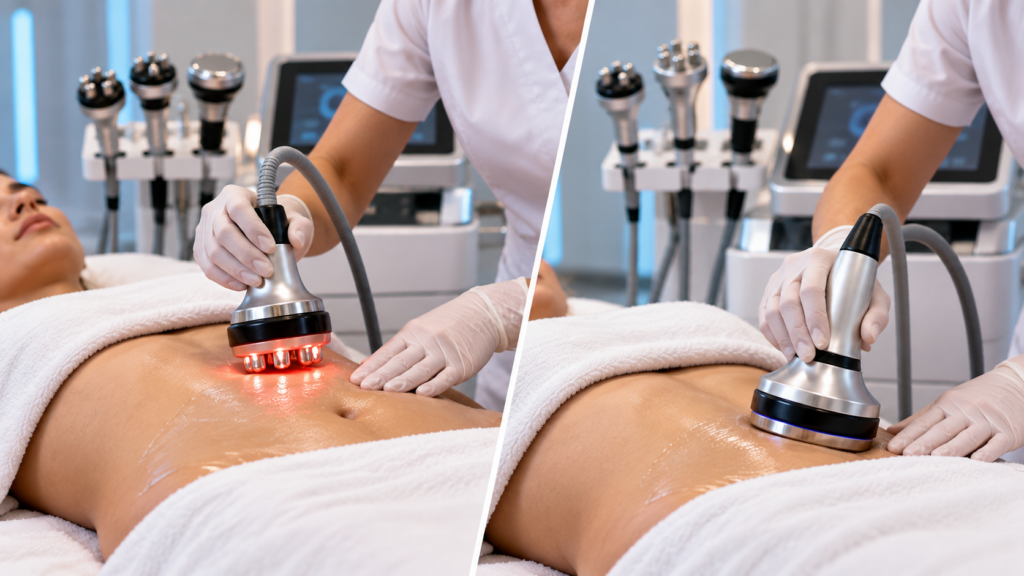
A face treatment focused on firmness might call for RF only. A larger area like the abdomen might start with cavitation and bring in RF later, once the skin also needs attention. Because every machine handles this differently, the safest approach is to follow that device’s instructions rather than copying a routine built for a different system. That flexibility, more than any single setting, is what defines RF and cavitation body contouring in daily practice.
Setting Realistic Expectations
Non-invasive body contouring is not weight loss, and treating the two as the same thing sets clients up for disappointment. RF and cavitation change how an area looks. They don’t move the number on a scale, and they aren’t a substitute for diet, exercise, or medical treatment.
Results also vary from person to person. Some clients notice a difference after a handful of sessions. Others need a longer course, and some see a more modest change no matter how closely they follow the protocol. Saying this plainly before treatment starts works better than letting a client assume a guarantee that was never made.
Why Multifunctional Equipment Makes Sense for Businesses
Beyond the treatment itself, there’s a straightforward operational case for equipment that does more than one job. Facial RF usually sits inside a general skin or anti-ageing menu. Body RF firming fits naturally with clinics doing post-weight-loss or post-pregnancy work. Cavitation usually anchors a fat-reduction service on its own. A single RF and cavitation body contouring machine lets a business offer both services without buying three separate machines.
Treatment-room space is often the real limit on growth. Most clinics work with a fixed number of rooms, and each extra machine takes up space. Equipment that combines several functions in one unit gives a business room to adjust its service menu as demand shifts, without adding another room. It also means the machine gets used more throughout the day, instead of sitting idle between narrow, single-purpose bookings.
What to Look for in an RF Cavitation Machine
These points matter most when evaluating an RF and cavitation body contouring machine for a clinic’s own use or for a distributor catalogue.
- RF type. Some machines offer one RF mode. Others offer several, such as bipolar for the face and tripolar or hexpolar for larger body areas.
- Cavitation frequency. Check what frequency it runs at and which areas it’s actually built for.
- Handpieces. More handpieces usually mean more flexibility across different treatment areas.
- Interface. A clear, simple control panel saves training time and speeds up adjustments mid-session.
- Support and training. Ongoing technical support and documentation matter once the machine is in daily use, not just at purchase.
- OEM options. For distributors and resellers, private-label availability can matter as much as the technology itself.
How the Ojan Beauty RU+6 Brings This Together
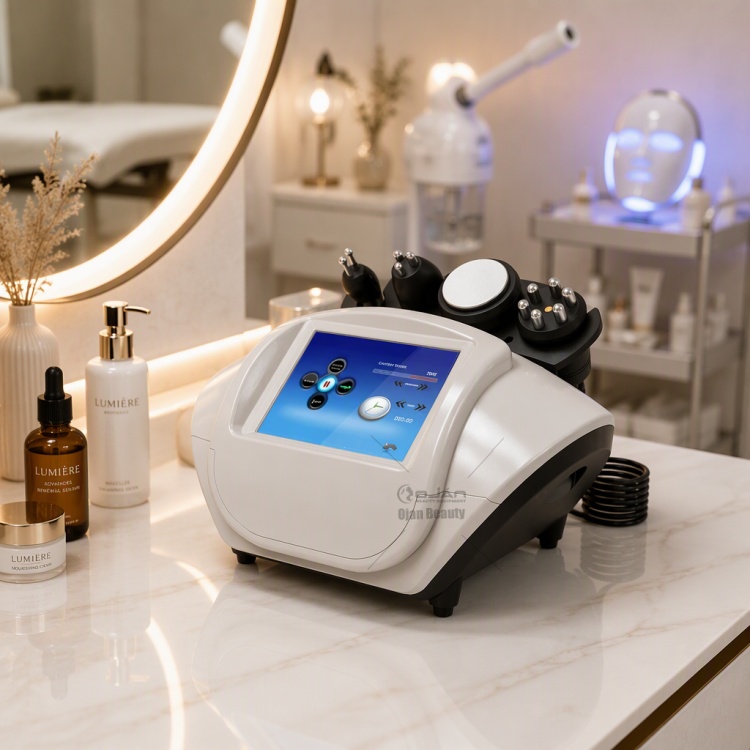
RU+6 is built around this kind of flexibility. It’s a compact tabletop machine with four swappable heads: a bipolar RF head for the face, a tripolar RF head for the body, and a hexpolar RF head with a built-in LED for larger areas. A separate cavitation head covers fat-focused areas like the abdomen, hips, and thighs.

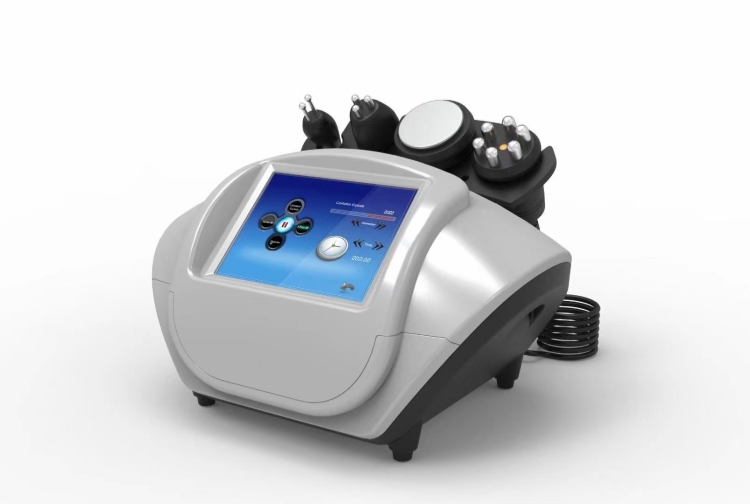

It’s worth being clear about how this actually works. The RU+6 doesn’t run RF and cavitation at the same time through one head. Three of the four heads are RF, and the fourth is a dedicated cavitation head. An operator switches between them depending on what the client needs, rather than combining both functions in a single pass. That still puts both technologies on one machine, which is the point: operators don’t have to choose between an RF-only or cavitation-only device.
For distributors and resellers, OJAN Beauty offers OEM branding along with factory-direct documentation and after-sales support, both useful when developing a private-label line. The compact tabletop footprint is also worth noting for smaller treatment rooms with limited floor space. It’s a practical example of what an RF and cavitation body contouring platform looks like once both technologies are built into one system, rather than sold as separate boxes.
For more on how the ultrasonic side of this works, see OJAN Beauty’s guide to cavitation treatment.
FAQs
Can RF and cavitation be used together for body contouring?
Yes. They’re often used together because they target different problems: cavitation reduces fat volume, while RF supports skin firmness over the treated area. Some machines run both through the same handpiece; others switch between dedicated heads. That pairing is what most buyers mean by RF and cavitation body contouring.
What is the difference between RF and ultrasonic cavitation?
RF heats the skin and surrounding tissue to support firmness. Ultrasonic cavitation uses low-frequency sound waves to disrupt fat cells directly. They work through different mechanisms and generally serve different goals.
What does a 40KHz cavitation machine do?
It applies ultrasound at a frequency suited to fat-focused body areas, using controlled sound waves to help break down fat cells so the body can process the released fat naturally over time.
Is an RF cavitation machine suitable for professional salons?
Yes, as long as staff are trained on the specific device and its settings. Professional systems are designed for repeated daily use and offer more control than consumer versions, but results still depend on proper technique and realistic client expectations.
What should a business look for when buying an RF cavitation machine?
RF mode options, cavitation frequency, number and type of handpieces, ease of use, available training and support, and OEM or private-label options for distributors and resellers.