

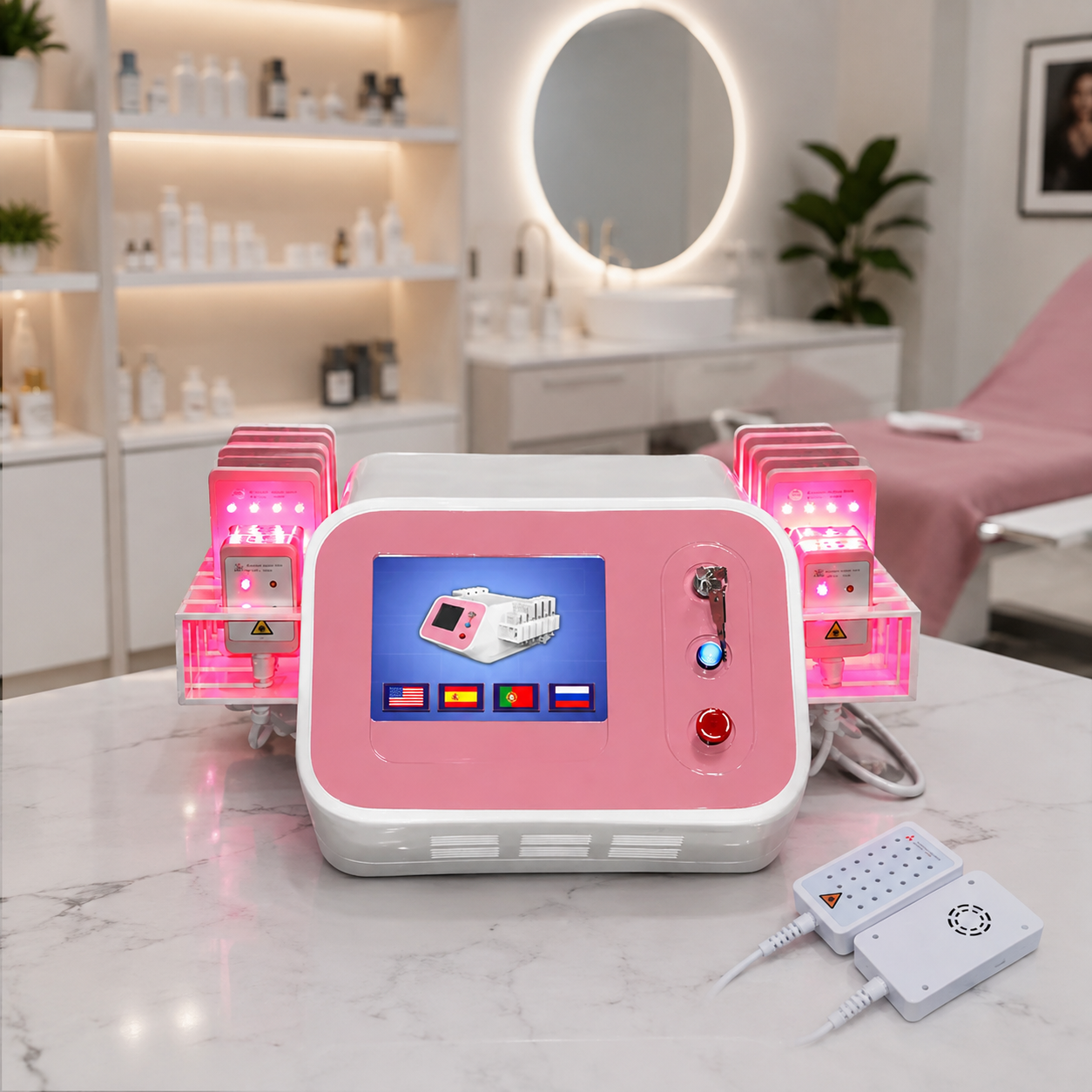
Lipo Laser Machine: The Complete Sourcing Guide For Distributors, Resellers & Clinics (2026)
A lipo laser machine uses low-level laser diodes to heat fat cells just under the skin, causing them to release stored fat that the body clears through the lymphatic system. It’s non-invasive, needs no anesthesia, and a typical session runs 20 to 40 minutes.
Quick Facts:
- Common Wavelengths: 635nm to 650nm (non-invasive pad systems), 980nm (added for deeper fat reduction and skin tightening in dual-wavelength systems)
- Session Length: 15 to 40 minutes, no downtime
- Pricing Model: factory-direct wholesale pricing, quoted per unit based on pad count, diode source, and OEM customization — request a quote rather than relying on published estimates, since specs vary widely between models
- Best For: salons, medspas, aesthetic clinics, and distributors building a body-contouring service line
If you sell, distribute, or operate this equipment, the real questions aren’t “does it work.” They’re which type fits your market, what certifications actually protect you, and how to avoid overpaying for the wrong machine. We build these devices ourselves, so this guide covers what we see buyers get wrong every week.
What Is a Lipo Laser Machine?

A lipo laser machine is a body-contouring device that uses low-level laser therapy (LLLT) to shrink fat cells without surgery. It’s different from two things people often confuse it with. First, it’s not surgical liposuction: no cannula, no incision, no anesthesia. Second, most lipo laser machines sold to salons and clinics are also not the same as invasive laser lipolysis, where a surgeon threads a fiber-optic probe under the skin. That’s a separate, clinic-only procedure performed with devices like Nd:YAG or diode fiber lasers under local anesthesia.
The naming in this industry is genuinely messy. You’ll see the same basic technology sold as “5D Lipolaser,” “6D Lipo Star,” “Strawberry Laser,” or simply “cold laser.” These are marketing names for pad configuration, not different technologies. Underneath, they’re almost always low-level laser diodes mounted in flexible pads that wrap around the treatment area, with red (roughly 650nm) and near-infrared (roughly 980nm) wavelengths doing different jobs within the same device.
PRODUCT LINK – Japanese Mitsubishi 650nm & 980nm Dual Wavelength Lipo Laser Machine
Lipo Laser Vs. Diode Laser Lipolysis Vs. Cavitation
| Feature | Pad-Based Lipo Laser | Diode Fiber Laser Lipolysis | Cavitation (Ultrasound) |
|---|---|---|---|
| Invasiveness | None | Minimally invasive (fiber under skin) | None |
| Downtime | None | 1 to 3 days | None |
| Typical setting | Salons, startup clinics | Medspas, dermatology practices | Salons, body-contouring studios |
Ojan manufactures machines across all three categories, which matters here. Most articles you’ll find online are written by a company that only sells one type, so they can’t give you an honest side-by-side.
How Lipo Laser Technology Actually Works

The mechanism is fairly simple once you strip away the marketing language. The laser diode emits light at a specific wavelength that passes through skin without damaging it, then reaches the fat layer underneath. That energy creates temporary openings in the fat cell membrane. The stored triglycerides inside the cell break down into free fatty acids, glycerol, and water, which the cell releases into the surrounding tissue. From there, the body’s lymphatic system carries the material away and processes it over the following days and weeks. Cleveland Clinic’s patient education material describes this same membrane-permeabilization process in its overview of laser lipolysis, and notes the procedure is generally considered safe with a quick recovery when performed appropriately.
In dual-wavelength machines, the two wavelengths tend to serve different roles: shorter wavelengths around 650nm are typically used to stimulate lymphatic drainage and reduce the appearance of cellulite, while longer wavelengths around 980nm penetrate deeper and are more associated with fat reduction and skin tightening. Some professional units also combine this with Electrical Muscle Stimulation (EMS), which uses electrical pulses to contract the muscle beneath the treated fat layer, adding a toning effect alongside the laser’s fat-reduction action.
What the Clinical Evidence Actually Shows
It’s worth being honest about the evidence base rather than overselling it, which most competitor content does not do. A 2023 clinical study published in Skin Research and Technology followed 132 patients treated with a 1444nm Nd:YAG laser for facial and body contouring. Researchers measured outcomes using the Global Aesthetic Improvement Scale over a 16-week period and found consistently positive results with no serious adverse events. That study covers invasive diode lipolysis rather than pad-based LLLT, and results vary by wavelength, power, and patient body composition. This is exactly why buyers should treat any single “inches lost” statistic with some skepticism, and instead focus on realistic, session-based expectations.
Types Of Lipo Laser Machines On The Market

Machines in this category generally fall into a few buying tiers, and the differences aren’t cosmetic. They change what your clients will actually experience.
Pad-Based Non-Invasive Systems are the entry point and the most common configuration for salons and clinics. A representative professional model, for example, uses 144 individual laser diodes across 12 pads (8 large, 4 small), sourced from a branded manufacturer rather than a generic supplier, running in both continuous and pulse modes with adjustable output per lamp. More pads mean faster full-body coverage, but pad count alone doesn’t tell the whole story, the diode’s brand and power stability matter more for consistent results than raw pad count.
Diode Fiber Systems operate at longer near-infrared wavelengths and deliver energy through a thin optical fiber inserted just under the skin. These are surgical-adjacent devices used in medspas and dermatology clinics, requiring trained operators and local anesthesia.
Multi-Function Combo Units (6-in-1, 8-in-1, 9-in-1) pair lipo laser pads with cavitation, RF, or vacuum roller technology in one console. These are popular with salons wanting one machine that covers several service-menu items instead of buying three separate devices.
Pad Count, Diodes, And Wavelength — What Actually Matters
When comparing quotes, ask three questions: how many diodes, what wavelength combination, and who manufactures the diode itself. A machine using a recognized diode brand (such as a Mitsubishi-sourced laser diode) will generally deliver more consistent output over years of daily use than one built on unbranded components, even if the unbranded machine has a higher pad count on paper. This is one of the most common ways buyers get misled by spec sheets that look similar but perform very differently in a treatment room.
Certifications And Compliance: What to Actually Verify
This is the section most buyers skip, and it’s the one that causes the most expensive mistakes. A machine without the right paperwork for your market can be held at customs, rejected by your liability insurer, or leave you with no legal footing if a client is injured.
- CE marking confirms a device meets EU safety requirements under the Medical Device Regulation (MDR). Ask for the actual Declaration of Conformity, not just a logo on the machine.
- ISO 13485 is the quality management standard specific to medical device manufacturing. It shows the factory follows documented, auditable production processes.
- FDA clearance/registration relates to the U.S. standard for device safety and effectiveness. You can verify claims directly through the FDA’s public database rather than trusting a website alone.
- RoHS covers restriction of hazardous materials, commonly required for import in the US, EU, and several Middle Eastern markets. A Free Sale Certificate is also frequently requested by customs authorities and importing distributors as proof the device is legally sold in its country of origin.
Requirements differ by region. The US leans hardest on FDA documentation; the EU requires CE under MDR; Gulf countries typically require SFDA or equivalent registration; and several Southeast Asian and Latin American markets accept CE as a baseline for import licensing. If you’re a distributor reselling internationally, always confirm what your specific destination country requires before placing a bulk order, and ask your supplier directly which certificates apply to which machine model, since not every certification automatically covers every product line.
Lipo Laser Machine Pricing: What Actually Drives the Number
Because these are B2B factory-direct devices, wholesale pricing is typically quoted per order rather than published, and varies based on four main factors: the diode/laser core itself (branded diodes cost more than generic ones), the certification stack behind it, the build quality (burn-in testing, touch-screen interface, cooling system), and what happens after you buy, warranty length, remote diagnostics, and training. A cheaper machine with no warranty and no support can cost more over a year than a pricier one with proper coverage, once you factor in downtime and repairs. Always request a written quote that separates the machine cost from shipping and customization, so you can compare suppliers on equal terms.
Total Landed Cost, Not Just the Quote
The factory price is never the full number. Add shipping (air freight via DHL, UPS, FedEx, or similar for smaller orders; ocean freight via less-than-container or full-container loads for bulk orders) and import duties, which vary by your country’s HS code classification for the device. Always ask suppliers to quote both FOB (you handle shipping and customs) and DDP (delivered, duties paid) so you’re comparing real, apples-to-apples numbers rather than a misleadingly low factory quote.
A Simple ROI Framework
To estimate payback period on any unit: take your planned price per session, multiply by expected weekly sessions, subtract consumable and electricity costs, then divide the machine’s total landed cost by that monthly profit figure. Most professional-grade machines in active salon use pay for themselves within a few months at moderate booking volume. The global lipolysis laser device market, valued at roughly $0.5 billion in 2025 and projected to grow at over 8% annually through the early 2030s according to market research aggregated by outlets covering the aesthetic device space, suggests this demand isn’t slowing down.
How to Choose a Supplier, Not Just a Machine
Two machines can look identical in a product photo and perform completely differently for years afterward. Before you commit:
- Confirm it’s a real factory, not a trading company. A trading company adds a markup with no added quality control. Ask for a live video walkthrough of the production floor: assembly lines, testing stations, finished inventory. A supplier who can’t show you this in real time usually isn’t manufacturing anything themselves.
- Read the warranty terms line by line. How long is coverage? Does it include the pads and consumable parts, or just the console? What’s the guaranteed response time, and who pays for replacement part shipping?
- Ask for a sample unit or a live reference call. Website testimonials are easy to fabricate. A phone call with a clinic that’s run the machine daily for over a year is not.
- Compare landed cost, not the sticker price. A cheap FOB quote can quietly become more expensive than a slightly higher DDP quote once shipping and duties land on your desk.
Private Labeling and OEM: Building Your Own Brand
If you’re a distributor or reseller rather than an end-user clinic, this is the section that matters most and the one almost no competitor content covers. Manufacturers offering OEM/ODM services can design according to your own artwork, add your logo to the product and packaging, and customize the box design to match your brand. This turns a generic import into a product with your own brand equity behind it, which matters enormously if you’re trying to build recurring wholesale relationships rather than one-off sales.
Safety and Who Should Avoid Treatment
Lipo laser is broadly low-risk when used correctly, but it isn’t appropriate for everyone. Cleveland Clinic’s clinical guidance notes it isn’t suitable for people who are pregnant or trying to become pregnant. Clinics should also screen for active skin infections at the treatment site and certain metabolic or cardiac conditions during consultation. Operators need real training, not just a quick video, since incorrect settings are the most common cause of burns or uneven results. Devices classified for medical electrical safety (such as Class II, Type B applied parts) are built with these operator and patient safety standards in mind, which is another reason certification documentation matters beyond just customs clearance.
Lipo Laser Vs. Other Body-Contouring Technologies

Laser Lipo sits alongside cryolipolysis (fat freezing), RF/HIFU skin tightening, and cavitation as non-surgical options, each with different mechanisms: cryolipolysis destroys fat cells through cold exposure, cavitation uses ultrasound to rupture cell membranes, and RF/HIFU relies on heat to tighten tissue. Lipo laser’s advantage is versatility. It treats smaller, targeted areas with essentially zero downtime, making it a strong add-on service alongside these other modalities rather than a replacement for any of them.
FAQs About Lipo Laser Machine
This depends on the specific manufacturer and model, not the category as a whole. Always ask your supplier for documentation and verify claims directly through the FDA’s public database rather than relying on a website statement alone.
Wholesale pricing depends on diode brand and count, certification stack, added functions like EMS, and OEM customization. Because specs vary so widely between models, suppliers typically quote per order rather than publishing fixed prices.
Lipo laser machines use external pads and are completely non-invasive. Diode laser lipolysis uses a thin fiber inserted under the skin and is minimally invasive, typically performed with local anesthesia in a clinical setting.
Yes. Manufacturers offering OEM/ODM services can design according to your artwork, add your logo to the unit and packaging, and customize the box design, which is common for distributors building their own brand.
At minimum, request CE, RoHS, and ISO 13485 documentation. For markets requiring additional clearance, ask specifically whether FDA registration or a Free Sale Certificate applies to the exact model you’re purchasing, since certifications can vary by product line.
Wrapping It Up
A lipo laser machine is a straightforward, low-risk technology once you understand what you’re actually buying. The mistakes that cost money almost never come from the laser itself. They come from skipping certification checks, trusting a trading company’s FOB quote without asking about landed cost, or picking a supplier with no real warranty behind the machine. If you treat this as a manufacturer relationship rather than a one-time purchase, checking for real factory proof, clear compliance documentation, and OEM flexibility if you’re building your own brand, you’ll end up with a device that performs consistently for years, not just on day one.
Ojan Beauty has manufactured beauty and aesthetic equipment since 2008, with CE, RoHS, ISO 13485, FDA, EPA, and Free Sale certifications behind our lipo laser line, along with full OEM/ODM support for distributors building their own brand. If you’re evaluating suppliers, Uncover our Lipo Laser Machines or Get in touch for a direct factory quote.
