

Is Laser Hair Removal Safe for the Bikini Area?
The bikini area doesn’t get burned, discoloured, or irritated because laser hair removal is unsafe. It gets those things because it’s the one area where nearly every variable that matters, skin tone, heat, friction, and hair density, works against a sloppy treatment at once. Get those variables right, and it responds to laser just as well as anywhere else on the body.
Why the Bikini Area Is Different
Skin here is thinner than skin on the legs or arms, sits under clothing that rubs it all day, and holds heat and moisture more than most treatment sites. It’s also usually a shade or two darker than the surrounding skin, which matters because pigment is exactly what a laser targets.
The hair itself tends to be coarse and dark, which helps the treatment work efficiently, but it also means the follicles sit close to skin sharing that same pigment. A misjudged setting shows up faster here, and colour change is more visible against the surrounding contrast. None of this makes the area unsafe. It just means there’s less room for error than on the lower legs.
How the Laser Actually Works
A laser fires a specific wavelength of light into the skin. Melanin in the hair absorbs that light and converts it to heat, damaging the follicle enough to slow or stop regrowth. Ojan Beauty’s own product guides are upfront that no laser promises 100% permanent removal, but clients typically see a substantial reduction, with regrowth that comes back finer and lighter over successive sessions.
Hair only responds while in its active growth phase, called anagen, and not every follicle in the bikini area is in that phase at once. That’s why one session is never enough. The American Academy of Dermatology puts first-session reduction at roughly 10 to 25 percent, with most people needing around six sessions spaced four to six weeks apart. Bikini and Brazilian areas often run a session or two longer, depending on hair colour and hormones.

What the Research Actually Shows
A large multicentre study in the Journal of the American Academy of Dermatology tracked side effects across a broad patient group and found a low overall incidence, with most reactions resolving on their own. The Cleveland Clinic calls the treatment safe and effective, with the caveat that only an experienced provider should perform it, since burns, scarring, and permanent discolouration are the failure modes when it isn’t.
A more recent clinical study recorded redness and mild swelling around treated follicles in nearly every participant, both resolving within days with no scarring or lasting pigment change at follow-up. The reaction people often worry about right after a session is usually evidence the treatment worked, not a sign something went wrong.
Where the research is consistent is on cause. Almost every serious complication traces back to a handful of preventable factors: settings pushed too aggressively, a laser mismatched to the client’s skin tone, a recent tan, or an untrained operator. Remove those four and the risk drops sharply.
Normal Reactions Versus Real Risks
Most of what shows up after a bikini session is expected and clears on its own: redness and warmth similar to a mild sunburn, small bumps of swelling around each follicle that settle within one to three days, mild itching or tingling, and hairs that look ingrown as treated ones shed. Gentle exfoliation once the area has calmed down clears most of those.
The real risks are uncommon but worth naming plainly. Burns and blistering are almost always linked to settings that are too high or to treating recently tanned skin, which is exactly why operator training matters as much as the machine. Pigment changes can leave skin darker or lighter in patches; most fade over weeks to months, but darker skin tones carry a higher risk. Folliculitis shows up as inflamed, pimple-like bumps around follicles, usually from bacteria or friction after treatment. Paradoxical hypertrichosis, where the treated area grows more hair instead of less, is rare (reported rates run from about 0.6% to 10%) and more likely in darker skin types, dark thick hair, or hormonal conditions, or when the laser is set too low to fully damage the follicle.
This article is general information, not medical advice. Anyone with an existing medical condition should check with a doctor first.
Who Should Wait or Skip It
Tell your provider everything, including supplements, not just prescriptions. A few situations usually call for postponing or choosing a different method:
- Pregnancy. No evidence it’s harmful, but no proof it’s safe either, so most providers recommend waiting.
- Isotretinoin (Accutane). Clinics commonly require a six-month wait after finishing, since it leaves skin photosensitive.
- Photosensitising medication. Tetracycline-class antibiotics are the usual example, and most clinics ask for a two-week gap.
- Active infection, herpes history, eczema, or psoriasis in the area. Irritation can trigger a flare, so these need to be under control first.
- A recent tan. Tanned skin absorbs more heat and burns more easily.
- Tattoos or keloid scarring in the treatment area. Ink absorbs energy unpredictably, and keloid-prone skin heals unpredictably too.
- Very light, grey, or white hair. Not a safety issue, but there’s too little pigment for the laser to grab onto, so results are limited on any machine.
Matching the Wavelength to the Skin Tone
If one factor decides whether a bikini treatment goes well, it’s whether the wavelength suits the skin it’s used on. 755nm suits lighter, finer hair, absorbed strongly by melanin, which makes it less forgiving on darker skin. 808nm is the versatile middle setting, effective across most skin types and hair densities, with adjustable pulse duration that helps control burn risk. 1064nm penetrates deeper while generating less surface heat, which is why it’s preferred for darker skin tones, though one clinical comparison found it slightly less comfortable than 808nm.
Cooling does the other half of the work. Contact cooling protects the skin’s surface while the energy reaches the follicle, lowering pain and cutting the risk of a surface burn.
Ojan Beauty’s Diode Lasers for Bikini Treatment
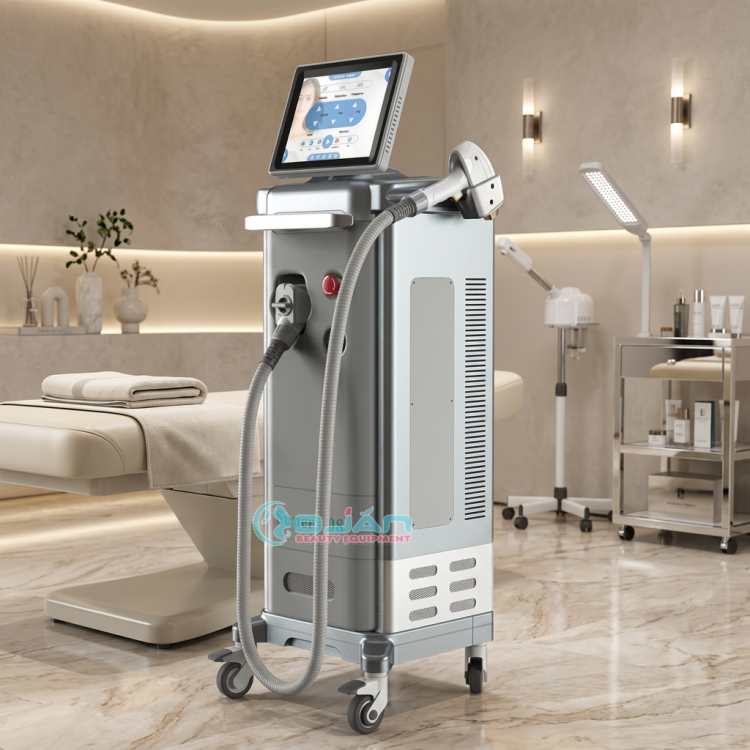
A bikini treatment lives or dies on whether the machine can adapt to the client in the chair, so the equipment matters as much as the technique. Ojan Beauty’s diode range combines all three wavelengths in one system, so a clinic isn’t stuck under-treating darker skin tones or turning clients away.
High-Quality Diode Laser 755/808/1064 Epilation Machine runs on gold-standard 808nm diode technology at 10 pulses per second, keeping sessions fast without sacrificing depth. Its Sapphire Dual-Chill contact cooling tip offsets treatment heat, letting a practitioner treat sensitive areas like the bikini line comfortably. With 755nm and 1064nm on the same unit, one machine can be tuned to the client instead of the client being limited to whatever single wavelength the clinic owns.

Super 808 755/808/1064nm Diode Laser Hair Removal Machine carries the same three wavelengths and pairs high power output with a short pulse width, which Ojan Beauty positions as a way to improve comfort without giving up treatment effect. It’s built for clinics wanting quick, precise sessions and a smoother client experience, with OEM branding available for businesses building this into their own service menu.
If you’re the one being treated rather than running the clinic, the takeaway is simple: ask which laser your provider uses and whether it can be adjusted to your skin tone before you book.

Prep and Aftercare That Actually Matter
Before your appointment: stay out of the sun and off tanning beds for about two weeks, using SPF 30 or higher. Shave the area 24 to 48 hours beforehand rather than waxing or plucking, since the laser needs the root intact. Show up with clean skin, free of lotion, cream, or deodorant, and pause retinoids or exfoliating acids as your provider recommends. Ask for a patch test if it’s your first session or your skin tends to react.
After your appointment: use a cool compress if the area feels hot, and stick to loose, breathable clothing. Skip hot showers, saunas, swimming, and intense exercise for 24 to 48 hours. Hold off on retinol, glycolic acid, salicylic acid, benzoyl peroxide, vitamin C serums, and fragranced products for the same window, in line with Ojan Beauty’s own aftercare guidance. Avoid tanning, keep sunscreen on nearby exposed skin, and leave bumps and scabs alone.
Call your provider if you notice blistering, spreading redness, pus, fever, severe pain, or pigment changes that aren’t settling down.
The Bottom Line
Laser hair removal in the bikini area is safe for most people, and the exceptions almost always trace back to the same preventable causes: the wrong wavelength for the skin tone, settings pushed too hard, a recent tan, or an inexperienced operator. Take those off the table and what’s left is a well-studied, low-risk treatment with side effects that are mostly mild and short-lived. Choose a provider who can explain their equipment without hesitation, follow the prep and aftercare rules, and the bikini area responds to laser just as reliably as anywhere else on the body