

How Does a Spa Capsule Differ from a Traditional Sauna?
A traditional sauna heats the room around you. A spa capsule heats you directly, sealing your body inside a pod while your head stays outside in open air. That single design difference is why almost everything else about the two experiences, the temperature needed, how long a session takes, and even who should avoid one or the other, ends up so different.
That distinction is also where the marketing claims come from, and why some of the bigger ones about weight loss and detox don’t hold up well under scrutiny. Here’s how the two actually compare on temperature, real evidence, and who should think twice before booking either one.
Convection Heat Versus Radiant Heat
A traditional sauna, the Finnish-style room most people picture, works by convection. Water poured over heated rocks fills the room with steam, and the hot, humid air around you does the work, running between 180°F and 190°F (82°C to 88°C) at high humidity. It typically needs 45 to 60 minutes to reach that temperature before anyone steps inside.
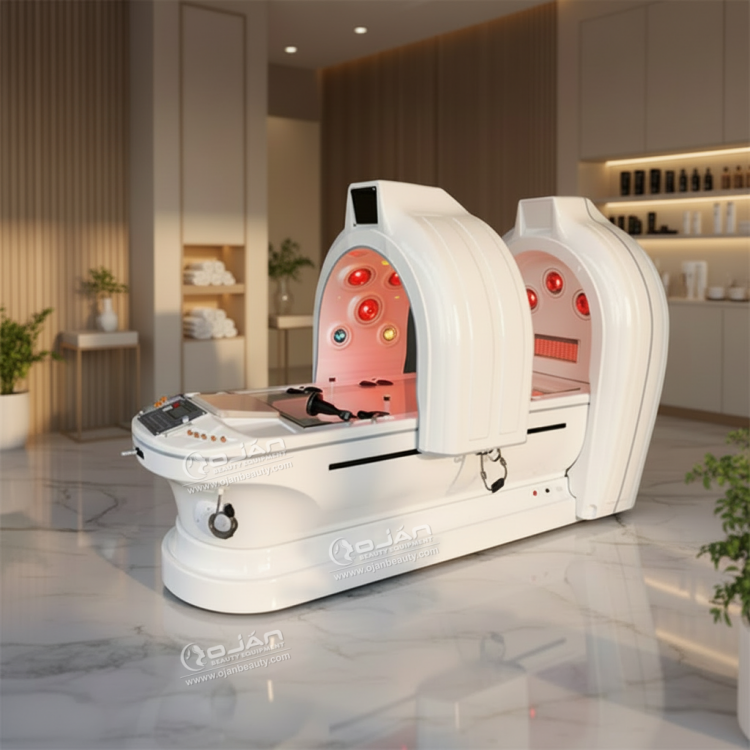
A spa capsule works by radiant heat instead. Far-infrared panels built into the pod’s walls warm the body directly rather than heating the air first, which is why capsules are usable within about 15 minutes of switching on. Some capsules also add steam, ozone, or hydro-massage jets on top of the infrared base, turning a single session into several therapies layered together.
Why the Temperature Ranges Differ So Much
Home infrared saunas typically run between 110°F and 140°F (43°C to 60°C), noticeably cooler than a Finnish room. Enclosed spa capsules can run hotter than that because the heat source sits inches from the skin rather than filling an entire room. Ojan Beauty’s own MX-S8 capsule, for example, reaches up to 90°C (194°F), closer to traditional sauna territory despite using infrared rather than steam.
What this means in practice: a capsule can produce a comparable sweat to a traditional sauna at a lower perceived heat, since infrared warms tissue directly instead of relying on hot air to raise skin temperature. That’s part of why people who find a traditional sauna’s heat oppressive often tolerate a capsule session more comfortably.
Inside a Session: Pod Versus Room
In a traditional sauna, you sit or lie on wooden benches in a shared room, fully enclosed in heated air, typically for 5 to 20 minutes at a time. In a spa capsule, you lie reclined inside a single-person pod that closes around the body while the head remains outside, breathing room air rather than heated air. Sessions run a bit longer, usually 20 to 30 minutes, since the lower perceived heat makes that more tolerable.
The capsule format also opens the door to features a room-based sauna can’t offer: built-in showerheads for rinsing off without leaving the pod, speakers for music, aromatherapy delivery, and in some models, coloured light therapy or ozone functions layered onto the core infrared heat.
What the Research Actually Supports
Sauna research is strongest for the traditional, whole-room version, largely thanks to long-running Finnish cohort studies. Frequent use, four or more sessions a week at 20 minutes or longer, has been linked to a markedly lower risk of sudden cardiac death, along with improved blood pressure and better exercise tolerance in people with existing heart conditions. Men using saunas four to seven times a week also showed a notably lower risk of dementia in observational data, though that link is far less studied than the cardiovascular findings.
Infrared-specific research is thinner but points in a similar direction for muscle recovery, joint pain, and mild improvements in lung function for people with asthma or COPD. Both formats show real, if modest, benefits for stress reduction and sleep quality.
Where the Marketing Oversells It
This is the part most spa marketing skips past. Weight-loss and detoxification claims, common on both traditional sauna and spa capsule product pages, don’t hold up well under scrutiny. What a hot session actually produces is water loss through sweat, not fat loss, and that weight returns as soon as you rehydrate. Most researchers don’t recommend either as a weight-loss method, and claims about “toxins” leaving through sweat aren’t well supported, since the kidneys and liver do that job regardless of how much you sweat.
None of this means the marketed numbers are fabricated outright. It means they describe a temporary, fluid-based effect rather than genuine fat loss, and treating a session as a substitute for diet or exercise sets people up for disappointment.
Who Should Sit This One Out
The contraindications overlap heavily between traditional saunas and spa capsules, since both work by raising body temperature:
- Cardiovascular conditions. Unstable coronary artery disease, heart valve disease, or a history of fainting from low blood pressure are reasons to get medical clearance first.
- Pregnancy. Both formats raise core temperature, which is generally advised against during pregnancy without a doctor’s sign-off.
- Medication that affects blood pressure or hydration. Diuretics and blood pressure medication change how the body handles heat stress.
- Kidney disease. Heat sessions increase fluid loss, which complicates conditions that already affect fluid balance.
- Unhealed wounds, recent surgery, or active skin conditions. Heat and sweat can aggravate skin that hasn’t fully recovered.
- Claustrophobia. Worth naming specifically for capsules, since the enclosed pod format doesn’t suit everyone the way an open sauna room does.
Documented side effects for both include light-headedness, heat intolerance, and dehydration, and rare but serious complications, including burns and fainting, have occurred among frequent users of either format. Staying hydrated, avoiding alcohol beforehand, and limiting sessions to the recommended window are what keep those risks low.
Getting the Most Out of Either Session
A few habits apply regardless of format. Drink water before and after, since both push fluid loss well beyond a normal workout, and skip alcohol beforehand, since it impairs temperature regulation and makes dizziness more likely under heat stress.
First-timers do better starting short: five to ten minutes in a traditional sauna, or the lower end of a capsule’s window, lets the body adjust before a full session. Anyone who feels light-headed or nauseous should step out immediately, and a cool shower afterward brings core temperature down gradually. Clinics should also set expectations upfront: a single 20-minute session won’t deliver the weight loss some marketing implies.
Ojan Beauty’s Spa Capsules for Clinics and Salons
Because a spa capsule packs several therapies into one enclosed unit, the equipment a clinic chooses determines how many treatments it can offer from a single machine.
MX-S8 Far Infrared Sauna Spa Capsule & Ozone Spa Capsule runs far-infrared heat up to 90°C across 20 to 30 minute sessions, paired with ozone and anion generation, coloured light therapy, aromatherapy delivery, UV sterilisation, and a built-in MP3 system. Ojan Beauty markets it toward detoxification and weight management, though as the research above shows, clients should be told upfront that the underlying effect is heat and fluid loss rather than fat loss. It’s built for salons and wellness clinics that want one capsule covering several treatment types at once.

High-Quality Fashion Space Tunnel Luxury Infrared Spa Capsule (Model MX-S2a, CE approved) combines far and near-infrared wavelengths designed to penetrate skin tissue, four-colour light therapy, an electrode pack targeting acupuncture points, and a built-in music system, running on 1800W at 220/110V. Sessions run shorter, around 15 minutes, and the unit ships in three sections for easier installation. It suits clinics positioning the capsule as a physical therapy or body-contouring add-on alongside other services.
Either model gives a clinic the enclosed, radiant-heat format without the plumbing and ventilation a full steam sauna room requires.
Room or Pod: How to Choose

For a clinic, the decision usually comes down to space and service mix. A traditional sauna room needs real square footage, plumbing, and ventilation, but seats more than one person and suits a shared relaxation experience. A spa capsule fits in far less space, serves one client at a time, and bundles in extra therapies a plain sauna room can’t offer.
For an individual, tolerance for heat and enclosed spaces matters more than either format’s marketing claims. Someone who finds a sauna’s humid heat overwhelming will likely find a capsule’s radiant warmth easier to sit through, while someone uncomfortable in an enclosed pod may prefer an open room they can leave at will.
The Bottom Line
A traditional sauna heats the air around a shared room using steam and convection, while a spa capsule heats the body directly with radiant infrared in an enclosed, single-person pod, which is why it needs less time to warm up and often feels more tolerable at a lower perceived heat. The cardiovascular and muscle-recovery benefits behind both are genuine, but the weight-loss and detox claims attached to each are overstated. Choose based on space, tolerance, and what a clinic actually wants to offer, not on which one promises the bigger calorie burn.