

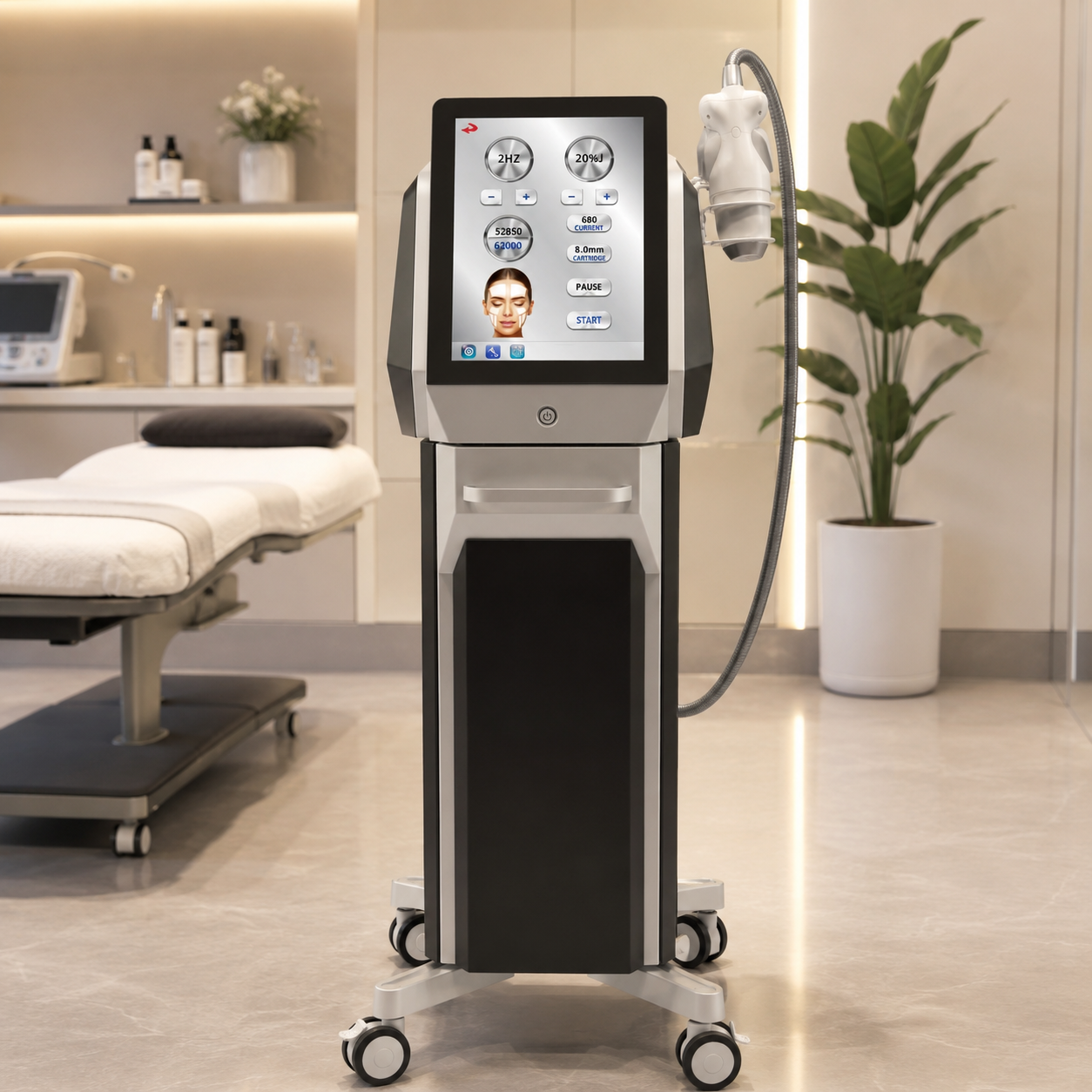
HIFU Machine Guide: How to Choose the Right Device (With Real Before-And-After Evidence)
Over the past several years, our team at Ojan Beauty has worked directly with clinics, medspas, and equipment distributors, testing, sourcing, and troubleshooting HIFU systems from multiple manufacturers. We’ve seen units that perform exactly as promised, and we’ve seen units returned within weeks because a distributor didn’t know what questions to ask before buying. This guide reflects that hands-on experience, combined with clinical research, so you can evaluate a HIFU machine — or a HIFU result with real confidence.
A HIFU machine (High-Intensity Focused Ultrasound) is a non-surgical device that uses focused sound waves to heat precise layers beneath the skin, triggering new collagen growth and gradual tightening. It’s one of the few non-invasive technologies that can reach the same structural layer targeted in a surgical facelift — the SMAS (superficial musculoaponeurotic system) — without any incision.
This guide is built for two audiences at once: clinics and distributors deciding which machine to buy, and patients or practitioners trying to understand what a real HIFU before-and-after result should look like. Both questions come down to the same thing — knowing what’s genuine versus what’s marketing.
What Is a HIFU Machine And How Does It Work?

A HIFU Machine focuses ultrasound energy at a specific depth beneath the skin’s surface, creating tiny points of heat called thermal coagulation points (TCPs). These points sit below the visible skin, so there’s no wound on the surface — the skin heals from the inside as new collagen forms around each point over the following weeks.
This is mechanically different from radiofrequency (RF) or laser treatments, which mainly affect the surface layers. Because HIFU can be focused at depth, it reaches structures lasers and RF typically can’t, which is why clinicians describe it as producing a “lifting” effect rather than just surface tightening. A peer-reviewed consensus review in the Aesthetic Surgery Journal describes microfocused ultrasound with visualization (MFU-V) as the current gold-standard energy device for non-invasive lifting, largely because of this depth capability (PMC, Aesthetic Surgery Journal).
The Science of Thermal Coagulation Points
When ultrasound energy converges at a focal point, tissue molecules vibrate against each other, generating localized heat around 60–70°C. This controlled heat damages a tiny column of tissue in a way that triggers the body’s natural wound-healing response — not visible injury, but a cellular signal to rebuild collagen and elastin. That’s why HIFU results build gradually rather than appearing instantly: you’re watching a biological repair process, not an immediate physical change.
Treatment Depths Explained
Most professional HIFU systems offer interchangeable cartridges at different depths:
- 1.5 mm – targets the superficial dermis, good for fine lines and skin texture
- 3.0 mm – targets the deeper dermis, used for general tightening
- 4.5 mm – reaches the SMAS layer, the same layer addressed surgically in a facelift
- 6–13 mm – used for body treatments, targeting deeper fat and connective tissue
Choosing the wrong depth for the treatment goal is one of the most common mistakes we see among newer clinics — a 1.5mm cartridge won’t produce jawline lifting, and using a 4.5mm cartridge on thin under-eye skin is inappropriate. Depth selection, not raw power, is what separates a well-run HIFU protocol from a disappointing one.
PRODUCT LINK – Professional 12D HIFU ICE Face Lifting & Skin Tightening Machine | Advanced Non-Invasive Body Slimming & Rejuvenation Device
HIFU vs. RF vs. Laser vs. Surgical Facelift
| Treatment | Depth Reached | Downtime | Visible Timeline | Durability |
|---|---|---|---|---|
| HIFU | Dermis to SMAS (1.5–4.5mm) | Minimal | 2–3 months, progressive | 12–24 months |
| Radiofrequency | Dermis/subdermal | Minimal | Weeks to months | 6–12 months |
| Laser resurfacing | Epidermis to dermis | Days to weeks | Weeks to months | 6–12 months |
| Surgical facelift | All soft tissue layers | Weeks | Immediate, refines over months | Several years |
A systematic review of 45 clinical trials published in the Aesthetic Surgery Journal found HIFU produced measurable skin laxity improvements of 18–30%, particularly in the lower face, neck, and periorbital area (Oxford Academic, Aesthetic Surgery Journal).
HIFU Before And After: What Real Results Actually Look Like

This is where a lot of marketing content misleads people. Real HIFU results are gradual and modest compared to surgery — and that’s actually a good sign of an honest source, not a weakness of the treatment.
The Realistic Results Timeline
- Immediately after treatment: mild redness or swelling; any “instant” tightening seen in photos is temporary fluid response, not the true collagen result
- 1–3 weeks: early, subtle firmness as initial collagen contraction begins
- 2–3 months: visible improvement in laxity and contour as new collagen matures
- 6–12 months: peak results for most patients, with some continued improvement up to 18–24 months
If a before-and-after photo claims a dramatic change within days, treat it with skepticism. Genuine clinical photography almost always spans several months.
How To Read A Before-And-After Photo Like A Professional
A trustworthy photo pair should disclose:
- Identical lighting, camera angle, and facial expression in both shots
- No makeup or filters applied after treatment
- The device model, cartridge depth, and number of sessions used
- The exact time gap between the “before” and “after” shot
If any of that information is missing, the photo is not verifiable — regardless of how convincing it looks.
Results By Treatment Area
- Jawline and jowls: improved definition, reduced sagging along the jaw contour
- Neck and submental area: smoother neck bands, tighter under-chin skin
- Cheeks and midface: subtle lift, often described as restored “volume” though it’s actually tissue tightening
- Periorbital area (brow): mild elevation and reduced hooding in appropriate candidates
- Body areas: improved firmness in localized zones such as the abdomen, though effects are more modest than facial results
Red Flags In HIFU Marketing Photos
Watch for undisclosed combination treatments (fillers, Botox, or surgery shown as “HIFU results”), inconsistent lighting or angle between the two photos, missing timepoints, and heavy retouching. A supplier or clinic that’s transparent about these details is one you can trust with the rest of their claims too.
What Makes A HIFU Machine High-Quality? A Manufacturer’s Technical Checklist
This is the part of the buying decision most patient-facing content skips entirely — and where clinics and distributors most often get burned.
Transducer Quality And Energy Consistency
The transducer is the component that actually converts electrical energy into focused ultrasound. Lower-quality transducers lose calibration quickly, meaning shot five might deliver noticeably different energy than shot fifty. Ask any manufacturer for their transducer lifespan (shot count) and calibration test data before purchasing.
Certifications That Actually Matter
- CE marking confirms compliance with EU health, safety, and environmental requirements
- ISO 13485 confirms the manufacturer follows a certified quality management system specific to medical devices
- FDA 510(k) clearance (for the U.S. market) confirms a device has been reviewed as substantially equivalent to an already-legally-marketed predicate device — you can verify any clearance directly on the FDA’s device database
- SGS testing reports confirm independent third-party verification of safety and performance claims
Don’t accept a certificate logo alone — ask for the certificate number and verify it independently. This single step avoids the majority of counterfeit or misrepresented equipment in this industry.
Cartridge System And Depth Range
Counted-shot cartridges (which lock after a set number of uses) protect both patient safety and a distributor’s warranty terms, since they prevent overuse of a degraded cartridge. A wider depth range (1.5mm through body-depth options) gives a clinic more service flexibility from one machine.
Safety Systems
Look for skin-contact sensors that prevent firing without full applicator contact, active cooling to protect the epidermis, and automatic energy cutoffs. These are inexpensive to build in but are often the first components cut from budget machines.
Manufacturer Support
Training, warranty terms, and spare parts availability matter more over a machine’s five-to-ten-year lifespan than its sticker price. Before buying, ask directly: what happens when a transducer fails in year three?
Types Of HIFU Machines Compared
- Professional multi-cartridge systems — best for full-service clinics offering face and body treatments
- Portable/compact devices — suited to mobile practitioners or smaller studios with lower client volume
- Face-only vs. face + body systems — face-only units are lower cost but limit your service menu; combined systems cost more upfront but expand revenue potential
- Combination devices (HIFU + RF or microneedling) — useful for clinics wanting one system to cover multiple treatment types, though each function is typically less powerful than a single-purpose machine
Is HIFU Safe? Side Effects And Who Should Avoid It
Most side effects are mild and temporary: redness, swelling, and tingling that resolve within hours to a few days (Applied Sciences / MDPI review of HIFU complications). A systematic review of microfocused ultrasound found rare adverse effects — numbness, bruising, or contact dermatitis — occurring in roughly 2% of cases, and identified excessive skin laxity or a BMI above 30 as factors that reduce the odds of a good outcome (PMC systematic review).
People who are pregnant, have active skin infections, implanted electronic devices such as pacemakers, or open wounds at the treatment site should not receive HIFU. Anyone with severe skin laxity is typically better served by a surgical consultation, since HIFU is designed for mild-to-moderate laxity, not major repositioning.
How To Choose the Right HIFU Machine For Your Clinic or Market
Match the machine to your actual client base first — a face-focused clinic doesn’t need body-depth cartridges, and a medspa expanding into body contouring does. For distributors and importers, regional compliance varies meaningfully: the EU requires CE/MDR documentation, the U.S. requires FDA clearance pathways, and many Middle Eastern and Southeast Asian markets require separate local registration even when CE or FDA documentation already exists. Confirming this before shipment avoids customs delays that can sit equipment in a warehouse for months.
Before signing with any supplier, ask for: independent test reports, reference clinics you can contact directly, certificate numbers you can verify with the issuing body, and clearly written after-sales and warranty terms.
Why Choose Ojan Beauty As Your HIFU Machine Supplier

Ojan Beauty manufactures and supplies HIFU and other aesthetic equipment to clinics, resellers, and distributors globally, with documented certification, in-house quality control, and OEM/ODM capability for partners who want a private-label solution. Our team works directly with buyers to verify certification numbers, provide training documentation, and support after-sales service — the exact steps outlined in the checklist above, because we built this guide around the questions our own distributors ask us.
Key Takeaways
- HIFU uses focused ultrasound to reach the SMAS layer, the same structure targeted surgically, without incisions.
- Real results build gradually over 2–3 months and peak around 6–12 months — instant “after” photos should raise questions.
- Machine quality depends more on transducer consistency, verified certification, and safety systems than on marketing claims.
- Side effects are typically mild and short-lived; a small percentage of patients experience longer-lasting but temporary effects.
- Always verify certificate numbers, request reference clinics, and confirm regional compliance before purchasing or distributing a HIFU machine.
FAQs About HIFU Machine Guide
Most patients see results lasting 12–24 months, depending on skin condition, age, and aftercare, with peak visible improvement typically between 6 and 12 months after treatment.
Many patients see meaningful change after one session, though some with more advanced laxity benefit from two to three sessions spaced several months apart.
Most people feel brief warmth or tingling during treatment rather than significant pain, and modern machines with adjustable energy settings and cooling reduce discomfort further.
No. HIFU can meaningfully improve mild-to-moderate skin laxity without surgery, but it cannot replicate the tissue repositioning a surgical facelift achieves for advanced sagging.
Look for CE marking, ISO 13485 quality certification, and, for the U.S. market, FDA 510(k) clearance — and verify certificate numbers directly with the issuing authority rather than relying on a logo alone.
Final Verdict
HIFU is a proven, non-surgical technology capable of real skin tightening and lifting — but its outcomes hinge entirely on machine quality, verified certification, and operator skill, not marketing claims or dramatic “instant” photos. Choose a properly certified system, expect gradual results over 2–3 months, and work with a supplier like Ojan Beauty that can back its equipment with verifiable documentation and support — that’s what separates a HIFU investment worth making from one you’ll regret.
HIFU is worth considering if you have mild-to-moderate skin laxity and want a non-surgical option with minimal downtime. Go in with realistic expectations — gradual improvement over 2–3 months, not overnight change — and choose a provider who’s willing to show you unedited, time-stamped before-and-after photos with disclosed settings. If a result looks too dramatic or too fast, it probably isn’t HIFU alone.