

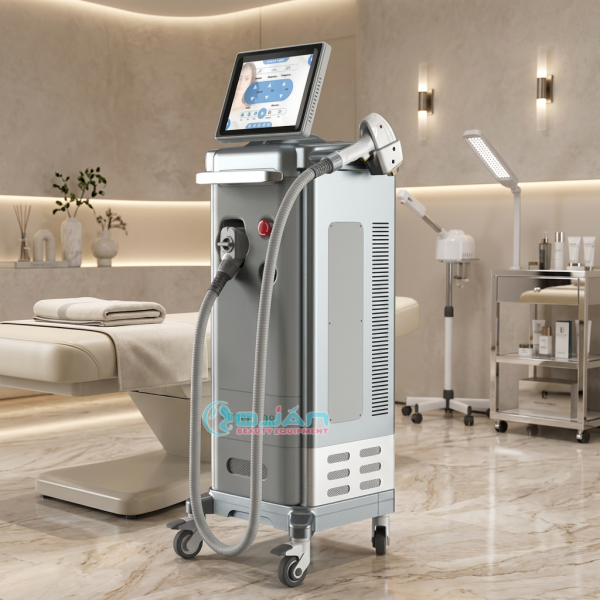
Does Diode Laser Hair Removal Work on All Skin Types?
If you’ve ever searched “laser hair removal near me,” you’ve probably run into a wall of confusing, contradictory advice. Some sites say laser hair removal only works on fair skin. Others claim it’s completely universal. So which is it?
Modern diode laser hair removal works on almost every skin type. But not every diode laser is built the same way, and that difference matters more than most clinics let on.
The technology has come a long way from the early 2000s, when laser hair removal really was mostly reserved for people with light skin and dark hair. Today’s multi-wavelength diode systems, like the ones Ojan Beauty manufactures for clinics and salons, are specifically engineered to treat a full spectrum of skin tones safely. But to understand why, you need to know a little about how the science actually works, and where it can still go wrong if the wrong equipment or settings are used.
Let’s break it all down.
How Diode Laser Hair Removal Actually Works
Diode laser hair removal relies on a process called selective photothermolysis, a fancy term for a fairly simple idea. The laser emits a specific wavelength of light that’s absorbed by melanin, the pigment that gives hair (and skin) its color. When that light energy hits the hair follicle, it converts into heat, damaging the follicle enough that it eventually stops producing hair.
The key word here is “selective.” The laser is designed to target the melanin concentrated in the hair shaft and follicle, while sparing the surrounding skin as much as possible. This is where skin tone becomes relevant, because your skin also contains melanin, and the more of it you have, the more the laser energy gets absorbed by your skin instead of just your hair.
That’s the whole challenge of laser hair removal in one sentence: the laser can’t always tell the difference between the melanin in your hair and the melanin in your skin. Get the wavelength and settings right, and you get safe, effective hair reduction. Get it wrong, and you risk burns, irritation, or pigmentation changes.

Why Skin Type Matters: A Quick Look at the Fitzpatrick Scale
Dermatologists classify skin tones using something called the Fitzpatrick scale, which ranges from Type I (very fair skin that always burns, never tans) to Type VI (deeply pigmented skin that never burns). It was originally developed to describe how skin reacts to sun exposure, but it’s now the standard reference point for laser treatments of all kinds, including hair removal.
Generally speaking:
- Fitzpatrick I–III (fair to medium skin): These skin types offer the highest contrast between skin and hair pigment, making them the most straightforward to treat with almost any laser wavelength.
- Fitzpatrick IV–VI (olive, brown, and deeply pigmented skin): These skin types contain significantly more melanin in the epidermis itself. That means a larger share of the laser’s energy can be absorbed by the skin rather than the hair follicle, raising the risk of overheating, blistering, or post-inflammatory hyperpigmentation if the equipment isn’t suited for it.
This is exactly why some older or lower-quality laser systems come with warnings against use on darker skin. It’s not that darker skin can’t be treated. It’s that it requires a smarter approach.
So, Does It Actually Work on All Skin Types?
Yes, with the right technology. This is where the specific type of laser matters enormously, and it’s why “diode laser” isn’t really one single thing. There are several wavelengths used in laser hair removal, and each interacts with skin and hair differently:
- 755nm (Alexandrite): Excellent for finer, lighter hair, but has historically been used with more caution on darker skin tones because it’s absorbed strongly by surface melanin.
- 808nm (Diode): Widely considered the industry’s gold-standard wavelength because it strikes a balance. It penetrates deep enough to reach the hair follicle while being efficiently absorbed by melanin, and it tends to be well tolerated across a broad range of skin tones.
- 1064nm (Nd:YAG): The go-to choice for darker skin. This longer wavelength bypasses much of the epidermal melanin and penetrates deeper into the dermis, targeting the hair follicle while generating less heat at the skin’s surface. That’s why dermatology literature consistently recommends it for Fitzpatrick IV–VI skin.
Here’s the real breakthrough in recent years: instead of forcing clinics to buy separate single-wavelength machines for different clients, manufacturers have started combining all three wavelengths into one device. A machine that can switch between 755nm, 808nm, and 1064nm, depending on a client’s skin tone and hair type, can genuinely serve nearly every person who walks through the door, rather than turning away or under-treating anyone with deeper skin tones.
That’s precisely the direction Ojan Beauty has taken with its professional diode laser range.
Hair Color Plays a Role Too
Skin type is only half the equation. Hair color matters just as much. Because the laser targets melanin, it works best on dark, coarse hair. Very light blonde, grey, or white hair contains little to no melanin, so there’s simply not enough pigment for the laser to latch onto, regardless of how advanced the machine is or how fair or dark your skin happens to be. This is a limitation of the underlying science itself, not a flaw in any particular device. If your hair is very light in color, you may see limited results no matter which system is used.
What This Means If You’re Getting Treated (or Running a Clinic)
If you’re a client, the takeaway is simple: don’t assume laser hair removal isn’t for you just because you have deeper skin. Ask your provider what wavelength(s) their machine offers, and whether it’s appropriate for your specific Fitzpatrick type. A reputable provider should be able to answer this without hesitation, and should always perform a patch test before a full treatment, especially for darker skin tones.
If you’re a clinic or salon owner, the takeaway is just as simple: your equipment is your biggest liability or your biggest asset. A single-wavelength, budget machine might handle a narrow slice of your client base well, but it can turn into lost bookings, refunds, or worse (an unhappy client with skin damage) the moment someone outside that narrow range sits in your chair. Investing in versatile, multi-wavelength technology isn’t just a nice-to-have; it’s what lets you confidently serve every client who calls to book an appointment.

Ojan Beauty’s Multi-Wavelength Diode Laser Machines
This is exactly the gap Ojan Beauty’s diode laser range is built to close. Both machines below combine 755nm, 808nm, and 1064nm wavelengths in a single system, so clinics aren’t limited to treating only one type of skin or hair.
1. High-Quality Diode Laser 755/808/1064nm Epilation Machine
This machine is built around the same principle we covered above: no single wavelength is right for every client, so it doesn’t rely on just one. The 755nm setting targets lighter, finer hair with precision, the 808nm setting handles most skin types and hair densities as the reliable middle ground, and the 1064nm setting is suited to darker skin tones, penetrating deeper while generating less surface heat. It also uses a Sapphire Dual-Chill contact cooling tip, which helps offset the heat generated during treatment, improving both comfort and safety. For clinics that want one machine capable of confidently treating a genuinely diverse client base, this is a strong starting point.
View the High-Quality Diode Laser 755/808/1064nm Machine
2. Super 808 755/808/1064nm Diode Laser Hair Removal Machine
Built on the same triple-wavelength foundation, the Super 808 is designed for high-volume, professional use, with a high-power handle and short pulse width intended to improve both comfort and treatment speed. Its interface is intentionally simple: the operator selects the client’s gender and skin tone, and the machine suggests appropriate parameters accordingly, which helps reduce the guesswork (and risk) involved in treating a wide range of skin types. It’s designed for full-body treatment, including arms, legs, underarms, lip, and bikini line, and, like Ojan Beauty’s other systems, it’s built to a factory-price point with OEM branding options for clinics and salons looking to scale.
View the Super 808 755/808/1064nm Diode Laser Hair Removal Machine

The Bottom Line
Diode laser hair removal isn’t a one-size-fits-all treatment, but with the right multi-wavelength technology, it can genuinely come close. The science shows that skin type doesn’t have to be a barrier to safe, effective hair removal; it simply has to be accounted for with the right wavelength, the right settings, and equipment designed with that variety in mind. That’s the philosophy behind Ojan Beauty’s diode laser range: rather than asking clients to fit the machine, the machine is built to fit the client.
If you’re a clinic owner looking to expand who you can safely and confidently treat, or a curious client wondering whether laser hair removal is realistic for your skin tone, the short answer is: probably yes, as long as the technology behind it is up to the job.