

Cavitation Machine Buyer’s Guide: 7 Specs to Check Before Ordering for Your Salon
Most cavitation machines on a supplier’s shop page look nearly identical: a handheld probe, a touchscreen, a long list of functions, and a price that moves around for no obvious reason. The differences that actually matter sit in a handful of numbers and build details that rarely make the headline, and they decide whether a unit delivers steady energy for years or starts losing probes within months. Learn to read those few lines and any two machines can be compared in minutes.
That matters more than usual in this category, because the evidence behind cavitation is thin and the equipment is where a salon either protects or wastes its reputation. Here are the seven specs worth checking before placing an order, what the research says cavitation can and can’t deliver, and how one Ojan Beauty model measures up against the checklist.
1. Cavitation Frequency
Frequency decides how the ultrasound behaves in tissue. One retailer’s comparison puts 40kHz at roughly 1.5 to 2.5 cm of penetration, suited to the abdomen, thighs, hips, and back, while 80kHz reaches about 0.8 to 1.2 cm and is gentler, aimed at small areas like the chin and underarms. Those depth figures are approximate, since the same article gives slightly different numbers in its body text.
Ojan Beauty’s own treatment guide adds a useful footnote: most clinical studies on ultrasonic cavitation reference 1 to 3 MHz, so kHz machines are a lower-frequency option that covers broader areas faster. Frequency alone doesn’t prove a machine works, either. Many clinics end up combining both frequencies in full-body programs, so ask for the frequency of each handle, and for measured output rather than a headline number.
2. Power Output
Home units typically sit at 10 to 30W, while professional machines run 50 to 100W, and a sensible floor for salon use is around 25W of peak cavitation power. The trap is the difference between what a machine draws from the wall and what its handpiece actually delivers. Ask the supplier to state output at the probe, so you know what the handpiece actually delivers.
3. Number of Handles and Functions
Machines come as 2-in-1, 3-in-1, or 4-in-1, usually combining cavitation with radio frequency and sometimes vacuum or micro-current. The combination matters because cavitation on its own does little for skin firmness, which is why retailers recommend RF alongside it for tightening. Bipolar RF at 1 to 2 MHz suits surface tightening, while multipolar RF heats deeper. If vacuum is included, look for adjustable suction across several levels, since weak suction is another recurring complaint, and for at least five adjustable RF intensity levels. Choose the handle set that matches the services you actually sell, not the longest feature list.
4. Probe Material and Build Quality
Probe failure within three to six months is one of the most common complaints on cheaper units. Look for ceramic or metal tips with even energy distribution, since metal also dissipates heat better, and be wary of plastic tips that degrade over time. Ask what a replacement probe costs and how long it takes to arrive, because a machine with a dead handle earns nothing. If the supplier can send a sample or a short video of a handle running under load, that’s worth more than any spec sheet.
5. Safety Features
Look for automatic shutoff after 15 to 20 minutes, overheating protection, and impedance sensing. Thermal burns are the best-documented risk with cavitation, alongside pain, subcutaneous nodules, and in rare cases tinnitus from low-frequency sound, and burns tend to happen when the handpiece is held still, moved too slowly, or used with too little coupling gel. Use only water-based conductive gel, since oils and lotions can cause overheating. Built-in safeguards reduce the risk, but they don’t replace staff training or session limits of around 20 minutes per area.
6. Certifications and Regulatory Status
CE and RoHS marking and ISO manufacturing certification are reasonable baselines to ask for, with the understanding that CE marking signals conformity with European requirements and RoHS limits hazardous substances, while neither says anything about whether the machine actually performs. Ask for copies of the certificates rather than accepting a logo on a page. Be more careful with the word “FDA.” One independent review of US regulatory databases reported finding no unfocused cavitation device cleared for fat reduction or body contouring, and noted that cleared body-contouring systems use focused ultrasound, a different technology. Even FDA registration doesn’t imply endorsement. Check your local rules on commercial use, and be cautious of any supplier who calls a spa cavitation unit “FDA approved.”
7. Warranty, OEM Options, and After-Sales Support
Look for at least a one-year warranty and a clear return window. Ask whether spare handles and parts are stocked, whether training or protocol guides are included, and, if you want your own branding, whether OEM or ODM service is available and at what minimum order. Confirm that the voltage range suits your market before shipping, since a unit built for 110V won’t run happily on 240V.
Red Flags to Watch for When Buying
A few warning signs apply to any listing. Units priced under roughly $80 often fail to deliver consistent energy or last long, and a missing serial number or compliance label is a reason to walk away. Be skeptical of unrealistic before-and-after photos and promises of instant results, because the honest timeline for cavitation is weeks, not a single session. If a supplier can’t answer a direct question about output, probe materials, or warranty, that silence tells you what you need to know.
What Cavitation Can and Cannot Do
This is the part supplier pages tend to skip. The studies on cavitation are small, mostly unblinded, short in follow-up, and frequently confounded by diet, exercise, or other treatments running alongside. In one trial of 90 people, adding cavitation to cryolipolysis plus a low-calorie diet produced no measurable extra loss in weight, BMI, fat mass, or waist size. Much of the immediate drop in circumference after a session is attributed to temporary fluid displacement, and lasting change takes weeks and depends on sustained diet and exercise.
Ojan Beauty’s own guide frames it as body contouring rather than weight loss, aimed at people near their goal weight with soft, pinchable fat of at least about 2 cm. Expect a course of around six to ten sessions, each lasting 30 to 60 minutes, with final results visible roughly six to twelve weeks after starting. That is moderate contouring, not a dramatic transformation. It’s also not for everyone: pregnancy, pacemakers or metal implants, anticoagulant use, severe liver or kidney disease, and active cancer are all reasons to skip treatment or get medical clearance first.
Ojan Beauty’s 3-in-1 Cavitation Machine
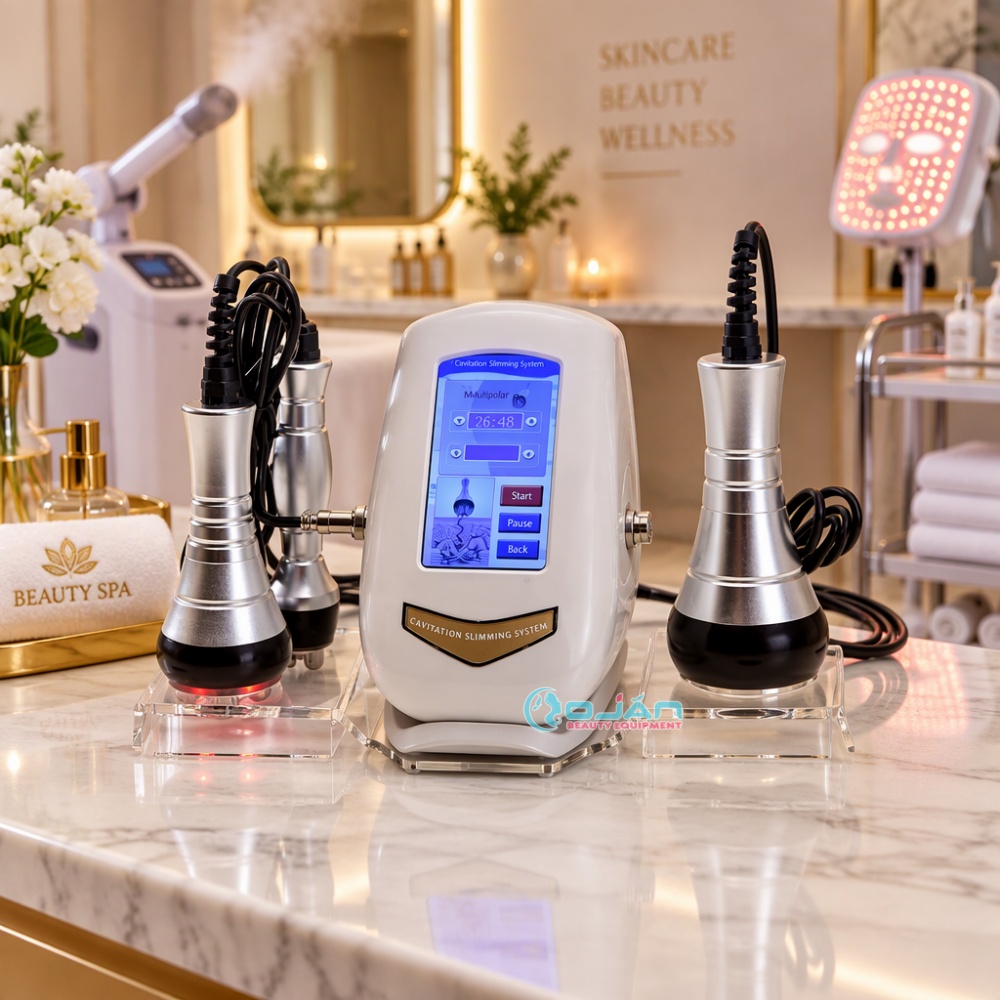
3 in 1 Ultrasound Body Massager Fat Burner Fat Cavitation Machine (model LW-101) is a three-handle system: a 40kHz ultrasonic cavitation handle, an RF handle, and a tripolar facial handle using micro-current, controlled from a colour touchscreen. The listed cavitation power is 50W, which sits inside the professional range described above, and the unit runs on 100 to 240V, with CE and RoHS certification and OEM/ODM supply available.

The RF handle is rated at 25W and the 40kHz ultrasonic handle at 20W, and the facial handle extends the machine beyond body work, which helps a salon get more use from one unit across face and body services.
Measured against the checklist above, the machine lines up well. The 40kHz cavitation handle suits large areas such as the abdomen, thighs, and hips, and the 50W cavitation power sits within the professional range. Pairing cavitation with an RF handle covers the skin-tightening side that cavitation alone doesn’t, while the 100 to 240V range makes the unit practical across different markets. CE and RoHS certification meet the baseline certifications to look for, and OEM/ODM supply lets a salon or distributor put its own branding on the machine. For a business wanting body cavitation, RF, and facial micro-current from a single system, it’s a well-rounded choice.
The Bottom Line
The right cavitation machine for a salon is the one whose frequency, verified output, handle set, build quality, safety features, certifications, and warranty line up with the services it plans to sell, not the one with the longest feature list. Keep expectations honest too: cavitation is a modest contouring tool, not a weight-loss method, and the evidence is stronger for combining it with diet and exercise than for the machine alone. For a salon wanting a 40kHz cavitation and RF combination with OEM options, Ojan Beauty’s 3 in 1 Ultrasound Body Massager Fat Burner Fat Cavitation Machine is a practical match for the checklist above.