

Can Fractional CO2 Laser Remove Stretch Marks?
If you’ve ever stood in front of a mirror and traced the silvery lines on your hips, thighs, or stomach, you already know how stubborn stretch marks can be. Creams promise the world and rarely deliver. Oils feel nice but barely touch the deeper layers where the real damage sits. So when fractional CO2 laser keeps coming up in skincare conversations, it’s fair to ask: does it actually work, or is it just another overhyped treatment?
The short answer is that fractional CO2 laser doesn’t erase stretch marks completely, but it is genuinely one of the most effective tools available for fading them and improving the texture of the skin around them. Here’s what’s actually happening beneath the surface, what kind of results are realistic, and which Ojan Beauty machines are built specifically for this kind of work.
Why Stretch Marks Are So Hard to Treat
Stretch marks, or striae, form when skin is stretched faster than it can comfortably adapt during pregnancy, puberty growth spurts, rapid weight changes, or muscle growth from training. That rapid stretching tears the dermis, the middle layer of skin where collagen and elastin live. The surface heals, but the structural damage underneath doesn’t just disappear on its own.
Newer marks, known as striae rubra, tend to look red or purple because the area is still inflamed and full of active blood vessels. Older marks, striae alba, have faded to white or silver once the inflammation settles — and unfortunately, this is also when they become more resistant to treatment, since the tissue has essentially “scarred over” with less elasticity and pigment.
This distinction matters a lot when it comes to laser treatment, because the two types respond very differently.
How Fractional CO2 Laser Actually Works
A fractional CO2 laser doesn’t treat the whole area at once. Instead, it fires the beam through thousands of microscopic columns, leaving the surrounding tissue untouched. Each of these tiny columns vaporizes a pinpoint of damaged skin, while the untouched tissue around it speeds up healing and reduces downtime compared to older, fully ablative lasers.
Underneath those micro-wounds, the body kicks into repair mode. It clears out the old, disorganized collagen in the stretch mark and starts laying down new collagen and elastin in its place. Over the following weeks and months, that fresh collagen continues to remodel the area, gradually smoothing the texture and tightening the surrounding skin.
This is exactly why fractional CO2 is considered one of the strongest options for deep, mature, white stretch marks — the type that creams and microneedling alone usually struggle to budge. The laser reaches the structural layer where the damage actually lives, rather than just working on the surface.
So, Does It Really Remove Stretch Marks?
Realistically: it improves them significantly, but it doesn’t make them vanish. Clinical data on fractional CO2 treatment shows visibility reductions of up to 75% after a course of three to six sessions, depending on the depth, age, and color of the marks being treated. Most people notice smoother texture, more even tone, and a softer, less indented appearance rather than a complete disappearance.
A few things tend to determine how much improvement you’ll see:
- Color and age of the marks— red or purple stretch marks generally respond faster and more dramatically because the tissue is still active and full of blood flow. White, older marks improve in texture and depth but rarely regain their original pigment.
- Number of sessions— this is not a one-and-done treatment. Most practitioners recommend a series of sessions spaced several weeks apart, since collagen remodeling is a gradual process that keeps improving for months after each visit.
- Skin type and aftercare— consistent sun protection and proper post-treatment care play a real role in how well the results hold up.
It’s also worth setting expectations around timing. You won’t walk out of a session with instantly smooth skin. The treated area typically looks red and feels warm for the first few days, similar to a mild sunburn, and the real changes happen quietly underneath the surface over the following weeks as collagen rebuilds.
The Machines Behind the Results
Results with fractional CO2 depend heavily on the quality and precision of the laser itself, which is where having the right equipment matters. Ojan Beauty designs and manufactures professional-grade laser systems built specifically for this kind of deep skin resurfacing work, and two of their machines are particularly well suited to treating stretch marks.
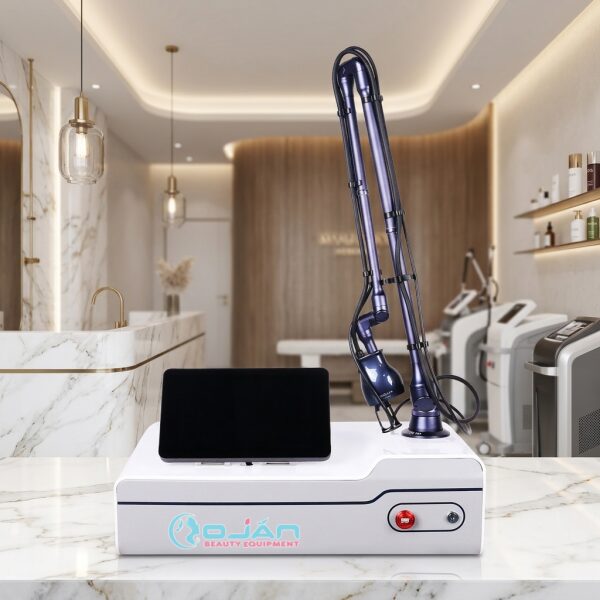
Fractional CO2 Laser Machine for Beauty Skin & Vaginal Tightening is built around a 10,600nm wavelength with a seven-joint articulated arm for precise, stable energy delivery. It offers continuous, single-pulse, interval, and super-pulse output modes, with adjustable scan density, depth, and shape which gives practitioners the control needed to treat deep, long-standing white stretch marks without overworking the surrounding tissue. Beyond stretch marks, the same precision resurfacing also makes it useful for general scar revision and skin tightening, making it a versatile addition for clinics and salons that want to expand their treatment menu.

Fractional Co2 Laser Machine For Beauty Skin Vaginal Tightening Machine
Revolutionary 7-In-1 RF Metal CO2 Fractional Laser Machine takes a multi-handle approach, pairing fractional CO2 resurfacing with additional RF handles for facial tightening, scanning coverage, and pigmentation treatment. Its RF metal tube is rated for up to 10,000 hours of stable performance, and the 10.6μm wavelength penetrates the dermis to trigger the same collagen-rebuilding response that improves stretch marks, scars, and uneven texture. For clinics that want one machine capable of handling a broader range of client requests and not just stretch marks but acne scarring, fine lines, and general resurfacing — this is built to cover that ground.

Revolutionary 7-In-1 RF Metal CO₂ Fractional Laser Machine Newest Design
Both machines are manufactured at factory pricing with OEM customization available, which is worth knowing if you’re a clinic owner or distributor looking to add advanced laser treatments to your service list without the markup of importing through a third party.
Who’s a Good Candidate for This Treatment
Fractional CO2 tends to work best for people who are at a stable body weight, have light to moderate stretch marks, and are realistic about what gradual improvement looks like. It’s suitable for both men and women, and age isn’t really a limiting factor — what matters more is the condition of the skin being treated.
That said, it’s not the right fit for everyone. People who are pregnant, have active skin infections in the treatment area, or have certain chronic skin conditions are usually advised to wait or avoid the treatment altogether until a qualified provider clears them. A proper consultation before the first session — checking skin type, mark depth, and medical history — is what allows a practitioner to choose safe, effective laser settings rather than guessing.
How It Compares to Other Stretch Mark Treatments
It’s worth knowing where fractional CO2 sits next to the other options you’ve probably already tried or considered:
- Topical creams and oilswork on the surface and can help with hydration and minor texture, but they don’t reach the dermis where stretch marks actually form, so the impact on established marks is limited.
- Microneedlingstimulates collagen in a less intense, less invasive way, which makes it a reasonable option for mild marks or as a maintenance treatment between laser sessions, but it generally produces slower, more modest results than ablative laser resurfacing.
- Non-ablative lasers, like picosecond or Thulium devices, are gentler and better suited to newer red or purple marks, with little to no downtime — but they don’t penetrate as deeply, so they tend to underperform on old, white, indented marks.
- Fractional CO2sits at the more intensive end of the spectrum. It involves a short recovery period and more noticeable redness afterward, but it also reaches deeper into the dermis than any of the gentler alternatives, which is why it’s frequently the treatment of choice for stubborn, long-standing stretch marks that haven’t responded to anything else.
Many clinics actually combine approaches — using fractional CO2 for deep, resistant marks and pairing it with a gentler laser or microneedling for maintenance between sessions. The right combination really comes down to the individual’s skin and how their marks have responded so far.
The Bottom Line
Fractional CO2 laser isn’t a miracle cure, but it’s backed by real collagen science and consistent clinical results. If your stretch marks are deep, old, or have resisted creams and rollers for years, this is one of the few treatments capable of reaching the layer where the damage actually started. Manage your expectations around gradual, multi-session improvement rather than overnight transformation, and you’ll get the most realistic picture of what this treatment can do for your skin.
For clinics and skincare professionals looking to add this treatment to their offerings, browsing Ojan Beauty’s full range of laser machines is a good next step — every device is engineered with the safety and precision needed to deliver consistent, professional-grade results.