

How Does Fat Freezing Work, and What Should Clients Expect After Treatment?
Clients usually arrive with a simple question. Can the stubborn bulge be frozen away? The honest answer is more careful than the marketing. Understanding how fat freezing works helps a clinic explain what the service can reasonably offer: a nonsurgical way to reduce a localised fat bulge, not a way to lose weight. Results come slowly and vary from person to person, and a few risks warrant a proper conversation before anyone signs a consent form.

How Cryolipolysis Targets Localised Fat
Fat freezing is the common name for cryolipolysis. The idea is that fat cells are more sensitive to cold than the skin above them, so controlled cooling can damage the fat in a chosen area while the skin is spared. The FDA describes it as cooling intended to damage fat cells in a targeted bulge, with the body clearing the damaged cells gradually over the following weeks.
That makes it a contouring method for a defined area, such as the abdomen, flanks, or upper arms. It does not treat obesity or produce the health benefits of weight loss. Clients who hope to see the scale drop need to hear that early. In short, fat freezing is a local, gradual process, and the explanation should say that plainly.
Equipment matters too. Many systems pull a fold of tissue into a cup with vacuum suction, and the FDA describes cooling in that format for up to an hour. Others use flat cooling plates strapped over the area with no suction. Protocols, applicator design, and cooling control differ, so it is a mistake to assume that every machine and every protocol behaves the same way.
What Happens During a Fat-Freezing Appointment
A good appointment starts before any cooling. A cryolipolysis treatment begins with a conversation, where the practitioner reviews medical history, confirms the client is a suitable candidate, and agrees on the area to treat. Photographs and measurements taken at this stage become the baseline for judging results later. Staff who can explain how fat freezing works in simple terms also set calmer expectations for the session itself.
Staff then position, secure, and monitor applicators or cooling plates. Clients commonly report cold, pulling, or pinching at the start, and the skin may feel numb as cooling continues. Staff should check the area at the end of the session, and some clinics massage it before the client leaves. Follow the manual’s exact sequence for the specific device, because a vacuum applicator and a flat-plate system are used differently.

What Clients May Notice Immediately After Treatment
In the first hours and days, clients should expect effects they can anticipate. The most common are redness, swelling, bruising, tenderness, and a change in skin colour. Numbness in the treated area can last for weeks. Less often, the FDA lists nodules and freeze burns, and nerve effects have been reported when treatment is delivered near certain areas, such as under the chin.
Anyone planning for what to expect after fat freezing should also know that nothing dramatic appears straight away. A treated area that looks unchanged on day two says nothing about whether the treatment worked, and swelling does not mean it failed. Clients should be told which symptoms are normal and when to call the clinic, especially for severe pain, blistering, or unusually pale or dark-looking skin.
When Do Fat-Freezing Results Become Noticeable?
Change develops over time, not in a single session. The FDA notes that the body gradually clears the treated fat over about two to three months, so early checks can be misleading. Because of how fat freezing works, the visible change lags well behind the appointment. Appearance depends on the client’s starting point, the area treated, the device, and the protocol, and some people respond more visibly than others.
Clinics protect themselves and their clients by measuring honestly. Take baseline photographs in the same lighting, position, and clothing every time, and record measurements at follow-up. Avoid quoting a percentage or a fixed number of weeks as a promise. A range, framed as typical rather than guaranteed, is easier to defend. Some clients will want a second session, and that decision belongs after the review, not before it.
Risks, Contraindications, and When to Seek Medical Advice
Any honest account of how fat freezing works has to include its risks, and safety needs more than a line in the consent form. The FDA says people with cold-sensitivity conditions such as Raynaud’s, cold urticaria, or cryoglobulinemia, poor circulation in the treatment area, or a hernia in or near it should avoid treatment. A clinic should screen for these before booking, and a client with any doubt should speak to a physician first.
One complication deserves its own conversation. Paradoxical adipose hyperplasia, or PAH, is when the treated fat grows instead of shrinking, forming a firm, raised area that is often shaped like the applicator. The FDA says it typically appears 2 to 5 months after treatment, doesn’t go away on its own, and may require surgery to correct. Published reviews describe it as uncommon, but uncommon is not the same as never, and clients should hear about it in plain words before treatment, not after.
Training and follow-up complete the picture. Staff need to recognise a freeze injury, know the documented emergency steps, and book a review visit rather than leaving clients to guess. The FDA also notes that the safety and effectiveness of fat freezing devices for over-the-counter or home use have not been established, and cryolipolysis devices in the United States are cleared as prescription devices.
What Matters When Comparing an Eight-Pad System
More pads mean more of the body can be treated in one visit, and that is the real appeal. It can shorten the time a client spends on the table and let a busy clinic cover several areas at once. It also raises operational questions that a brochure rarely answers. Pad count changes capacity, not how fat freezing works, so the same screening and aftercare apply to every pad.
- Whether every pad cools to the same level, and how consistently
- Whether pads can run together or separately, and how that is controlled
- How the EMS stage is sequenced with the cooling stage
- How temperature and skin are monitored during treatment
- Water-tank capacity, maintenance, and cleaning routines
- Training, service support, and spare parts
- Regulatory documentation for your market
Ask for these in writing, and compare configurations before choosing. Comparing cryolipolysis machines side by side makes that easier. A higher pad count is a capacity feature. It doesn’t prove better results or a safer treatment.
How OJAN Beauty’s MX-C16 Fits That Checklist
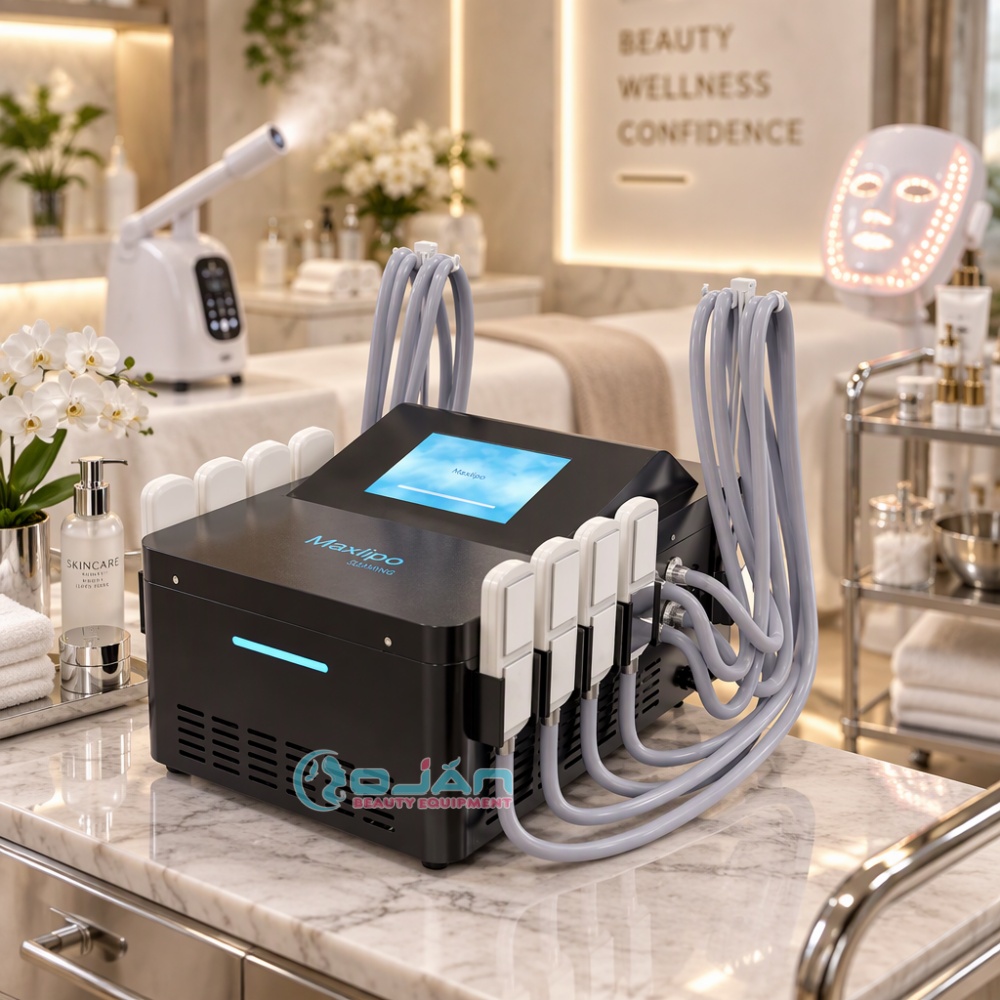
OJAN Beauty’s MX-C16 8-Pad Maxlipo Cryo Slimming System with EMS is a flat-plate, non-vacuum cryolipolysis machine with eight cryo plates. The plates can operate simultaneously or separately. Cooling comes from a semiconductor water-circulation refrigeration system, with a 3.5 L water tank, and the lowest temperature is shown as -10 degrees. No unit or tolerance is given for that figure, so a buyer should ask for it in writing.
Straps hold the handles in place, and an 8-inch colour touchscreen runs the controls. The suggested routine pairs 40 to 50 minutes of cooling with 15 to 20 minutes of EMS. As a cryolipolysis machine with EMS, it adds a muscle-stimulation stage after cooling, but the EMS frequency, plate dimensions, and operating manual are not published. OEM customisation is offered.
Those are specifications, not proof of clinical outcomes, and they don’t change how fat freezing works or what clients should be told. Claims of cell death, painless treatment, and rapid fat elimination are unverified marketing claims, and buyers should not accept them without supporting evidence. Ask for clinical documentation, and request the regulatory papers for your market.

Frequently Asked Questions
How long does it take to see fat-freezing results?
Results appear gradually, usually over a couple of months as the body clears treated fat, and they vary between clients. No timeline should be promised.
What side effects are common after cryolipolysis?
Common side effects include redness, bruising, swelling, discomfort, and skin colour changes, and numbness can last for weeks. Seek advice if you have severe pain, blistering, or a firm, growing area.
Is fat freezing a weight-loss treatment?
No. It targets a localised bulge for contouring. The FDA is clear that non-invasive body contouring does not treat obesity or deliver the health benefits of weight loss.
Can fat freezing make the treated area larger?
Rarely, yes. Paradoxical adipose hyperplasia can enlarge the treated fat, usually months after treatment, and may require surgery. Clients should be told before consenting.
What should a clinic check before buying an eight-pad cryolipolysis machine?
Check cooling consistency, whether pads work independently, temperature monitoring, safety features, maintenance needs, training, and regulatory documents for your market.