

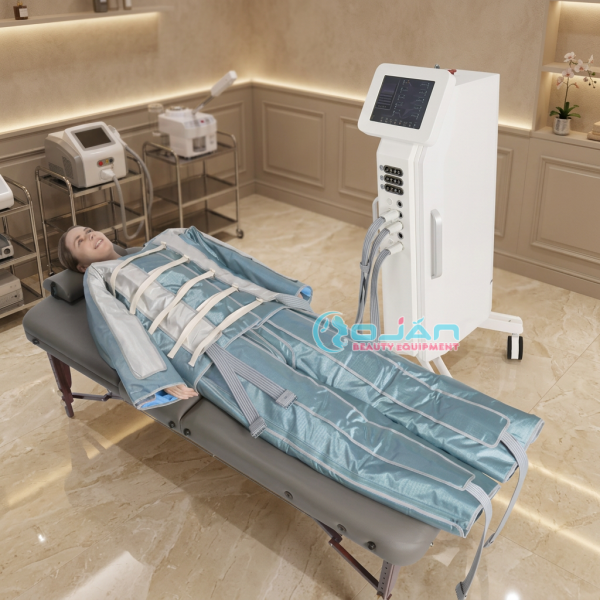
5 Benefits of 3-in-1 Pressotherapy Machines (Backed by Experts)
Clinics find the practical appeal just as strong as the physiological benefits, as one setup handles circulation, fluid movement, recovery, and skin-smoothing goals without shifting the client between different machines. Electrical impulses trigger gentle muscle contractions, warming targeted areas as the suit inflates in a controlled pattern.
That is how a 3-in-1 pressotherapy machine brings three familiar body-treatment methods into one appointment: sequential pneumatic compression, far-infrared heat, and low-frequency electrical muscle stimulation, or EMS. For clients, the session feels active without requiring physical effort. The strongest case for these machines is not dramatic weight-loss language, but the way three well-understood mechanisms can work side by side within a professionally screened, sensibly programmed treatment.
1. More Therapy in the Same Appointment
In treatment rooms where every changeover counts, practitioners save valuable time by building one coherent protocol instead of scheduling separate compression, warming, and muscle-stimulation appointments through combining all three functions. Running compression, heat, and EMS during the same booked session offers clear operational advantages. Controlled muscle contractions occur without requiring client exercise as low-frequency EMS impulses fire.
Meanwhile, far-infrared heat boosts local tissue temperature and promotes vasodilation, enhancing comfort and supporting local blood flow. A wave of pressure travels from the feet or lower limbs toward the body through sequential pneumatic compression, encouraging venous return and directing interstitial fluid upward, so each modality brings a unique purpose to the table.

In practical terms, a combined session can give clinics:
- one setup and one sanitation cycle instead of three;
- a broader treatment experience within a standard appointment window;
- consistent settings that can be documented and repeated.
Clinics offering combined sessions often use systems like the Professional 3 In 1 Pressotherapy Machine | Lymphatic Drainage Air Pressure Suit With EMS & Infrared Therapy For Effective Weight Loss which pairs the three therapies in a single suit.
The value is not that three therapies automatically produce three times the result. It lies in thoughtful coordination. Compression may be the main driver for fluid movement, heat may support comfort and local circulation, and EMS may provide mild neuromuscular activity. A trained practitioner can adjust intensity, temperature, electrode placement, and session length around the client’s goals instead of treating every setting as a maximum.
2. Better Circulation and Oxygen Delivery
Sequential compression does more than create a massage-like sensation. Repeated inflation and deflation changes the pressure around the limbs, helping blood move through the venous system and altering how it behaves at the microscopic level. That is where the circulation claim becomes more concrete.
Research on a series of lower-limb pressotherapy treatments found measurable changes in blood rheology. Red blood cells became more deformable, meaning they could change shape more easily as they passed through narrow capillaries. Blood viscosity and red cell aggregation decreased as well. Those shifts can support microcirculation, since thinner-flowing blood and more flexible cells move through small vessels with less resistance. The review links these changes with improved oxygen delivery to peripheral tissues.

Heat adds a second circulatory mechanism. Local warming encourages blood vessels to widen, increasing blood flow near the treated area. Mechanical pressure can increase endothelial shear stress, the frictional force created as blood moves along vessel walls. That stimulus is associated with nitric oxide release, which supports vasodilation. Together, these effects offer a credible basis for the warm, light feeling many clients describe after treatment.
Pressotherapy does not treat vascular disease and should not be presented as a substitute for medical care. Client screening matters, since a sudden increase in venous return may be unsafe for people with deep vein thrombosis, phlebitis, congestive heart failure, or serious vascular complications.
For suitable clients, the sound claim is improved peripheral circulation during and after the session, with heat and compression working through separate but complementary pathways. That is more accurate than loose language about “detoxing” the body.
3. Less Fluid Retention and Post-Treatment Puffiness
Fluid movement, rather than actual fat loss, is usually the very first change clients notice. Interstitial fluid sits in the spaces between cells and can easily pool when lymphatic return is sluggish, such as after long periods of sitting, hormonal changes, travel, or heavy training. Sequential pneumatic compression addresses this by applying directional pressure, pushing that fluid toward lymphatic collection points and right back into circulation.

A well-designed suit inflates from distal to proximal areas, such as from the feet upward through the legs. That pressure gradient matters. A programmed wave supports one-way movement rather than simply squeezing tissue in place. The technical review describes a chamber sequence that progresses toward the body and helps direct fluid toward lymph nodes.
Clients may notice:
- a lighter feeling in the legs;
- less tightness around the calves or ankles;
- a temporary reduction in visible puffiness;
- clothing or footwear feeling less snug.
Those effects can appear quickly, which is why pressotherapy is often used before events, after travel, or as part of a recovery appointment. The visible change comes mainly from redistribution of retained water and reduced tissue congestion. It should not be sold as rapid fat removal or lasting weight reduction. The source material makes the same distinction, explaining that early changes in weight or measurements are primarily linked to interstitial fluid movement rather than immediate loss of adipose tissue.
Hydration, kidney function, hormone levels, movement habits, and underlying health conditions all affect how long the lighter feeling lasts. Repeated sessions do not replace medical assessment for persistent swelling.
4. Easier Recovery From Exercise-Related Muscle Soreness
Pressotherapy reduces post-exercise muscle soreness, as shown across twelve clinical trials in a systematic review and meta-analysis. Reducing discomfort from delayed-onset muscle soreness, or DOMS, is why sequential compression shows up so often in sports recovery rooms. Moving fluid through worked tissues and supporting venous return, the pressure cycle creates a soothing mechanical stimulus after demanding exercise. Stiff areas can feel far more comfortable with heat added, so low-level EMS brings gentle contractions without heavily loading the muscles.
The same evidence did not show meaningful improvements in immediate performance measures, such as jump height, and did not consistently reduce systemic creatine kinase. People may feel better without recovering measurable strength or performance any faster.

A recovery session may suit:
- recreational clients with heavy legs after training;
- runners, cyclists, and field-sport athletes between sessions;
- clients seeking passive recovery on a rest day;
- people who value reduced soreness more than a performance boost.
The machine should not be framed as a shortcut around rest, nutrition, sleep, or sensible training load. It is better viewed as a comfort and recovery tool. A client may leave feeling less tender and more mobile, yet the muscle still needs time to repair.
Programming matters as well. Excessive pressure on irritated tissue can be unpleasant, and EMS intensity should remain tolerable rather than forcing strong contractions into sore muscles. Heat may need to be reduced for clients who feel inflamed or unusually sensitive after exercise. Used conservatively, the three functions can create a more comfortable recovery appointment without promising changes the evidence does not support.
5. Smoother-Looking Skin With Consistent Use
Although a 3-in-1 pressotherapy machine cannot alter that anatomy in a single session, it can influence several factors that make dimpling look more noticeable. Connective tissue bands, fat-cell structure, local circulation, skin thickness, and fluid trapped within tissues all shape how cellulite appears.
Reductions in local measurements and subcutaneous thickness routinely occur across therapies like mechanical massage, manual lymphatic drainage, and connective tissue manipulation. Much of that visible smoothing stems from lower tissue congestion and reduced pressure around connective tissue bands. Compression drives excess interstitial fluid out of congested tissue to make this happen. Decreasing that swelling relieves outward pressure around the fibrous septa tethering the skin, so the surface ends up looking considerably more even.
Far-infrared heat may support the process by increasing local temperature and blood flow. Warm tissue is more pliable during treatment, and improved perfusion can support normal tissue activity. Compression then supplies the repeated mechanical stimulus. EMS adds mild muscle contraction beneath the treated area, though it should not be described as building the same strength or shape that comes from progressive exercise.
Clinics should describe likely outcomes as a gradual softening in the appearance of dimpling, not removal of cellulite. Setting realistic expectations and committing to a full course of treatments usually brings about longer-lasting cosmetic change, though a single session might reduce puffiness enough to smooth skin briefly. That is why “with consistent use” remains the key phrase.
Skin appearance is influenced by hydration, age, hormones, activity, body composition, and genetics, so responses vary. Photography under the same lighting, distance, posture, and time of day gives a more honest view of progress than casual mirror checks. Good documentation helps clients see modest changes without turning normal skin texture into a medical problem.
Final Thoughts
A 3-in-1 pressotherapy machine earns its place in a clinic through practical treatment design and believable physiology. Compression supports venous return, blood flow, and fluid movement. Far-infrared heat warms tissue and encourages vasodilation. EMS produces controlled contractions that add a mild neuromuscular element. Together, those functions can save treatment-room time, reduce puffiness, ease post-exercise soreness, and support smoother-looking skin over a course of care. The best results come from careful screening, measured settings, and language that stays close to the evidence.