

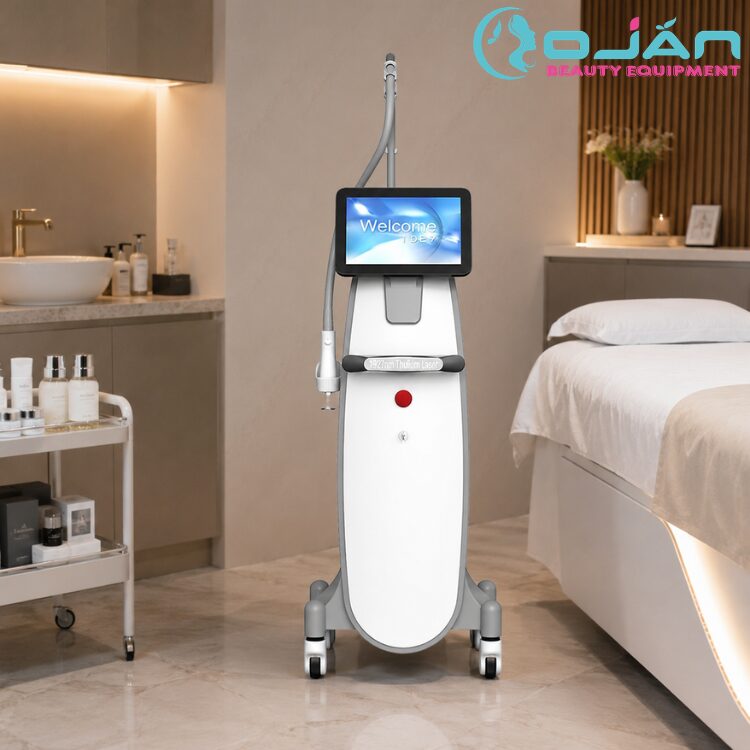
Laser Facial Machine Buying Guide: How To Pick The Right Equipment For Your Salon
Buying a laser facial machine is one of the biggest decisions a salon owner can make. It’s also one of the easiest to get wrong. Prices range from a few thousand dollars for a basic IPL device to nearly twenty thousand for a medical grade CO2 system, and each machine treats a different set of skin concerns. Pick the wrong one, and you’re stuck with equipment your clients don’t want and your staff doesn’t trust.
This guide breaks down the three main laser technologies, explains the science in plain language, and walks through exactly what to check before you spend a single dollar, from certifications to warranty terms to real payback timelines.
The Three Main Types of Laser Facial Equipment

Every laser facial machine on the market today falls into one of three categories. They don’t compete on price so much as on what they treat, which skin tones they’re safe for, and how much downtime a client has to accept afterward.
Diode Laser (808nm): Best for Hair Removal and Light Rejuvenation
The diode laser is the most common machine in salons worldwide, and for good reason. Its 808nm wavelength is absorbed strongly by melanin in hair follicles, but weakly by the water and blood vessels in surrounding skin. That means it destroys the follicle without damaging the tissue around it, a principle called selective photothermolysis.
A single wavelength 808nm diode machine safely treats Fitzpatrick skin types I through IV. Newer triple wavelength models, which combine 755nm, 808nm, and 1064nm in one handpiece, extend safe treatment to type VI skin as well. Many diode machines also include a rejuvenation setting that uses lower energy to stimulate collagen, without the recovery time of more aggressive treatments.
When comparing diode machines, look for a wavelength accuracy within 3nm of the stated 808nm, adjustable energy output between 1 and 120 J/cm², and a pulse width you can tune from 1 to 400 milliseconds. The laser bar itself should be rated for at least 20 million shots. Cooling matters more than most buyers realize. A good system layers water, air, semiconductor, and contact sapphire cooling together. Skip the semiconductor stagemedical-grade, and the machine will overheat during a busy day of back to back bookings.
PRODUCT LINK – Vertical 808nm Diode Laser Hair Removal Machine | Factory Sale Price
IPL (Intense Pulsed Light): The Multi-Purpose Option
IPL isn’t technically a laser at all. It’s a xenon flash lamp that fires broad spectrum light across 400 to 1200nm, then filters that light to target pigmentation, redness, mild acne, or hair follicles depending on the filter used. It’s the closest thing to a Swiss Army knife in aesthetic equipment, which makes it a popular starting point for salons offering their first energy based treatment.
The downside is precision. Because IPL light isn’t a single wavelength, it delivers less targeted energy than a true laser at the same power setting. Clients typically need 8 to 12 sessions for hair reduction with IPL, compared to 6 to 8 with a diode laser. IPL also carries more risk on darker skin tones (Fitzpatrick IV through VI), since the broad spectrum energy is more likely to be absorbed by melanin in the outer skin layer, raising the risk of dark spots afterward.
Where IPL earns its keep is the “lunchtime facial” crowd, clients who want visible improvement with zero downtime and don’t mind committing to a series of sessions. Newer OPT and SHR variants stretch the light pulse into a gentler plateau instead of a sharp spike, which cuts down on the snapping sensation clients used to complain about.
PRODUCT LINK – Hot Sale ND YAG Laser 1064nm/532nm/1320nm | Tattoo Removal Machine
CO2 Fractional Laser: The Gold Standard for Resurfacing
If diode is the workhorse and IPL is the generalist, the CO2 fractional laser is the specialist. It runs at 10,600nm, a wavelength absorbed almost entirely by water, so it vaporizes skin tissue instead of heating it from below. The “fractional” design means it treats the skin in a grid of tiny columns, leaving untouched tissue between them to speed up healing, a major improvement over older fully ablative lasers that required weeks of recovery.
This technology, first described by Harvard’s Dr. R. Rox Anderson and colleague John Parrish, is the reference standard for treating deep acne scarring, pronounced wrinkles, and severe sun damage that doesn’t respond to gentler treatments. A single CO2 session can produce results that several rounds of IPL simply can’t match. The tradeoff is real downtime: 5 to 10 days of redness and peeling, with full healing taking up to two weeks. On darker skin tones, practitioners need to use lower energy settings and space sessions further apart to avoid pigment changes.
CO2 fractional machines require medically trained operators who understand how laser energy interacts with skin at a deeper level, and who can manage client expectations around recovery time. If your clients want visible results without disappearing for a week, a non ablative fractional laser or a well operated IPL machine may serve them better.
PRODUCT LINK – Thulium Laser Beauty Machine | Advanced Fractional CO2 Skin Rejuvenation Equipment
How Laser Light Actually Works On Skin

You don’t need a science degree to buy the right machine, but understanding one idea will save you from expensive mistakes.
In 1983, dermatologists R. Rox Anderson and John Parrish published a landmark paper in the journal Science describing selective photothermolysis, the principle behind nearly every aesthetic laser sold today. The idea: pick a wavelength that your target (a hair follicle, a blood vessel, a patch of pigment) absorbs strongly, deliver it faster than the target can cool down, and you destroy that target while the tissue around it stays safe.
Three variables control how any laser behaves, and you only need to remember these three:
- Wavelength decides depth. Shorter wavelengths stay near the skin’s surface, good for pigment and small vessels. The 808nm diode wavelength reaches the mid dermis where hair follicles live. The 1064nm Nd:YAG wavelength goes even deeper, which is why it’s considered the safest option for darker skin. CO2’s 10,600nm wavelength barely penetrates at all, it vaporizes the surface instead.
- Pulse width decides safety. A pulse shorter than the target’s cooling time keeps the heat contained to just that target. Pigment particles cool in under a microsecond; hair follicles take tens of milliseconds; blood vessels fall somewhere in between. This is why hair removal lasers use millisecond pulses instead of the ultra short pulses used in tattoo removal.
- Fluence decides strength. Measured in joules per square centimeter, fluence controls how strong the treatment effect is, and how much risk comes with it. The goal is always the lowest fluence that still gets results for that client’s skin type and hair color.
Remember this simple rule: wavelength for depth, pulse width for safety, fluence for strength. Every laser machine is just a different combination of those three settings.
Matching the Right Laser Technology to What Your Clients Actually Want
The most common buying mistake salon owners make is purchasing the machine that excites them, instead of the one their clients will actually pay for repeatedly. Before comparing spec sheets, look at your own booking history. What do clients ask for most? What do they request that you currently can’t offer?
| Client’s Main Concern | Best Fit Technology | Typical Sessions | Session Price (USD) | Equipment Cost Range |
| Unwanted facial or body hair | Diode Laser (808nm) | 6 to 8 | $150 to $400 | $3,500 to $7,500 |
| General rejuvenation, multiple concerns | IPL / OPT | 3 to 5 (pigment), 8 to 12 (hair) | $150 to $300 | $2,800 to $5,500 |
| Fine lines, mild texture issues | Non Ablative Fractional | 3 to 5 | $500 to $800 | $5,000 to $12,000 |
| Deep wrinkles, acne scarring | CO2 Fractional | 1 to 3 | $800 to $2,500 | $7,999 to $18,000 |
| Redness, rosacea, visible capillaries | IPL or Pulsed Dye Laser | 3 to 5 | $200 to $500 | $3,000 to $8,000 |
| Tattoo removal, stubborn pigment | Q Switched / Picosecond | 4 to 10 | $200 to $600 | $5,000 to $15,000 |
A simple way to decide: list your top three most requested treatments, find them in the table, and treat that technology as your starting point. Diode hair removal usually offers the fastest payback of any category, typically 8 to 14 months, which is why most salons add it first. Once that machine runs at 60% utilization or higher, it’s time to consider adding a second platform. Many established clinics eventually pair diode with CO2 fractional, which together covers roughly 90% of client demand.
What to Check Before You Buy: Certifications, Build Quality, and Support
Knowing which technology fits your clients is only half the job. You also need to evaluate whether the specific machine in front of you will actually hold up.
Certifications Are Non-Negotiable
A laser device without the right paperwork isn’t just risky. In many markets, it’s illegal to use on paying clients.
- ISO 13485:2016 is the medical device quality management standard. It requires documented risk management, clinical evaluation, and ongoing safety monitoring, a much higher bar than the general ISO 9001 certificate. Ask for the certificate number and check it against the issuing body’s public records.
- CE Marking matters, but not all CE marks are equal. A Class IIb medical CE mark requires review by an independent notified body, while a Class IIa beauty use mark only requires self declaration. Check the four digit notified body number on the European Commission’s NANDO database.
- FDA 510(k) Clearance is required for U.S. sales. Search the FDA’s own database by manufacturer or device name. If the device doesn’t appear, the “FDA cleared” claim is false.
- IEC 60825-1 classifies laser safety levels and determines what eyewear and room protocols are required.
- RoHS and FCC certifications confirm the device avoids hazardous materials and doesn’t interfere with other electronics.
Ask any supplier to send all five certificates before discussing price. A legitimate manufacturer will have them ready instantly.
Build Quality Determines Long-Term Reliability
Paperwork proves a machine passed inspection once. Build quality determines whether it still performs the same after thousands of treatments. Look for manufacturers who inspect 100% of incoming components (not just a sample), run circuit boards through at least 48 hours of burn in testing, and stress test finished units through temperature cycling and vibration testing before shipping. Ask which company supplies the laser diode bars. Reputable names include Coherent, DILAS, and FocusLight. A supplier who won’t name their component source is usually hiding something.
OJAN Beauty, for example, follows this exact standard across its equipment line: 100% incoming component inspection, documented burn in testing, temperature cycling, and full unit verification before any machine ships, backed by ISO 13485, CE, FDA, RoHS, and FCC certification. Whether or not you choose OJAN Beauty, use this level of documentation as your benchmark. If a supplier can’t describe their process with this much detail, that gap usually shows up later in the equipment.
After-Sales Support Matters More Than the Warranty Length
A two year warranty that excludes the handpiece, the most expensive, most used part, is worse than a one year warranty that covers everything. Read the exclusions before you compare numbers. Ask specifically about remote diagnostic support, since a supplier who can troubleshoot over video call resolves most issues without shipping a technician overseas. Request a written spare parts list with lead times, and ask what training is included: video guides, live remote sessions, or on site training during installation.
How to Verify a Manufacturer Before You Pay a Deposit
Supplier badges on marketplace listings prove a company exists. They don’t prove the machines work or the warranty gets honored. Run these six checks before sending any money:
- Check company age. Manufacturers with 10+ years in business have survived market shifts and warranty claims. Verify incorporation dates through official business registries, not website claims.
- Ask for real performance numbers. On time delivery rate above 95% and a customer reorder rate above 25% are strong signals of a stable operation.
- Request a live video factory tour, not a promotional video. Watch for active assembly lines, organized component storage, and visible quality checkpoints.
- Ask for third party test reports from an independent lab such as TÜV, SGS, or Intertek, confirming wavelength accuracy and safety compliance.
- Call two or three customer references in your region who bought similar equipment over a year ago. Ask about reliability and how warranty claims were actually handled.
- Order one unit first. Run it through your full protocol for 30 days on volunteer clients before committing to a larger order.
Calculating the Real Cost of Ownership
The invoice price is only the starting point. A cheaper machine with frequent breakdowns and expensive replacement parts can cost more over three years than a pricier, better built one.
| Cost Element | Budget Machine | Quality Machine |
| Purchase price | $3,500 | $7,500 |
| Handpiece replacement (x2) | $1,200 | $800 |
| Consumables & maintenance | $900 | $450 |
| Downtime losses (3 days/yr vs. 1) | $1,800 | $600 |
| 3 Year Total | $7,400 | $9,350 |
The gap narrows considerably once real running costs are included, and that’s before accounting for cancelled appointments or inconsistent results.
For a realistic diode laser scenario: a $6,000 machine, priced at $180 to $300 per session, booked 8 times a week, generates roughly $7,200 in monthly revenue. After consumables and staff time, net monthly contribution lands near $5,400, meaning the machine pays for itself in under two months. Even at half that booking volume, payback stays under four months. A CO2 fractional machine follows a slower curve, typically 12 to 18 months, but carries a much higher margin per client and adds a treatment competitors may not offer at all.
FAQs About Laser Facial Machine
Diode hair removal is usually the best first purchase. It has the fastest payback period of any laser category and treats the most commonly requested service in most salons.
IPL works, but it typically needs more sessions to reach the same result, around 8 to 12 sessions compared to 6 to 8 with a diode laser, and carries more risk on darker skin tones.
Prices range from about $2,800 for an entry-level IPL device to $18,000 or more for a medical-grade CO2 fractional system, depending on features and certification level.
At minimum, look for ISO 13485, CE marking, FDA 510(k) clearance where applicable, IEC 60825-1 laser safety classification, and RoHS and FCC compliance.
A diode hair removal machine typically breaks even within 2 to 4 months at moderate booking volume. CO2 fractional lasers usually take 12 to 18 months due to higher upfront cost and lower session frequency.
CO2 fractional lasers can be used on darker skin tones, but they require lower energy settings and longer intervals between sessions to reduce the risk of pigment changes.
Most manufacturers recommend replacement every 50,000 to 100,000 shots, or 6 to 12 months, whichever comes first. Check your specific warranty terms.
Getting Your Salon Ready for Launch
Once the machine arrives, run at least 10 full practice sessions on volunteers before booking a single paying client. Use that time to finalize your settings for each skin type, build staff confidence, and catch any equipment quirks early.
Write a standard operating procedure for every treatment: exact settings by skin type, number of passes, pre and post-care instructions, and a clear response plan for adverse reactions. Depending on your location, you may need a certified Laser Safety Officer on staff. Even where it isn’t required, someone should be responsible for matching protective eyewear to the correct wavelength, maintaining warning signage, and logging every session.
Keep a maintenance log from day one: shots fired, error codes, cooling performance. A gradual dip in output energy is an early warning sign, not a sudden failure. And photograph your first 20 clients with consistent lighting and angles. Real before and after results from your own clinic will do more for bookings than any manufacturer’s brochure.