

How Long Does Diode Laser Hair Removal Last Compared to Other Methods?
We’ve all been there. You shave, it grows back in two days. You wax, you get a few weeks of smoothness, and then it’s back. You try threading, epilating, hair removal creams — and the cycle continues indefinitely. So when people talk about diode laser hair removal as a long-term solution, the obvious question is: how long does it actually last?
The short answer is significantly longer than anything else on the market. But let’s go beyond that and look at exactly how each method compares — because the difference is quite dramatic once you see it laid out.
The Hair Removal Methods, Compared
Shaving — Days
Shaving is the most accessible method, but also the most temporary. It cuts hair at the surface of the skin, leaving the follicle completely intact and ready to grow again. Most people see regrowth within 1 to 3 days. Over time, frequent shaving can lead to ingrown hairs, skin irritation, and a rough texture as blunt-cut hairs push back through the skin.
Hair Removal Creams (Depilatory Creams) — Up to a Week
These creams use chemicals to dissolve the hair just below the skin’s surface. Results last slightly longer than shaving — up to a week for some people — but the follicle is untouched, so regrowth is inevitable and often rapid. The chemical ingredients can also irritate sensitive skin with repeated use.
Waxing & Sugaring — 3 to 6 Weeks
Waxing and sugaring pull the hair out from the root, which is why results last considerably longer than surface-level methods. With repeated use, some people notice that hair grows back finer and sparser over time — but the follicle is never permanently damaged, so regrowth always returns.
It’s worth noting that waxing can be painful, especially on sensitive areas, and carries risks of skin redness, irritation, and ingrown hairs. For salons, it also requires consumables with every treatment, which adds ongoing cost.
Threading — 2 to 5 Weeks
Threading removes hair from the follicle, similar to waxing, and is particularly popular for facial hair and eyebrows. Results are precise and last a few weeks, but like waxing, it offers no long-term reduction in hair growth. It’s also limited to small areas and isn’t practical for the body.
Electrolysis — Permanent (But Slow)
Electrolysis is the only hair removal method officially classified as permanent by regulatory bodies. It uses a fine probe inserted into each individual hair follicle to deliver an electric current that destroys the follicle at its root. The results are truly permanent — but the process is extremely time-consuming, as each follicle must be treated individually. For larger body areas, this can mean dozens of sessions spanning months or even years. It’s also typically more painful than laser treatments.
IPL (Intense Pulsed Light) — Semi-Permanent
IPL uses broad-spectrum light to target melanin in the hair follicle. It’s often confused with laser hair removal, but they’re different technologies. IPL emits a wider, less focused spectrum of light, which means it’s less precise and less effective — particularly on finer hair, lighter hair, or darker skin tones. Results can last several months to a couple of years, but most people require top-up sessions more frequently than with diode laser treatment.
IPL works best on people with high contrast between skin tone and hair colour (i.e., fair skin and dark hair). Its effectiveness diminishes significantly outside of that profile.
Diode Laser Hair Removal — Long-Lasting to Permanent
This is where the real difference lies. Diode laser hair removal uses a concentrated, single-wavelength beam of laser light that targets melanin in the hair follicle with precision. The energy is absorbed by the follicle, converted to heat, and that heat damages the follicle’s ability to regrow hair — without harming the surrounding skin tissue.
After a full course of sessions (typically 6 to 8), most people achieve a 70–90% permanent reduction in hair growth. The hair that does remain tends to be significantly finer, lighter, and slower-growing than before. Occasional maintenance sessions once or twice a year can maintain results indefinitely.
The key reason diode laser outperforms other methods is specificity. The laser targets the follicle directly and deeply — reaching into the dermis where the hair bulb sits — rather than simply cutting, pulling, or chemically dissolving the hair shaft.
Why the 808nm Diode Wavelength Is Considered the Gold Standard
Not all laser hair removal machines are created equal. Within laser technology, the 808nm wavelength has become the industry standard for good reason.
At 808nm, the laser penetrates deep enough into the dermis to effectively reach the hair follicle bulb, while being absorbed efficiently by melanin. It threads the needle between being effective enough to damage the follicle and safe enough not to harm the surrounding tissue or the outer skin layer.
This is the technology at the heart of Ojan Beauty’s professional diode laser range. Their High-Quality Diode Laser 755/808/1064nm Machine uses the gold-standard 808nm technology, with energy penetrating deep into the dermis at a rapid 10 pulses per second — heating the hair shaft and follicle thoroughly without destroying the surrounding tissue. It’s clinically proven to deliver safe and effective results across all skin types and hair colours.

High-Quality Diode Laser 755/808/1064nm Machine
Why Three Wavelengths Are Better Than One
Ojan Beauty’s top diode laser machines go a step further by combining three wavelengths in a single system: 755nm, 808nm, and 1064nm. Each targets the hair follicle at a different depth and works best on a different profile:
- 755nm— targets lighter, finer hair with precision
- 808nm— the universal wavelength, effective across most skin and hair types
- 1064nm— ideal for darker skin tones, penetrating deeper while minimising surface heat
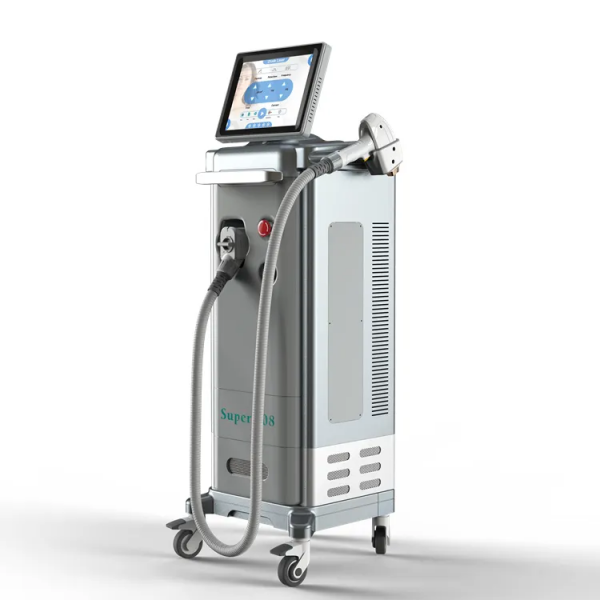
This triple-wavelength approach means one machine can genuinely serve every client who walks through the door, regardless of skin tone or hair type. The Super 808 Triple-Wavelength Diode Laser Machine from Ojan Beauty is built exactly around this principle — combining all three wavelengths to deliver comprehensive, inclusive hair removal results that single-wavelength systems simply can’t match.

Super 808 755/808/1064nm Diode Laser Hair Removal Machine | Beauty Equipment
How Many Sessions Does Diode Laser Take?
Because hair grows in cycles — and the laser is most effective during the active growth phase (anagen) — multiple sessions are needed to catch each follicle at the right moment. The typical protocol is:
- 6 to 8 sessionsspaced 4 to 6 weeks apart for body areas
- 4 to 6 sessionsfor facial areas (which have shorter growth cycles)
- Annual or biannual top-upsto address any minor regrowth from follicles that weren’t fully disabled
After completing a full course, the majority of clients experience a dramatic, lasting reduction. Many report being virtually hair-free on treated areas for years without maintenance.
Who Is Diode Laser Most Effective For?
Diode laser works best on people with darker hair, as melanin is the target — more pigment means the laser has more to absorb. However, modern machines like those in the Ojan Beauty range include advanced cooling systems and adjustable energy settings that make treatments safe and effective across a wide range of skin tones, including darker complexions (using the 1064nm wavelength).
The one profile where laser hair removal is less effective is very light, blonde, grey, or red hair, which has less melanin. For these cases, electrolysis may be a more suitable long-term option.
The Comfort Factor
One concern people often have about laser hair removal is pain. Modern diode laser machines have come a long way. Ojan Beauty’s professional machines feature built-in cooling systems that actively protect the skin’s surface during treatment, significantly reducing discomfort. Most clients describe the sensation as a mild snapping or warmth — far more tolerable than waxing for most people, and notably more comfortable than electrolysis.
The high-power output of professional machines (ranging from 600W to over 2000W depending on the model) also means sessions are faster than older laser systems — a full leg treatment, for example, can be completed in under an hour.
Why Ojan Beauty for Professional Diode Laser?
Ojan Beauty has been manufacturing professional-grade beauty equipment since 2010, holding certifications including FDA, CE, ISO 13485, and RoHS. Their diode laser range is built for clinical performance — combining proven 808nm technology, triple-wavelength flexibility, advanced cooling, and user-friendly controls in machines designed for high-volume professional use.
Whether you’re equipping a medical spa, a beauty clinic, or a high-end salon, their diode laser machines are available at factory-direct pricing with OEM customisation available. Explore the full range at the Ojan Beauty Diode Laser Hair Removal collection.
The Bottom Line
If you’re looking for a method that genuinely reduces hair growth over time rather than managing it indefinitely, diode laser hair removal is the clear frontrunner. It’s the only approach that combines clinical effectiveness, speed, comfort, and lasting results in a way that works across skin and hair types.
For salons and clinics investing in the right equipment, it’s also one of the most profitable and client-retaining services available in the market today.