

Can Vibration and Roller Massage Really Help Improve the Look of Cellulite?
Can a machine that just rolls and vibrates over skin actually change how cellulite looks? It’s a fair question, especially for a business considering equipment that doesn’t heat, suction, or inject anything into the treated area.
The honest answer sits between two extremes. A roller machine isn’t a gimmick, and it isn’t a cure. Understanding what roller massage for cellulite can and can’t do is the difference between a service that keeps clients coming back and one that oversells its results from day one.

Why Is Cellulite So Difficult to Improve?
Cellulite isn’t only about the amount of fat under the skin. Bands of connective tissue run between the skin and the muscle underneath, anchoring the skin down at certain points while fat sits around them. That uneven pull is what creates the dimpled, quilted look, and it’s why cellulite can show up on people at almost any body weight.
Because that underlying structure doesn’t change quickly, no external treatment reshapes those connective bands in a single session, and in most cases it doesn’t reshape them at all. What a treatment can influence is the fluid, circulation, and skin surface around that structure, which is where mechanical roller body contouring comes in.
Skin thickness and elasticity play a role too, which is part of why cellulite becomes more visible with age for a lot of people, independent of body weight. That’s also why roller massage for cellulite gets requested by clients who have already tried diet and exercise changes without seeing the dimpled texture improve. The structure driving cellulite generally doesn’t respond much to weight loss alone.
What Can Mechanical Roller Massage Actually Change?
A roller head moving across skin does real, measurable things: it moves tissue, supports local circulation, and helps clear fluid that has built up in the area. That combination is generally associated with a smoother, less puffy appearance in the treated area, at least for a period after the session.
Outcomes vary from person to person and depend heavily on consistency. A single session tends to produce a short-lived change. A course of regular sessions is more likely to produce a visible difference that holds for longer, though how long depends on the individual, their skin, and how the treatment is maintained afterward.
A typical session moves the roller head across the treatment area in overlapping passes, usually for 10 to 20 minutes depending on the area and the client’s tolerance. Pressure and speed are generally adjusted as the session goes, rather than run at one fixed setting throughout, since tissue response can change even within a single appointment.
Does Vibration Add Anything to Roller Massage?
Rotation on its own is a repeated, directional motion: a roller head turning against the skin in one pattern or another. Vibration adds constant, rapid movement on top of that, which changes the sensation and can reach tissue a purely rotating head might pass over more lightly.
For a business, that difference usually shows up in which areas each mechanism suits best. A vibration roller cellulite treatment tends to work well across larger body areas like the thighs, abdomen, and back, where broader, sustained stimulation is useful. Rotation-driven heads are often better suited to smaller, more precise areas, which is part of why a machine offering both functions can cover more of a treatment menu than a single-function machine.
That split also affects how a business schedules its day. A clinic offering roller massage for cellulite across several larger areas needs the vibration function running for most of its bookings. A smaller share of appointments, facial work or spot treatment, calls for the rotation heads instead.
Can Roller Treatments Really Improve the Look of Cellulite?
“Improve” is doing a lot of work in that question, and it’s worth being precise about what it means here. Roller massage for cellulite can support a smoother, less dimpled appearance for a period of time. It does not remove cellulite, and no honest business should describe it that way.
Results depend heavily on consistency and the individual client. Some people notice a visible difference after a handful of sessions; others need a longer course, and some see a more modest change no matter how closely they follow the protocol. Setting that expectation before treatment starts protects the business as much as it protects the client.
Vibration Rollers vs. Rotation Heads: Where Each One Fits
| Vibration Rollers | Rotation Heads | |
| Movement | Continuous vibration along a rolling axis | Directional rotation: clockwise, counterclockwise, or alternating |
| Typical use | Larger body areas: thighs, abdomen, back, arms | Smaller, more precise areas: face, neck, targeted spots |
| Practical advantage | Broader, sustained stimulation across bigger surfaces | More controlled, targeted pressure and pattern |
| Treatment focus | Circulation-focused cellulite body contouring treatment passes | Detail work and facial or small-area massage |
Neither mechanism replaces the other outright. They suit different parts of the same treatment menu, which is why some machines are built to offer both rather than making a business choose.

What Should a Business Look for in a Roller Body-Contouring Machine?
These points matter most when evaluating a machine built for roller massage for cellulite and general body-contouring work, whether for a clinic’s own use or a distributor catalog.
- Roller-head selection. Interchangeable heads in different shapes and textures let staff match intensity and feel to the treatment area and client tolerance.
- Speed and directional control. Adjustable speed and rotation pattern give an operator room to tailor a session rather than running one fixed setting for every client.
- Timer. A wide, programmable timer range supports both quick facial passes and longer body sessions from the same console.
- Ergonomics. Handle weight and grip affect how comfortable a treatment is for staff running back-to-back appointments.
- Body and facial versatility. A machine that covers both areas extends a service menu without a second equipment purchase.
- Cleaning and maintenance. Roller heads that are easy to remove and sanitize matter for daily, multi-client use.
- OEM/ODM support. For distributors and resellers, private-label availability can matter as much as the underlying mechanism.
Why the Cellusphere EN6-2S Takes a Different Approach
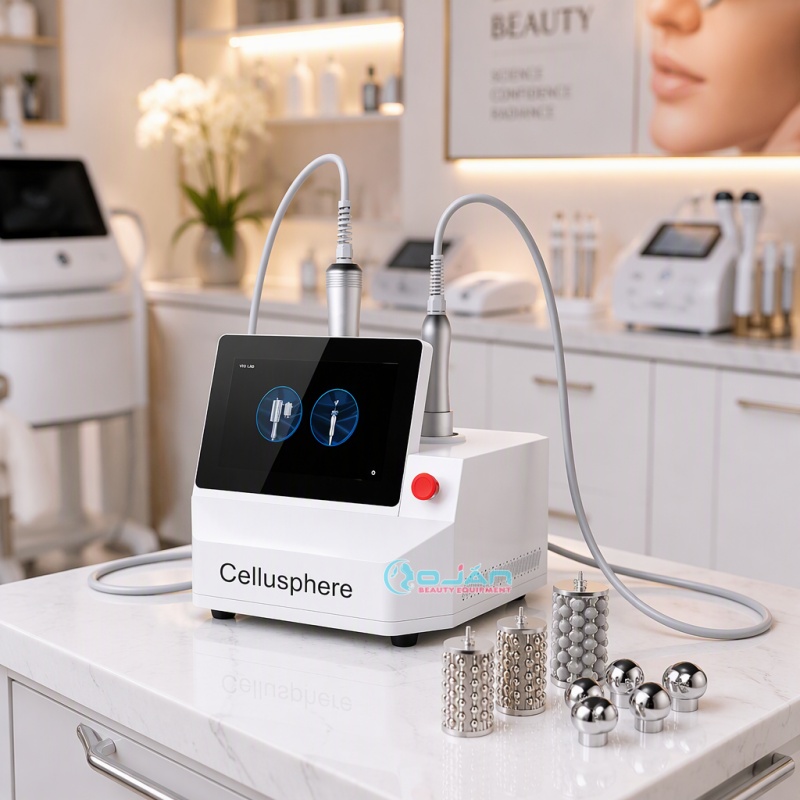
Cellusphere EN6-2S pairs a large vibration handle with a small rotation handle on one touchscreen console. Together they cover vibration body contouring on larger areas and detail work on the face and neck, without a second machine. Seven interchangeable roller heads span four large-handle styles and three small-handle heads, so staff can match texture and intensity to the area and the client without extra sourcing.
The console runs three rotation patterns, clockwise, counterclockwise, and alternating, with a 5 to 30 second adjustable interval, alongside 10-step speed control and a 1 to 99 minute timer. Separate Body Care and Face Care modes switch the interface to match the handle in use, so staff aren’t reconfiguring settings between a body pass and a facial treatment.

The large-handle roller heads also carry built-in LED illumination, a detail clients notice during a body pass. The system runs on a wide AC100-240V power range at 50/60Hz with a draw of 135VA or less, so it plugs in without a separate transformer across most markets. It also sits on a 4-caster rolling trolley for moving between treatment rooms.
For a distributor building a body-contouring equipment line, the EN6-2S gives clinics a dedicated roller massage for cellulite option and a facial or detail-work option in the same purchase, rather than two separate machines. OJAN Beauty offers the EN6-2S factory-direct with OEM and ODM branding, custom packaging, and flexible minimum order quantities. For more on what’s actually happening underneath the skin, see OJAN Beauty’s guide to cellulite and shockwave therapy.
FAQs
Can roller massage reduce the appearance of cellulite?
Yes, to a degree. Roller massage for cellulite can support a smoother, less dimpled appearance for a period of time, generally through improved circulation and fluid movement in the treated area. It doesn’t reduce the underlying connective tissue structure that causes cellulite, and results vary by person and depend on consistent sessions.
Does vibration help cellulite?
Vibration adds continuous mechanical stimulation on top of rolling movement, which many businesses use for broader body areas like the thighs and abdomen. It works alongside rotation rather than replacing it, and like any mechanical treatment, its effect on appearance is temporary and varies by individual.
How does a body roller massage machine work?
A motorized handle drives a roller head across the skin, either through vibration along a rolling axis or through directional rotation. The mechanical movement manipulates tissue and supports circulation and fluid movement in the treated area, similar in principle to manual massage but delivered consistently by a machine.
Is mechanical roller massage the same as cellulite treatment?
Not exactly. Mechanical roller massage is one type of cellulite body contouring treatment, focused on tissue movement and circulation rather than fat reduction or a change to the connective tissue structure that causes cellulite. It’s often used alongside other services rather than as a standalone solution.
What should a salon look for in a body roller machine?
Interchangeable roller heads, adjustable speed and rotation direction, a flexible timer, comfortable ergonomics for staff, body and facial versatility, easy cleaning between clients, and the OEM or private-label options a manufacturer offers.