

Shockwave Therapy for Cellulite: Does It Actually Work?
Cellulite isn’t excess fat. It’s tension. Underneath the dimpled skin on a thigh or a glute, tough fibrous bands called septae are pulling the skin down at fixed points while fat pushes up around them, and that push-pull is what creates the dimpled, quilted texture people spend years trying to smooth away.
That distinction matters, because it explains why some treatments fail completely: they attack the fat, not the tension pulling on the skin. Shockwave therapy takes a different approach, and there’s now a real body of clinical research testing whether that approach actually holds up. Here’s what the evidence shows, honestly, along with where it falls short.
What Cellulite Actually Is, Mechanically
Cellulite forms because of the specific architecture of fat and connective tissue beneath female skin. Fibrous septae run vertically from the deeper tissue layer up to the underside of the skin, anchoring it in place. Between those anchor points, fat cells expand and push upward. Where the septae pull down and the fat pushes up, you get a dimple. Where there’s no anchor, the skin stays smooth.
This is why cellulite shows up on people at every body weight, and why losing weight alone doesn’t necessarily fix it. The problem isn’t just how much fat is there. It’s the rigid connective tissue holding the skin down unevenly around it.
How Shockwave Therapy Targets That Structure
Shockwave, or acoustic wave therapy, delivers rapid mechanical pulses (a sharp spike in pressure followed by a brief negative pressure phase) directly into the treated tissue. Unlike heat-based treatments that work by raising tissue temperature, shockwave works mechanically, through vibration and pressure.
That mechanical action does a few specific things to the tissue responsible for cellulite’s appearance:
- Softens and stretches rigid septae. The repeated mechanical pulses loosen the fibrous bands that are pulling the skin down at fixed points, reducing the tension that creates visible dimpling.
- Improves local circulation. The pressure waves stimulate blood vessel formation and increase nutrient delivery to the treated area, supporting the tissue’s own repair processes.
- Stimulates collagen production. Mechanical stress on the dermis triggers new collagen synthesis over time, which thickens and firms the skin from within, making it more resistant to the dimpling effect even after treatment ends.
- Supports lymphatic drainage. Better circulation and reduced tissue rigidity make it easier for the body to clear excess fluid and metabolic byproducts from the treated area.
None of this breaks down fat directly the way cavitation or cryolipolysis does. Shockwave’s real target is the structural tension in the skin, which is precisely why it’s positioned as a texture and firmness treatment rather than a fat-reduction one.
What the Clinical Evidence Actually Shows
This is the part most cellulite treatments skip past, so it’s worth being direct about what’s actually been tested and what the results were.
A placebo-controlled, double-blinded, randomized trial on acoustic wave therapy found measurable improvement in dimple number and depth, skin firmness, and body circumference in the treated group compared to placebo, with results holding up at both the one-month and three-month follow-ups. A separate open-label trial involving 30 women with moderate to severe cellulite ran 12 sessions over six weeks and tracked outcomes using the Cellulite Severity Scale, circumference measurements, and even MRI imaging of subcutaneous fat thickness, alongside patient-reported quality-of-life scores.
Elsewhere, research published in Lasers in Surgery and Medicine found that a large majority of treated areas achieved at least a measurable improvement on standardized cellulite severity scales, and independent, blinded reviewers correctly identified before-and-after photos with a high degree of accuracy, which matters because it shows the improvement was visible to outside observers, not just something patients wanted to believe they saw.
That’s a genuinely stronger evidence base than most non-invasive cellulite treatments can claim. It’s not a cure, and it’s not permanent without maintenance, but the placebo-controlled data specifically is the kind of result that’s hard to dismiss as marketing.
Where the Evidence Has Limits
Being fair to the research also means being honest about its boundaries. Most published trials use relatively small sample sizes, commonly in the range of 15 to 30 participants, which is enough to establish a genuine effect but not enough to fully characterize how results vary across different skin types, ages, or cellulite severities. Results are also not permanent. Like most non-surgical body contouring treatments, shockwave’s benefits fade over months without periodic maintenance sessions, since the underlying tendency toward fibrous septae formation doesn’t disappear.
It’s also not a fat-loss treatment, and clinics that market it that way are setting clients up for disappointment. The clinical improvements documented in these studies are in skin texture, dimple depth, and firmness, not significant reductions in body fat.
How Many Sessions It Actually Takes
Across the published protocols, a consistent pattern shows up: single sessions produce minimal visible change, but a course of 6 to 12 sessions, typically spaced once or twice a week, produces measurable, photographable improvement. Most studies measured outcomes at the one-month and three-month marks after the final session, not immediately afterward, which mirrors the pattern seen in other body contouring treatments where the body needs time to respond and remodel tissue.
How It Compares to Other Cellulite Treatments
Cellulite treatments generally fall into a few categories, and it’s worth placing shockwave alongside them rather than in isolation. Topical creams and massage-based treatments can produce temporary, cosmetic improvement by moving fluid and briefly plumping skin, but they don’t address the septae causing the dimpling and their effects fade within hours to days. Subcision procedures physically cut the fibrous bands and tend to produce more dramatic, longer-lasting results, but they’re invasive, involve downtime, and carry the risks that come with any minor surgical procedure.
Shockwave sits in the middle of that spectrum. It’s non-invasive, requires no anesthesia or downtime, and the effect on the septae, while mechanical rather than surgical, is real enough to show up on independently reviewed photography and standardized severity scales. It won’t match the magnitude of a surgical subcision, but it also doesn’t carry that procedure’s risk or recovery time, which is why it’s often positioned as a middle-ground option for people who want measurable improvement without going under a blade.
Many clinics also combine shockwave with radiofrequency or other heat-based technologies in the same session, on the logic that shockwave loosens the fibrous structure mechanically while RF adds a thermal collagen-stimulating effect on top. That combination approach is part of why several of the machines built for this indication pair shockwave with RF modes rather than shipping it as a standalone technology.
Ojan Beauty’s Shockwave Therapy Machines
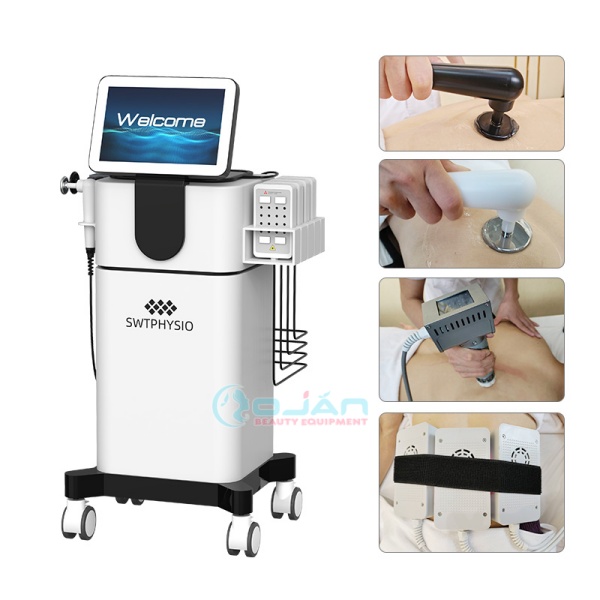
Because shockwave’s actual effect depends on delivering consistent, well-calibrated mechanical energy into the tissue, the equipment a clinic uses has a direct bearing on outcomes. Here are two shockwave systems from Ojan Beauty relevant to cellulite treatment.
1. 5 In 1 Multifunctional ShockWave +448Khz RET CET+ EMS+ Lipo Laser Body Slimming Machine
This system pairs core shockwave therapy, delivered at up to 240W across a 1Hz to 16Hz frequency range, with 448kHz radiofrequency in both CET and RET modes, EMS muscle stimulation, and lipo laser. The shockwave component is described as effective for reducing cellulite, tightening, and smoothing skin, either as a standalone application or layered with the machine’s other modalities to accelerate results. The RET mode specifically targets body shape and cellulite concerns on the legs alongside lymphatic drainage support, giving clinics a way to combine the structural benefits of shockwave with complementary heat-based collagen stimulation in the same session.
View the 5 In 1 Multifunctional ShockWave Body Slimming Machine

2. 2 In 1 Shockwave Therapy Equipment & Extracorporeal Shockwave Therapy Machine
This model combines a dedicated shockwave handle with a separate therapeutic ultrasound handle on one 10.4-inch touchscreen system. It runs at 6 bar shockwave pressure alongside 3MHz ultrasound, and its function list explicitly includes fat reduction alongside its core use in treating chronic musculoskeletal pain. For clinics that want a straightforward, dual-modality shockwave device without the added complexity of a full multi-technology platform, this is a more focused option.
View the 2 In 1 Shockwave Therapy Equipment Machine
The Bottom Line
Shockwave therapy for cellulite has something a lot of aesthetic treatments don’t: placebo-controlled clinical trials showing real, measurable, independently verified improvement in skin texture, dimpling, and firmness. It works by mechanically loosening the fibrous septae responsible for cellulite’s dimpled appearance and stimulating the skin’s own collagen response, not by melting fat. The honest answer to “does it work” is yes, with real evidence behind it, but only as part of a full course of sessions, only for texture and firmness rather than fat loss, and only with realistic expectations about needing maintenance over time.


