

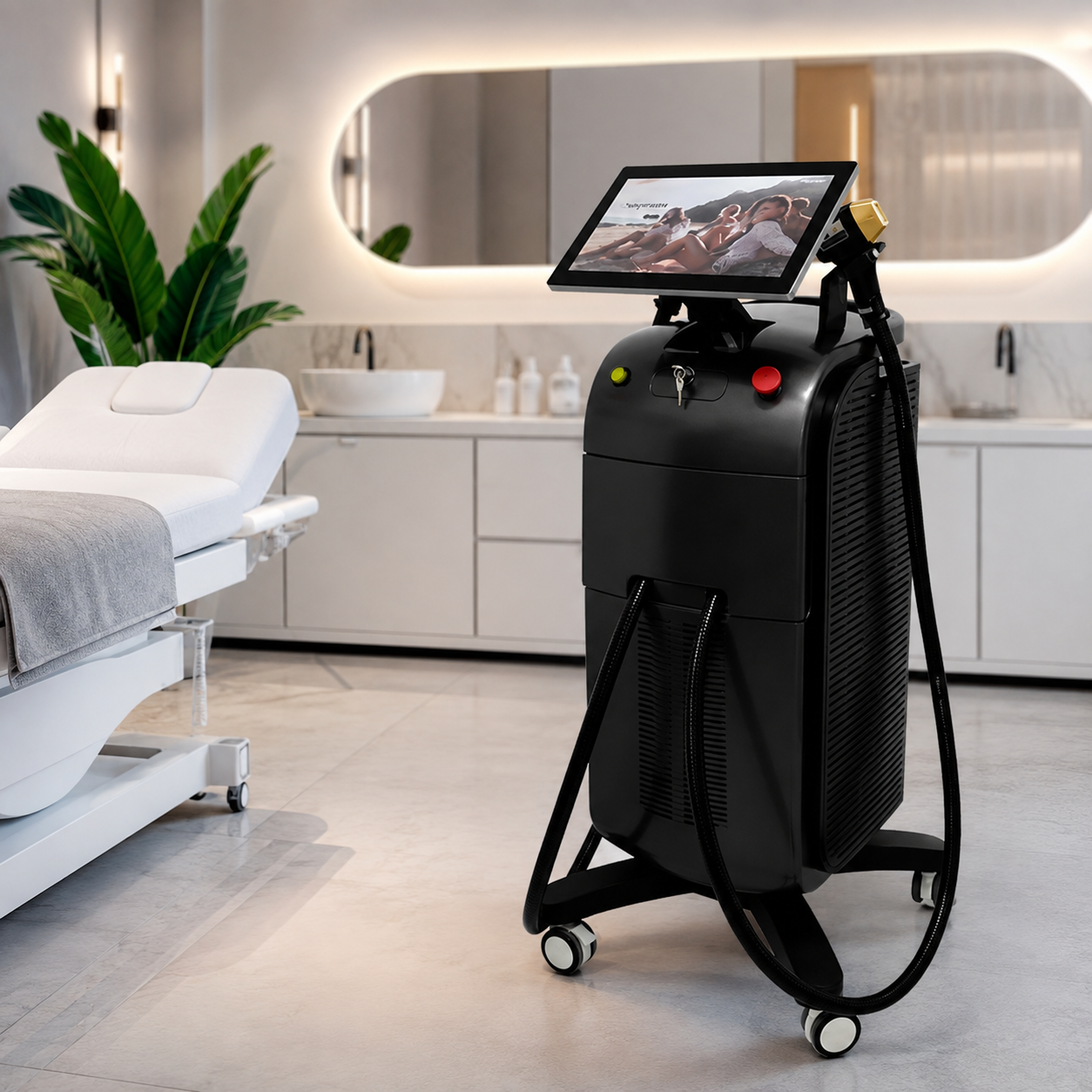
Diode Laser Explained: How It Works, Why It’s The Gold Standard, And What Buyers Need To Know (2026 Guide)
A diode laser is a type of medical laser that uses semiconductor technology to produce a beam of light in the 800 to 810 nanometer (nm) range. In hair removal, this light targets melanin, the pigment in hair, and turns it into heat that disables the hair follicle. It’s the most widely used laser wavelength in the aesthetic industry today, and for good reason, it balances safety, comfort, and results better than most other laser types.
This guide is written for two audiences. If you’re a patient or aesthetician, you’ll get a clear, science-backed explanation of how diode lasers work and what to expect from treatment. If you’re a clinic owner, distributor, or importer, you’ll also find a practical breakdown of what to look for in a diode laser machine before you buy one.
At Ojan Beauty, we’ve manufactured and exported diode laser hair removal machines to salons, clinics, and distributors across the USA, Europe, and the Middle East since 2008. Everything below reflects what we’ve learned from that experience, combined with published clinical research.
How Does a Diode Laser Work?

A diode laser works through a process called selective photothermolysis, a term first described by Harvard dermatologists Rox Anderson and John Parrish in a landmark 1983 study published in Science.¹ In simple terms, it means the laser is tuned to a wavelength that a specific target (in this case, melanin) absorbs strongly, while the surrounding skin absorbs very little.
Here’s what happens step by step:
- The laser handpiece emits light at roughly 800 to 810nm.
- Melanin inside the hair shaft and follicle absorbs this light.
- The absorbed light converts into heat within a few milliseconds.
- The heat damages the follicle’s stem cells, stopping or slowing future hair growth.
- Surrounding skin, which contains far less melanin, stays largely unaffected.
Most modern Diode Laser Machines pair this process with a cooling system, usually a sapphire or contact-cooled tip, that keeps the skin surface cold before, during, and after each pulse. This is what makes today’s diode treatments far more comfortable than older laser generations from the 1990s and early 2000s.
Why the 800 to 810nm Wavelength Specifically?
Melanin absorbs light strongly across a range of wavelengths, but the 800 to 810nm band offers the best combination of two things: strong melanin absorption and deep penetration into the skin. Shorter wavelengths, like the 755nm Alexandrite, absorb melanin even more strongly, but they don’t penetrate as deep and carry a higher risk on darker skin. Longer wavelengths, like the 1064nm Nd:YAG, penetrate deeper but absorb melanin more weakly, which can mean less effective treatment on fine or lighter hair. Diode sits in the middle, which is exactly why it became the industry’s default choice.
The Hair Growth Cycle: Why You Need More Than One Session

No laser removes hair permanently in a single visit, and this isn’t a limitation of the equipment. It’s biology. Every hair on your body cycles through three phases, and a laser can only disable a follicle that’s actively growing.
- Anagen (growth phase): The follicle is deep, active, and packed with melanin. This is the only phase where a laser can effectively destroy it. At any given time, only about 10 to 30% of hairs on a treated area are in this phase.
- Catagen (transition phase): The follicle starts shrinking and detaching from its blood supply. Melanin drops, so the laser has little to target.
- Telogen (resting phase): The hair is dormant or shedding. There’s almost no melanin present, so the laser has no effect.
Because hairs cycle through these phases independently of each other, clinics space diode laser sessions 4 to 6 weeks apart. This interval gives dormant follicles time to re-enter the growth phase, so each session catches a fresh batch of hairs. A published network meta-analysis of 13 randomized controlled trials found that diode laser produced a statistically significant reduction in hair count at both the 3-month and 6-month follow-up marks compared to untreated control areas.²
Diode Laser Vs. Other Hair Removal Technologies
Patients often ask which laser is “best.” The honest answer is that no single laser wins in every category. Each wavelength trades off effectiveness, safety, and comfort differently depending on skin tone and hair color.
| Technology | Wavelength | Best For | Key Limitation |
|---|---|---|---|
| IPL (Intense Pulsed Light) | Broad spectrum, 500 to 1200nm | Fair skin, dark hair, budget treatments | Not a true laser; less precise, more sessions needed |
| Alexandrite | 755nm | Fair to light-medium skin, fine-to-medium hair | Higher risk of burns/pigment changes on darker skin |
| Diode | 800 to 810nm | Fair to moderately dark skin (Fitzpatrick I to V), most hair colors | Less effective on very light, grey, or red hair |
| Nd:YAG | 1064nm | Darker skin tones (Fitzpatrick V to VI), deep-rooted coarse hair | Weaker melanin absorption; may need higher energy |
| Triple/Multi-Wavelength Diode | 755nm + 808nm + 1064nm combined | All skin tones and hair types in one machine | Higher upfront machine cost |
Is Diode Laser Better Than IPL?
Generally, yes, for consistency and long-term results. IPL uses unfiltered, broad-spectrum light, which scatters energy across many wavelengths instead of concentrating it precisely on melanin. A true diode laser delivers a single, focused wavelength, which typically means fewer sessions and more predictable outcomes, though IPL machines usually cost less upfront.
Is Diode Laser Safe for Dark Skin Tones?
Yes, when the correct wavelength and settings are used. Diode lasers absorb less energy from surrounding skin pigment compared to shorter-wavelength lasers like Alexandrite, which lowers the risk of post-inflammatory hyperpigmentation (PIH), a common concern for Fitzpatrick skin types IV to VI. Many modern clinics now use dual- or triple-wavelength diode machines that add a 1064nm mode specifically to increase safety margins on deeper skin tones.
Benefits Of Diode Laser Treatment

- High, evidence-backed efficacy. A 2023 meta-analysis of randomized trials found diode laser achieved measurable, statistically significant hair reduction compared with control groups at both 3-month and 6-month checkpoints.²
- Works on a wide range of skin tones. Fitzpatrick I to V patients can generally be treated safely with proper settings.
- Faster sessions. Larger spot sizes and higher repetition rates let practitioners cover large areas like legs or backs quickly.
- Improved comfort. Integrated cooling systems substantially reduce the sting associated with older laser generations.
- Fewer sessions than IPL. Because the wavelength is concentrated rather than scattered, most patients need fewer total visits.
Limitations to Know Before You Start

- Not effective on white, grey, or red hair. These colors contain too little melanin for any laser (not just diode) to target reliably.
- Requires a full treatment course. Expect 6 to 8 sessions on average, spaced 4 to 6 weeks apart, based on clinical hair-cycle data.
- Temporary side effects are possible. Redness, mild swelling, and follicular bumps are common and usually resolve within a day or two.
- Rare but real risks. Burns, blistering, or pigment changes can occur, almost always linked to incorrect energy settings or an inexperienced operator rather than the technology itself.
What Happens During a Diode Laser Session?

Before treatment: The area is shaved 24 to 48 hours in advance (hair above the skin surface can burn and reduce effectiveness). Sun exposure and tanning should be avoided for at least one to two weeks beforehand, since tanned skin increases the risk of pigment-related side effects.
During treatment: The practitioner applies the handpiece directly to the skin. Most patients describe the sensation as a warm pinch or a light rubber-band snap, especially with modern cooling systems running. Session length depends on the area. Underarms typically take 10 to 15 minutes, while full legs can take 45 to 60 minutes.
After treatment: Mild redness and follicular swelling are normal and usually fade within 24 to 48 hours. Sunscreen (SPF 30+) is essential on the treated area for at least two weeks, and patients are usually told to avoid hot showers, exfoliation, and swimming for a day.
How to Choose a Diode Laser Machine (For Clinics, Salons & Buyers)

If you’re evaluating equipment rather than treatment, the questions change. Here’s what actually separates a reliable diode laser machine from a poor one, based on what we assess for buyers every day.
Technical Specifications That Matter
- Wavelength configuration: Single (808nm), dual (808nm + 1064nm), or triple (755nm + 808nm + 1064nm). Triple-wavelength machines cost more but treat a wider range of skin and hair combinations without switching devices.
- Maximum fluence (J/cm²): Higher available energy gives practitioners more flexibility for coarse or deep-rooted hair, but it must be paired with strong cooling.
- Spot size: Larger spot sizes (12mm and above) treat bigger areas faster, which matters for clinic throughput.
- Cooling system type: Semiconductor refrigeration and sapphire contact cooling are currently the most reliable comfort technologies.
- Diode bar lifespan: Ask for the rated shot count (commonly 10 to 50 million shots). This affects the long-term cost of ownership.
Certifications To Verify
Before importing or reselling any diode laser machine, confirm it carries recognized safety and quality certifications: CE marking (EU conformity), FDA 510(k) clearance or listing (for the US market), and ISO 13485 (medical device quality management). These aren’t just paperwork. They’re what your customers and regulators will ask for, and they protect your business from compliance issues down the line.
OEM/ODM And Private Labeling for Distributors
Many resellers and clinic chains prefer to sell equipment under their own brand. A good manufacturer will offer OEM/ODM services, custom logos, packaging, and even control-panel branding, with reasonable minimum order quantities. This is standard practice for established suppliers and worth asking about directly.
Sourcing And Import Logistics
Diode laser machines are typically shipped by air (DHL, UPS, FedEx) for smaller orders or by sea freight for bulk container orders. Buyers should factor in import duties, required certifications for their destination country, and after-sales support (spare parts, training materials, warranty terms) before finalizing a supplier.
Ojan Beauty’s Triple-Wavelength Diode Laser Machines
Since the biggest buyer question is almost always “which wavelength configuration should I stock,” it’s worth showing what a well-specced triple-wavelength diode machine actually looks like on paper. All four models below combine 755nm (fine/light hair), 808nm (the gold-standard wavelength for most hair types), and 1064nm (darker, tanned skin) in a single handpiece system, but they differ in spot size, power, and cooling architecture:
| Model | Wavelengths | Spot Size | Laser Power | Cooling System | Notable Feature |
|---|---|---|---|---|---|
| MX-96 Diode Laser 755/808/1064 | 755nm, 808nm, 1064nm | Standard | High average power, 10 pulses/sec | Sapphire Dual-Chill contact cooling | Fast repetition rate for larger treatment areas |
| MX-A40 3-Wavelength Diode Laser | 755nm, 808nm, 1064nm | 12×18mm | 500W | Semiconductor + water + air, constant-temperature | Rated for 10 million shots; 10.4-inch true color screen |
| MX-100 Professional 3-Wavelength Diode Laser | 755nm, 808nm, 1064nm | Up to 25×31mm | 500W | TEC + sapphire contact cooling | “IN-Motion” mode for 10 shots/second body treatments |
| MX-99 Alexandrite-Style 3-Wavelength Diode Laser | 755nm, 808nm, 1064nm | 12×24mm | 600W (6-bar, customizable) | Semiconductor + water + air cooling | Adjustable energy up to 30 J/cm²; includes skin rejuvenation mod |
A few things stand out when you compare them side by side. The MX-A40 and MX-100 are built for high-volume clinics that need to move fast between clients, with large spot sizes and rapid repetition rates. The MX-99 offers the widest adjustable energy range (1 to 30 J/cm²), which gives practitioners more flexibility for coarse or stubborn hair, plus an added skin rejuvenation function. All four use some form of constant-temperature cooling, which matters more than most buyers realize: air-and-water-only cooling systems typically max out at 2 to 3 hours of continuous use, while semiconductor and TEC-based systems are built for 24-hour clinic operation without overheating the handpiece.
For resellers and importers, all four machines are available with OEM/ODM branding and factory pricing, which means you can put your own logo and packaging on proven hardware rather than developing a device from scratch.
FAQs About Diode Laser
No laser makes hair removal 100% permanent. Diode laser produces long-term hair reduction. Most patients see significantly less regrowth, and remaining hair tends to be finer and lighter. Maintenance sessions once or twice a year are common.
Most patients need 6 to 8 sessions spaced 4 to 6 weeks apart, based on the natural hair growth cycle. The exact number depends on the treatment area, hair thickness, and hormonal factors.
Most people describe it as a warm pinching or snapping sensation rather than sharp pain. Machines with integrated contact cooling significantly reduce discomfort compared to older laser systems.
Both can be used safely on darker skin when configured correctly, but Nd:YAG (1064nm) generally carries a lower pigment-related risk on very dark skin (Fitzpatrick V to VI) because it absorbs less energy from surrounding skin pigment. Many modern diode machines, including triple-wavelength models, now include a 1064nm mode to close this gap.
Look for CE marking, FDA 510(k) clearance or listing for the US market, and ISO 13485 certification for medical device manufacturing. These confirm the machine meets recognized safety and quality standards.
The Bottom Line
Diode laser technology earned its place as the industry standard because it does something few aesthetic technologies manage: it balances real, clinically proven hair reduction with a strong safety profile across a wide range of skin tones. It isn’t a one-time fix. It works with the body’s natural hair growth cycle over a course of sessions, and results depend heavily on the machine’s wavelength, energy output, cooling system, and the skill of the person operating it.
For patients, that means choosing a provider with modern, well-maintained equipment and a treatment plan built around your skin and hair type. For clinic owners, distributors, and importers, it means the decision doesn’t stop at “diode or not.” It comes down to wavelength configuration, certifications like CE, FDA, and ISO 13485, and a manufacturer that stands behind the equipment after the sale.
Ojan Beauty has supplied CE- and FDA-listed diode laser machines to salons and distributors worldwide since 2008, including the triple-wavelength MX-96, MX-A40, MX-100, and MX-99 models covered above, with OEM/ODM options for private-label buyers. Explore our diode laser hair removal machines or get in touch to discuss distributor and wholesale pricing.