

How Does a Cryolipolysis Machine Work on Stubborn Fat?
Fat cells freeze at a higher temperature than skin, muscle, and nerve tissue. That one fact is the entire basis of cryolipolysis, and it’s the reason a treatment that sounds almost too simple, “just cool the fat until it dies”, actually holds up under a microscope.
Most people have heard the marketing shorthand: fat freezing. Fewer know what’s actually happening under the applicator, or why some fat cells die from cold exposure while the skin sitting right above them walks away unharmed. That gap in understanding is where the real value of this article sits.
The Cold, Hard Physics of Fat Cell Death
Fat cells (adipocytes) are more sensitive to cold than the tissues around them. Skin, nerves, and blood vessels can tolerate a controlled drop in temperature without lasting damage, but the triglycerides packed inside a fat cell start to crystallize well before that point. When a cryolipolysis machine holds a treatment area at a precise range, typically between -1°C and -9°C, those crystallized fat cells trigger a process called apoptosis.
Apoptosis is programmed cell death, the same mechanism your body already uses to clear out old or damaged cells every day. This distinction matters more than it sounds like it should. Necrosis, the kind of cell death caused by trauma or extreme injury, damages everything around it and triggers inflammation. Apoptosis is quiet and selective. The fat cell effectively receives a signal to shut itself down, while the skin, nerves, and blood vessels sitting millimeters away are left untouched.
From Applicator to Elimination: The Four-Stage Process
A cryolipolysis session isn’t just “cold goes in, fat comes out.” It follows a specific sequence, and understanding each stage explains why results take weeks to appear rather than showing up on the treatment table.
1. Pre-Heating
Many modern machines run a brief warming phase first, typically in the 37°C to 45°C range for a few minutes, before any cooling begins. This step increases blood flow to the treatment area, which primes the tissue and helps the subsequent cooling phase work more efficiently.
2. Controlled Cooling
The applicator (whether it’s a vacuum-suction cup or a flat cooling plate) brings the targeted fat layer down to that -1°C to -9°C range and holds it there for the length of the session. This is the phase where triglycerides inside the fat cells begin to crystallize.
3. Apoptosis
Over the following hours and days, the crystallized fat cells trigger their own programmed breakdown. This doesn’t happen instantly. It’s a biological process that unfolds gradually as the cell membrane structure changes and the cell prepares for removal.
4. Natural Elimination
This is the stage most people don’t expect. Over the next 2 to 6 weeks, the body’s own lymphatic system and liver metabolize and clear out the dead fat cells, the same way it processes any other cellular waste. This is why cryolipolysis results build slowly and why the true “after” photo is taken weeks after the session, not the day after.
Why Some Machines Use Suction and Others Don’t
Not every cryolipolysis machine cools fat the same way, and the difference actually affects the client experience. Traditional applicators use vacuum suction to draw the treatment area up into a cup-shaped handle before cooling begins. This works well, but the suction itself can cause discomfort, bruising, or a pulling sensation that some clients find unpleasant.
Newer flat-plate designs skip the vacuum step entirely. Instead of pulling tissue into an applicator, a flat refrigeration plate makes direct, full-surface contact with the skin. The tradeoff is a gentler, more comfortable session with more even cooling across the treated area, though it typically relies on precise plate-to-skin contact rather than suction to hold position.
What Determines How Much Fat Actually Gets Reduced
Cryolipolysis isn’t a weight-loss treatment, and it was never designed to be one. It’s a body contouring tool for localized fat that doesn’t respond to diet and exercise. A few variables determine how visible the outcome ends up being:
- Fat layer thickness. The treatment targets subcutaneous fat within a specific depth range. Areas with a pinchable fat layer respond better than areas with minimal fat to begin with.
- Treatment area size. Smaller, well-defined zones like the flanks or upper arms tend to show more dramatic proportional change than large areas like the full abdomen.
- Number of sessions. A single session on a given area is common, but many clinics recommend a course of 3 to 5 sessions, spaced roughly a month apart, for more complete contouring.
- Applicator coverage. Multi-handle machines that treat several zones simultaneously, or that maintain more uniform contact with the skin, tend to produce more even results than single-handle devices working one small area at a time.
Clinical data on well-calibrated cryolipolysis systems shows fat layer reductions in the range of 20% to 27% per treated area following a single session, though individual results depend heavily on the factors above.
What a Session Actually Feels Like
Because cryolipolysis sounds intense on paper, freezing tissue on purpose, it’s worth separating the physics from the actual client experience. Most people describe the sensation in three distinct phases: an initial intense cold as the applicator reaches target temperature, followed by a numbing effect within the first several minutes as local nerve sensitivity drops, and then relative comfort for the remainder of the session. Many clients read, work, or simply relax once numbness sets in.
Sessions typically run 20 to 60 minutes depending on the treatment area. Smaller zones like the arms or underarms are usually on the shorter end, while larger areas like the abdomen or back take longer to ensure even, complete cooling across the full fat layer. There’s no anesthesia, no needles, and no incisions involved at any point, and clients can generally return to normal activity immediately afterward.
Mild, temporary side effects are common and expected: redness, slight swelling, tingling, or a pulling sensation in the treated area for the first few hours or days. These effects are a normal part of the tissue’s response to controlled cooling, not a sign of complication, and they typically resolve well before the fat-clearing process even reaches its peak.
Who Cryolipolysis Actually Works Best For
Cryolipolysis is a contouring tool, not a substitute for weight loss. It’s designed for people who are already close to their target weight but carry specific, stubborn fat pockets that don’t respond to diet or exercise, common areas include the abdomen, flanks, thighs, back, arms, and chin. Someone looking for significant overall fat loss won’t get that outcome from this treatment, and setting that expectation clearly at the consultation stage is one of the simplest ways clinics protect client satisfaction.
It’s also worth noting that cryolipolysis targets a specific fat layer thickness. Areas with very little pinchable fat generally aren’t good candidates, since there isn’t enough tissue for the applicator to draw in or make full contact with. A quick physical assessment before treatment, checking how much fat can actually be gripped or contacted in the target zone, is standard practice for a reason.
Ojan Beauty’s Cryolipolysis Machines
Because so much of the outcome comes down to precise temperature control and even applicator contact, the machine itself is a major factor in how consistently a clinic can deliver results. Here are two cryolipolysis machines from Ojan Beauty built around that principle.
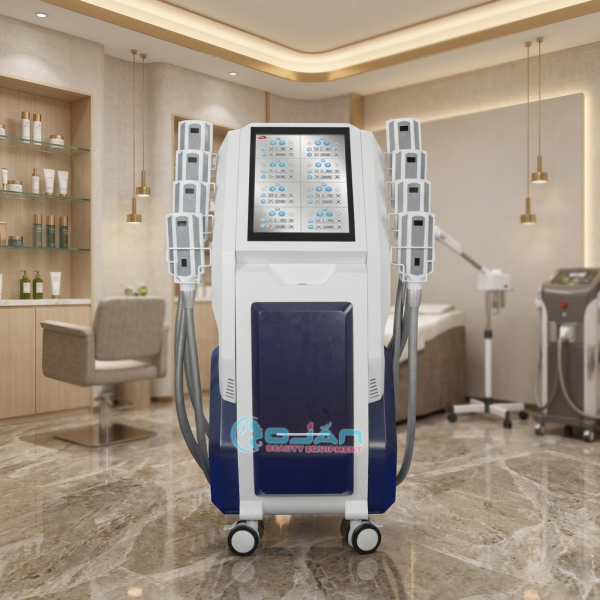
1. 8 Handle Ice Sculpture Board Cryolipolysis Machine
This machine takes the flat-plate approach described above, using non-vacuum, full-surface freezing plates instead of suction cups. Eight independent cooling handles can run simultaneously or separately, letting a clinic treat multiple zones, such as the abdomen, thighs, arms, and flanks, in a single appointment. It runs the same dual-phase process outlined earlier: a short pre-heating stage to improve circulation, followed by precision cooling between -1°C and -9°C, controlled through a 15-inch touchscreen. Ojan Beauty notes clinically observed fat reductions of up to 27% per treated area, with the equipment carrying CE, FDA, and KFDA certification.
View the 8 Handle Ice Sculpture Board Cryolipolysis Machine

2. Professional 360 Body Cell Freezing Cryolipolysis Machine
This model pairs core cryolipolysis with a broader set of contouring technologies, including vacuum RF, ultrasound cavitation, and lipo laser, in a single system. Its 360-degree cooling applicator is built to deliver even coverage around the full circumference of a treatment area rather than one flat side at a time, which is useful for zones like the waist or thighs where fat wraps around the body. Temperature, suction, and treatment duration are all adjustable, giving clinics the flexibility to customize sessions for different body types and areas.
View the Professional 360 Body Cell Freezing Cryolipolysis Machine

The Bottom Line
Cryolipolysis works because fat cells are more vulnerable to cold than the tissue around them, and that vulnerability lets a machine trigger targeted, natural cell death without touching a scalpel. The visible results, though, are never immediate. They depend on precise temperature control during the session and several weeks of the body’s own lymphatic system doing the actual clearing afterward. Understanding that timeline, and choosing equipment built to deliver consistent, even cooling, is what separates a treatment that genuinely reshapes stubborn fat from one that leaves clients wondering if anything happened at all.