

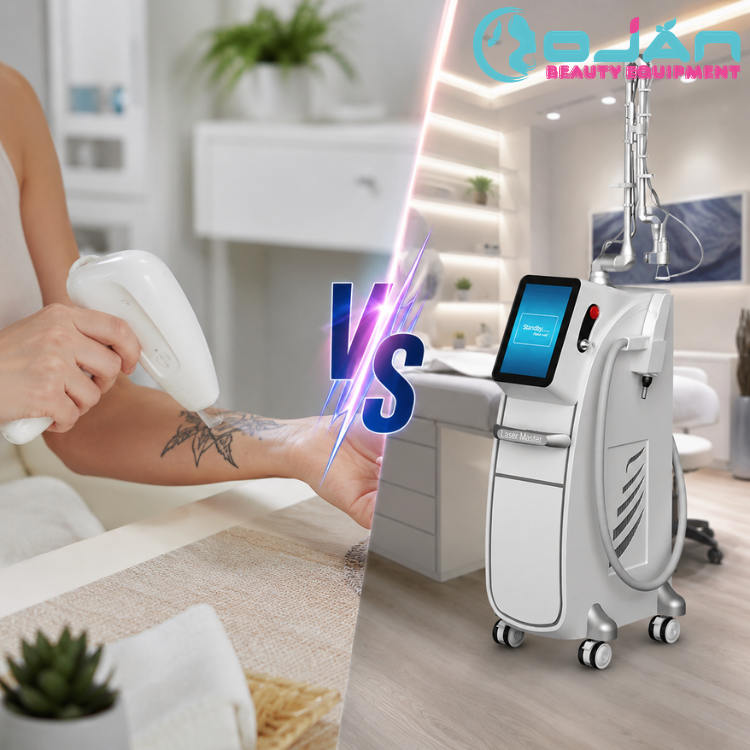
At-Home Vs Professional Laser Tattoo Removal: What The Data Really Shows (2026 Guide)
No at-home device can safely or fully remove a tattoo. Tattoo ink sits in the dermis, a skin layer that home creams, pens, and low-power lasers cannot reach with enough energy to break up ink particles. Only clinical-grade lasers, such as Q-switched Nd:YAG or picosecond systems operated by trained professionals, generate the wavelength precision and power output needed to do this safely. The U.S. FDA has never approved a tattoo removal cream, kit, or home device for this purpose.
At Ojan Beauty, we manufacture and supply laser-based aesthetic equipment to clinics, salons, and distributors in more than 40 countries. We get this question from two very different audiences: people wondering if they can remove a tattoo themselves, and clinic owners or importers trying to figure out which laser is actually worth stocking. This article answers both, honestly and with real sources, not marketing claims dressed up as facts.
What “At-Home Tattoo Removal” Actually Means In 2026
Search “tattoo removal at home” and you’ll find three types of products being sold.
The three categories people search for
Creams and gels. These are sold as fading treatments with ingredients like retinol or peeling acids. Salabrasion and mechanical abrasion. This involves scrubbing or cutting into the skin with salt or sandpaper to physically wear it down. Handheld “laser pens.” Low-cost devices marketed as personal laser tattoo removers, usually shipped from overseas without medical certification.
Why none of these reach the dermis
Tattoo ink is deposited about 1 to 2mm below the surface, in the dermis. Creams and abrasion techniques only affect the epidermis, the thin outer layer that sheds naturally every few weeks. They physically cannot touch the ink. Handheld laser pens come closer in concept, but their power output is a fraction of what’s needed to fragment ink particles. Most run at energy levels designed for cosmetic skin marks, not tattoo pigment.
What regulators actually say
The FDA has been direct about this. Its consumer guidance states plainly that the agency has not approved any tattoo removal ointments, creams, or do-it-yourself kits, and warns that these products can cause rashes, burns, and permanent scarring instead of removing ink (FDA, Tattoo Removal: Options and Results). That’s not a marketing claim from a clinic. It’s the regulator’s own published position.
How Professional Laser Tattoo Removal Actually Works

This is the part most articles skip, and it’s the part that actually explains why professional treatment works and home devices don’t.
Selective photothermolysis, in plain language
Professional lasers use a principle called selective photothermolysis. The laser fires an intense, extremely short pulse of light tuned to a wavelength that ink particles absorb far more readily than surrounding skin. The ink heats up and fractures into tiny fragments in a fraction of a second, while the skin around it stays largely unaffected. Your immune system then clears the fragments away over the following weeks, which is why removal happens gradually across several sessions, not in one visit.
Q-switched Vs Picosecond lasers
Clinics generally choose between two laser types, differentiated by pulse duration:
| Laser type | Pulse duration | Common wavelengths | Best for |
|---|---|---|---|
| Q-switched Nd:YAG | Nanoseconds | 1064nm, 532nm | Dark ink (black, blue), all skin tones |
| Picosecond | Picoseconds (1000x shorter) | 1064nm, 755nm, 532nm, 585nm | Stubborn colors, faster clearance, fewer sessions |
Multiple wavelengths matter because different ink pigments absorb different colors of light. A single-wavelength device simply can’t treat a multicolor tattoo effectively. This is one reason four-wavelength systems have become standard in professional clinics.
PRODUCT LINK – Portable Q-Witched ND YAG Laser Carbon Gel Pigmentation | Tattoo Removal Machine
PRODUCT LINK – Hot Sale Pico Second | Laser Tattoo Removal Machine
Why power output is the real differentiator
Clinical lasers are rated in Joules per square centimeter and can deliver energy densities that home devices are never built to reach, both for safety reasons and because achieving that output requires industrial-grade optics, cooling, and power supply. This isn’t a marketing gap. It’s a physical one. A device that can’t reach the required energy threshold can’t fragment ink, no matter how it’s marketed.
At-Home Devices Vs Clinical-Grade Equipment: A Transparent Comparison
Here’s an honest side-by-side, without invented statistics.
| Feature | At-Home Device | Clinical-Grade Laser |
|---|---|---|
| Regulatory clearance | Typically none (no FDA 510(k), no CE medical certification) | FDA-cleared and/or CE-marked as a medical device |
| Wavelengths available | Usually one | Multiple (532/755/1064/1320nm typical) |
| Operator | Untrained consumer | Licensed or certified technician |
| Cooling system | Minimal or none | Integrated contact or air cooling |
| Documented safety data | None published | Backed by 510(k) clinical equivalence data |
Why regulatory clearance is the real dividing line
In the U.S., laser products fall under FDA rules in 21 CFR Part 1040, and any laser marketed for a medical use, including tattoo removal, must meet device performance and safety standards, with higher-powered classes requiring hazard labeling and controls (FDA, Laser Products and Instruments). Established clinical tattoo removal lasers, like Q-switched Nd:YAG systems, have gone through the FDA’s 510(k) premarket review process to demonstrate they’re safe and effective compared to already-cleared devices. Unregulated home lasers almost never carry this documentation, because going through it is expensive and the products aren’t designed to meet the same output or safety standards.
The documented risks of unregulated use
The same FDA guidance that addresses creams and kits extends the warning to unsupervised device use generally: without professional oversight, users risk burns, scarring, and skin discoloration, because there’s no calibration for skin type, ink density, or safe energy thresholds. This is not a hypothetical. It’s the same reason licensed clinics require a consultation before every first session. Ink color, skin tone, and tattoo age all change what settings are safe.
Why Clinics And Salons Only Invest In Professional-Grade Lasers

We’ve supplied laser equipment to clinics on five continents, and the reasoning is consistent everywhere, regardless of market.
Safety and liability
A licensed clinic operates under local medical device and cosmetic procedure regulations. That means insurance, informed consent, and a documented safety record, none of which exist for someone using a device at home. If something goes wrong, a clinic has protocols; a home user does not.
Consistency across skin tones
Skin responds differently to laser energy depending on melanin content, classified on the Fitzpatrick scale from I to VI. A calibrated clinical laser lets a technician adjust pulse energy and wavelength to match the client’s skin tone, reducing the risk of pigment changes. A single fixed-output home device has no such flexibility, which is exactly why complication rates climb sharply outside professional settings.
The real cost equation, for the business, not just the patient
Most consumer articles compare the price of a single home device to the price of one clinic session. That’s the wrong comparison for anyone running or supplying a business. A clinic weighs equipment cost against session revenue, treatment throughput, spare parts availability, and equipment lifespan, often 8 to 10 years for a well-built system. A $300 home gadget that can’t deliver safe or complete results isn’t cheaper; it’s a liability with no service life and no resale value.
What Resellers, Clinics, And Importers Should Verify Before Sourcing a Laser
This is the section most manufacturer blogs skip entirely, and it’s the one that actually protects your investment if you’re buying equipment rather than a single treatment.
Certification checklist
Before importing or reselling any tattoo removal laser, confirm the supplier can provide: CE marking under the EU Medical Device Regulation, FDA listing status if selling into the U.S. market, ISO 13485 quality management certification, and RoHS compliance for electronics. Ask for the actual certificate documents, not just a logo on a website. Certificates are traceable and verifiable with the issuing body.
Technical specs that actually matter for resale
Buyers should compare wavelength count (single vs. multi-wavelength), adjustable spot size range, cooling method (contact cooling reduces client discomfort and complaint rates), pulse duration range, and, critically, after-sales support and spare parts lead time. A laser that can’t be serviced locally becomes a liability the first time a handpiece needs replacing.
Red flags in supplier marketing
Watch for unsourced performance claims, like “85% fade in three sessions” with no clinical reference, customer “testimonials” with no verifiable identity, or comparison charts with numbers that don’t cite where they came from. If a supplier can’t show you where a statistic originated, don’t repeat it to your own customers; it becomes your liability, not just theirs.
OEM/ODM considerations for distributors
If you’re building a private-label brand, confirm the manufacturer’s OEM/ODM process includes documented quality control at each production stage and that certification transfers correctly to your branded product. A private-labeled device still needs its own valid compliance paperwork in your target market.
FAQs About At-Home Vs Professional Laser Tattoo Removal
No. At-home devices lack the power, wavelength precision, and safety controls of clinical lasers, and the FDA has not approved any home tattoo removal product. Improper use can cause burns and permanent scarring.
Q-switched lasers deliver energy in nanosecond pulses and work well on dark ink across most skin tones. Picosecond lasers use pulses roughly 1,000 times shorter, which can break ink into smaller fragments and often clears stubborn colors in fewer sessions.
Most tattoos need 6 to 12 sessions spaced 6 to 8 weeks apart, depending on ink density, color, and skin tone. This spacing gives the immune system time to clear fragmented ink between treatments.
This depends on local regulation, but most jurisdictions require certified training or medical supervision for laser tattoo removal because it’s classified as a higher-risk cosmetic procedure. Check local health authority rules before offering the service.
Confirm CE marking, ISO 13485 certification, and FDA listing status if selling in the U.S., and request the actual certificate documents from the supplier rather than relying on website claims.
Final Thoughts
The gap between at-home and professional laser tattoo removal isn’t a matter of opinion or brand loyalty. It comes down to physics, regulation, and accountability. Home devices can’t reach the ink, aren’t cleared as medical devices, and carry no safety documentation. Professional systems are built, tested, and certified specifically to do this job safely. For anyone considering removal, that difference decides whether the process actually works. For anyone buying or reselling equipment, it decides whether the business is defensible five years from now, not just profitable this quarter.
Whether you’re a clinic owner deciding what to offer clients or a distributor deciding what to stock, the pattern is the same: professional-grade tattoo removal is a physics and regulation problem, not a marketing problem. At Ojan Beauty, we build our laser systems to meet certifiable safety standards and back every unit with documentation you can independently verify, not statistics we made up. If you’re evaluating a Q-switched or picosecond tattoo removal laser for your business, reach out and we’ll walk you through the actual certificates, specs, and service terms before you commit.
